Apart from music, Prokofiev’s main passion was chess. He learned to play chess at the age of seven and maintained his love for the game for the rest of his life. He was especially fascinated with his father’s chess set which was beautiful but untouchable for the young boy, “My father had a wonderful Chinese chess set with finely carved ivory pieces. Sometimes, father would take them out of the cotton wool to show them to guests, and I would always ask him to teach me how to play. He would reply, however, that the game too was difficult and unsuitable for me, and that set was not for playing anyway, since the pieces were unstable and falling constantly.”


#1
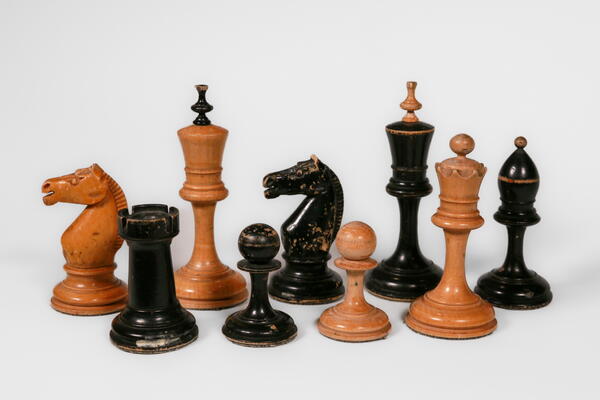
Chess pieces of Sergei Prokofiev
#5
#6
During that period, I was nurturing the idea of transferring chess from a square to a hexagonal board with hexagonal cells. It is a common fact that adjacent hexagons fill the entire area like quadrangles and unlike pentagons or octagons that have gaps between them. However, having drawn a hexagonal board and started applying the moves of various pieces, I came across some unexpected difficulties: for example, the bishop somehow moved similar to a rook, the knight’s move became either too simple or overly complicated, and the pawn’s move was completely confusing… I never quite finished the invention.
Sergei Prokofiev even invented his own variation of chess
#7
Prokofiev maintained his enthusiasm for chess throughout his life. He attended chess clubs in Saint Petersburg and Moscow and often played with his friends, some of these games taking place over the phone or letters.
In 1909, the eighteen-year-old Prokofiev played against the world champion Emanuel Lasker and got a draw, which he was extremely proud of. This game caused quite a sensation among both professionals and amateurs. In 1914, Prokofiev defeated José Raúl Capablanca by setting him a trap with mate in three moves. Several years later, in 1921, Capablanca became world chess champion. Prokofiev also often played with musicians, including Glière and Goldenweiser. The most famous chess game between musicians took place in 1937 at the Central Art Workers’ Club. The violinist David Oistrakh outclassed Prokofiev in a 4-3 win. According to their agreement, the loser had to play a concert at the club.
In 1909, the eighteen-year-old Prokofiev played against the world champion Emanuel Lasker and got a draw, which he was extremely proud of. This game caused quite a sensation among both professionals and amateurs. In 1914, Prokofiev defeated José Raúl Capablanca by setting him a trap with mate in three moves. Several years later, in 1921, Capablanca became world chess champion. Prokofiev also often played with musicians, including Glière and Goldenweiser. The most famous chess game between musicians took place in 1937 at the Central Art Workers’ Club. The violinist David Oistrakh outclassed Prokofiev in a 4-3 win. According to their agreement, the loser had to play a concert at the club.
#4
Name: Chess pieces of Sergei Prokofiev
Date of creation: the 1930s
Place of creation: Russia
Dimensions: Height — 10 cm (No. 1520/3); 8.5 cm (No. 1520/4); 8 cm (No. 1520/5); 6.5 cm (No. 1520/6); 5.5 cm (No. 1520/7)
Date of creation: the 1930s
Place of creation: Russia
Dimensions: Height — 10 cm (No. 1520/3); 8.5 cm (No. 1520/4); 8 cm (No. 1520/5); 6.5 cm (No. 1520/6); 5.5 cm (No. 1520/7)
#2
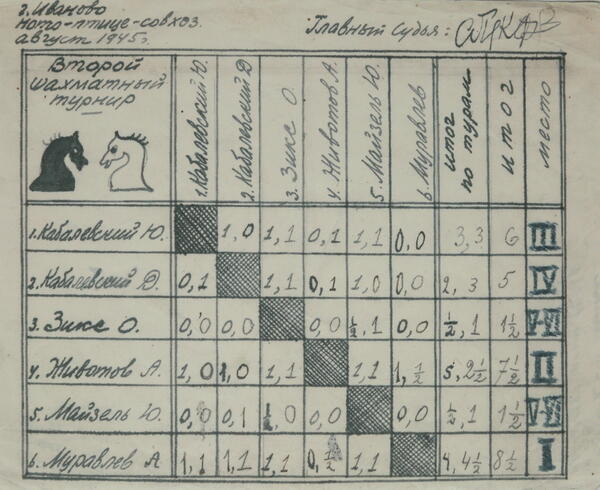
The score sheet of the Second Chess Tournament
#9
Sergei Prokofiev was first introduced to chess at the age of seven and at once became fascinated with the game. He maintained his love for chess for the rest of his life, putting more time and effort only into his music. In his work, the composer was very rational: he was known for his accuracy, precision, and order. As a chess player, on the other hand, Prokofiev was a passionate fan and player who preferred to play attacking chess.
In chess, Prokofiev found the perfect means of expression as he was a true competitor and enjoyed the thrilling challenge, the speed, and the need to think several moves ahead both in life and in his art. He took great pride in defeating the Cuban grandmaster José Capablanca in 1914. Capablanca gave three simultaneous exhibitions in Saint Petersburg with Prokofiev as one of his opponents. The grandmaster won the first two games and lost the third. In his diary entry of May 15, 1914, Prokofiev gave an extensive account of his game. He mentioned that it began 1 d4 d5 2 Nf3 Bf5 3 c4 Nc6, after which Capablanca (white) stood in front of the board for two or three minutes, frowning and pulling at his hair. Prokofiev himself was thrilled beyond words at having set the champion a real problem.
In chess, Prokofiev found the perfect means of expression as he was a true competitor and enjoyed the thrilling challenge, the speed, and the need to think several moves ahead both in life and in his art. He took great pride in defeating the Cuban grandmaster José Capablanca in 1914. Capablanca gave three simultaneous exhibitions in Saint Petersburg with Prokofiev as one of his opponents. The grandmaster won the first two games and lost the third. In his diary entry of May 15, 1914, Prokofiev gave an extensive account of his game. He mentioned that it began 1 d4 d5 2 Nf3 Bf5 3 c4 Nc6, after which Capablanca (white) stood in front of the board for two or three minutes, frowning and pulling at his hair. Prokofiev himself was thrilled beyond words at having set the champion a real problem.
#10
Around six o’clock Capablanca came into the Club: he is an utterly irresistible person, lively, handsome, quick-witted, and — this is the point — a genius. You should have seen how quickly he showed up the mistakes of our Petersburg masters: on the spot, the instant their games were finished, and right in front of their very eyes! I was entranced.
In his diary entry of January 8, 1914, Prokofiev wrote
#11
Prokofiev took part in the chess activity of the Central Art Workers’ Club. His rather unique match with the violinist David Oistrakh made a lasting impression on Moscow chess players. The winner was awarded the Art Workers’ Club prize and the loser had to give a concert for the club members.
The famous chess grandmaster Mikhail Botvinnik described his encounters with Sergei Prokofiev at a chessboard, “I played chess with Prokofiev several times. He played a very vigorous, forthright game. His usual method was to launch an attack which he conducted cleverly and ingeniously. He obviously did not care for defense tactics.”
Sergei Prokofiev remained an avid chess player throughout his life.
#8
Name: The score sheet of the Second Chess Tournament
Date of creation: 1945
Place of creation: Ivanovo
Technique: paper, writing ink, pencil, colored pencils
Dimensions: 16×20 cm
Date of creation: 1945
Place of creation: Ivanovo
Technique: paper, writing ink, pencil, colored pencils
Dimensions: 16×20 cm
#12
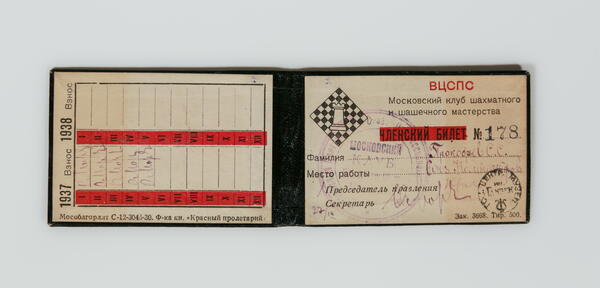
Membership card of the Moscow Chess Club
#14
Sergei Prokofiev was not only a great composer, pianist, and conductor but also a talented chess player. He learned to play chess when he was seven years old. He immediately started writing down chess games in a small notebook. Sometimes, he made such notes on the back side of the sheet paper with his compositions. The young Prokofiev spent hours poring over the games of great chess players which he found in old chess magazines. He learned by heart the games between Chigorin and Tarrasch and between Steinitz and Lasker.
Moreover, the young composer enjoyed making up games between famous players and creating fantasy tournament tables.
Moreover, the young composer enjoyed making up games between famous players and creating fantasy tournament tables.
#15
In this way, I could bring together the masters who had never actually played with each other or imagine that someone who had already died could meet a new player who appeared after their death.
In his autobiography, Sergei Prokofiev explained
#16
The sixteen-year-old Prokofiev attended his first chess club meeting without telling his parents. It was the Saint Petersburg Chess Club at 55 Nevsky Prospect. The composer recalled his first visit to the club in his autobiography, “While I was standing at one board and watching a game between some strangers, a very young student entered the Club, and also lingered for a while, unsure where he could stand. Having guessed that I was also a first-timer, he approached me and said, ‘You know, I’ve never been here before.’ I replied that neither had I. He asked, ‘Would you like to play? ’ I said, ‘I certainly would.’ We took a chess set and sat down to play. I was terribly anxious, afraid that he could tear me to pieces. This is why I tried to exchange pieces at any opportunity, simplifying the game. We played three games: the first one was a draw, he won the second, and I won the third. We were both satisfied.”
For Prokofiev, the Saint Petersburg Chess Club forever remained the coziest one and his favorite, “In fact, I have visited numerous chess clubs throughout my life, but I still have a deep affection for that room, with its soft lighting and calmness, where people could put aside their cares and for some time immerse in a completely different world with its own interess.”
For Prokofiev, the Saint Petersburg Chess Club forever remained the coziest one and his favorite, “In fact, I have visited numerous chess clubs throughout my life, but I still have a deep affection for that room, with its soft lighting and calmness, where people could put aside their cares and for some time immerse in a completely different world with its own interess.”
#13
Name: Membership card of the Moscow Chess Club
Date of creation: March 27, 1937
Date of creation: March 27, 1937
№: 5961491
Place of creation: Moscow
Technique: writing ink, printing, stamp
Dimensions: 5,3×8 cm
Place of creation: Moscow
Technique: writing ink, printing, stamp
Dimensions: 5,3×8 cm
#17
Ministry of Culture of the Russian Federation
read morehide
00:00
00:00
1x
Chess pieces, The score sheet, Membership card
Exhibition
0
 Point your smartphone camera to open in the app
Open in app
Share