The sickle is one of the oldest agricultural tools known to cultures around the world. Despite its simple appearance, it has deep historical roots — its earliest prototypes date back to the Stone Age, when sharp flint blades were mounted into wooden handles. By the 1st millennium BCE, iron sickles with the familiar curved shape had already appeared. From that time onward, the sickle became an essential part of the peasant’s toolkit. Although technological advances eventually displaced it from the fields, in Russia the sickle remained in agricultural use well into the mid-20th century.
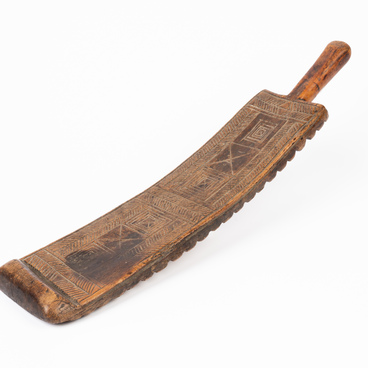
A sickle is a handheld reaping tool, sometimes called a “reaping knife”, primarily used for harvesting grain crops. It consists of a curved, serrated blade attached to a cylindrical wooden handle.
Traditional Russian sickles were relatively small and were typically forged by local village blacksmiths, then sold at regional fairs. Later, mass factory production began, and the sickles from the collection of the Unecha Local Lore Museum belong to this later type — dating from the 1930s and 1940s.
Harvesting with the sickle was usually women’s work, despite being extremely labor-intensive and physically demanding. A woman’s strength, endurance, and dexterity were judged by her performance in the field. Elderly peasant women often recalled their youth with pride, saying: “When I was young, I didn’t just chew bread — I reaped a hundred sheaves a day!” The technique was straightforward but required considerable skill: the harvester would grasp a bundle of stalks with her left hand and slice through them with the sickle in her right. Removing a single handful typically required three precise strokes.
In the villages of the Unechsky district, a special harvest rite known as “Dozhinki” was observed. At the start of the harvest, it was considered crucial to choose a “first reaper” — a woman distinguished by her health, strength, agility, and “light hand”. She would carefully cut exactly three sheaves, arrange them in a cross, and place her sickle on top. This act was rooted in superstition: it was believed that anything harvested on the first day could be claimed by a witch. While the chosen reaper worked, other women gathered at the edge of the field and sang harvest songs — to set the rhythm of labor, lift spirits, and ensure a bountiful yield.
Today, sickles are preserved primarily in museum collections. The Unecha Local Lore Museum holds a significant collection of these tools, some of which were still in use by local residents as late as the 1960s and 1970s.