Before cast-iron and steam irons reached Russian homes, women did not iron clothes in the modern sense. Instead, they rolled and kneaded the fabric until it became soft, smooth, and wrinkle-free. The indispensable tool for this task was the rubel. The word rubel comes from the Slavic root meaning “to chop” or “to rub”.
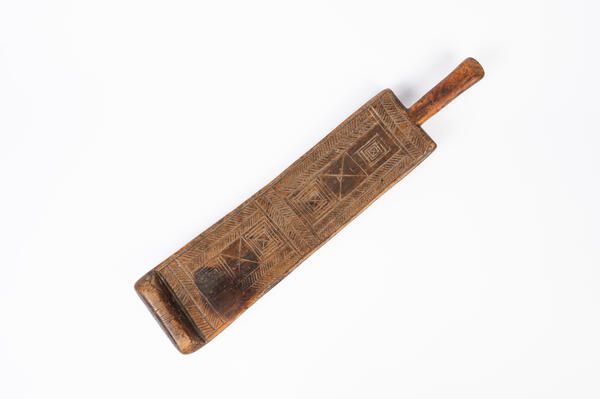
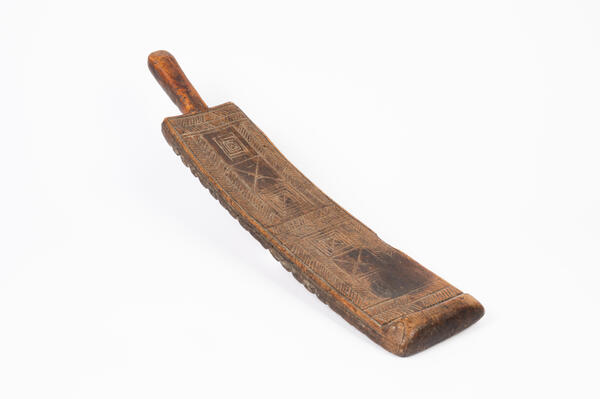
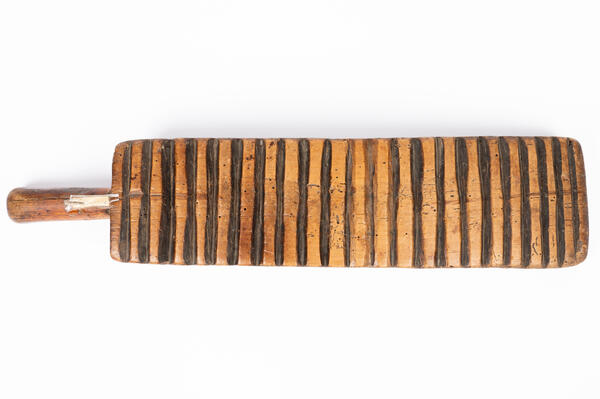
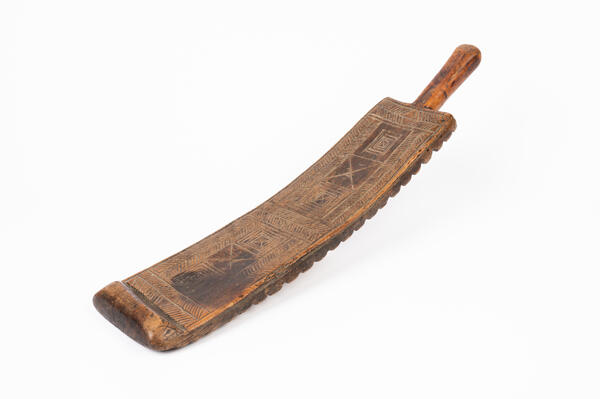
A rubel is a wooden board, often slightly curved, with one or two handles. The convex side features transverse grooves or notches to grip the fabric, while the concave underside was frequently adorned with carvings, floral patterns, or symbolic ornaments. It was always used with a companion tool: a smooth, round wooden roller.
The “ironing” process worked like this: a freshly washed and dried garment was tightly wrapped around the roller. The rubel was then placed on top, and the woman pressed down firmly while moving the roller back and forth across a sturdy surface — typically a table or the lid of a wooden chest. Through this rhythmic motion, the fabric was gradually smoothed and softened.
Though physically demanding, the results were impressive. Because of its importance, a rubel and roller set was often given as a traditional gift — to a daughter, sister, bride, or wife. Grooms sometimes carved their beloved’s name or decorative motifs into the rubel as a personal token. Crafting a rubel required only basic tools — an ax, chisel, and file — and a piece of dense, durable wood such as oak, maple, or birch. Almost any villager could make one.
Beyond laundry, the rubel had other uses: it helped soften leather and finish felt boots (valenki). In the hands of inventive folk musicians, it was even transformed into a musical instrument, which was struck or scraped to create rhythm.
Today, the rubel survives primarily in ethnographic and local history museums as a relic of pre-industrial domestic life. At the Unecha Museum of Local Lore, visitors can see an original rubel paired with its roller in the “Traditional Peasant Life” section. These humble yet clever devices stand as a testament to the ingenuity and resourcefulness of rural Russians — who created “household gadgets” that still inspire admiration today.