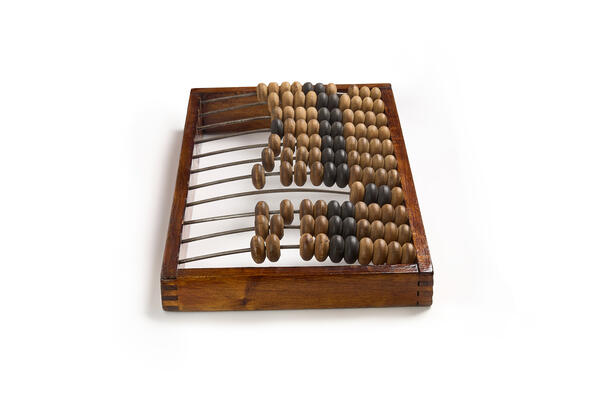
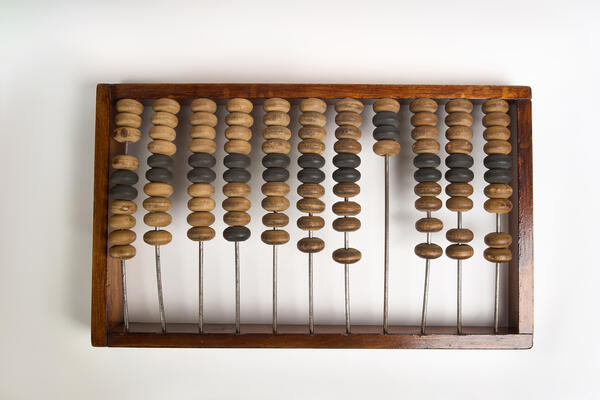
Russian abacus is a simple device that for the past five centuries was indispensable in performing arithmetic calculations.
The design of the abacus is extremely simple: it is a frame with several rows of wires on which beads or other similar pieces (kostyashki) are strung. Each wire with a set of beads represents a decimal place. Each bead on the first wire has the value of 1 digit, on the second wire 10 digits, on the third wire 100 digits, and so on.
The calculations performed using the beads include adding and subtracting any numbers, multiplying and dividing, as well as more complex operations, such as calculating the square or cube root.
There is no reliable information about where Russian abacuses came from. According to one version, their country of origin is China, where they are known under the name “suanpan” since the II century BC. From there they came to Russia in the 14th century during the Tatar-Mongol yoke.
According to another version, the abacus is of Russian rather than Oriental origin. Arguments in favor of this theory were given by the Soviet historian, a specialist in Russian numismatics Ivan Georgievich Spassky. He drew attention to the fact that Russian abacuses, unlike Chinese ones, have a horizontal arrangement of wires with beads and, moreover, use the decimal rather than quinary numbering system.
The first Russian abacuses appeared in the 16th
century and were called “doschany schot” (counting with wooden pieces). At that
time, instead of metal or wooden rods, beads were strung on thin cords.
Abacuses as we know them did not appear until the 18th century.