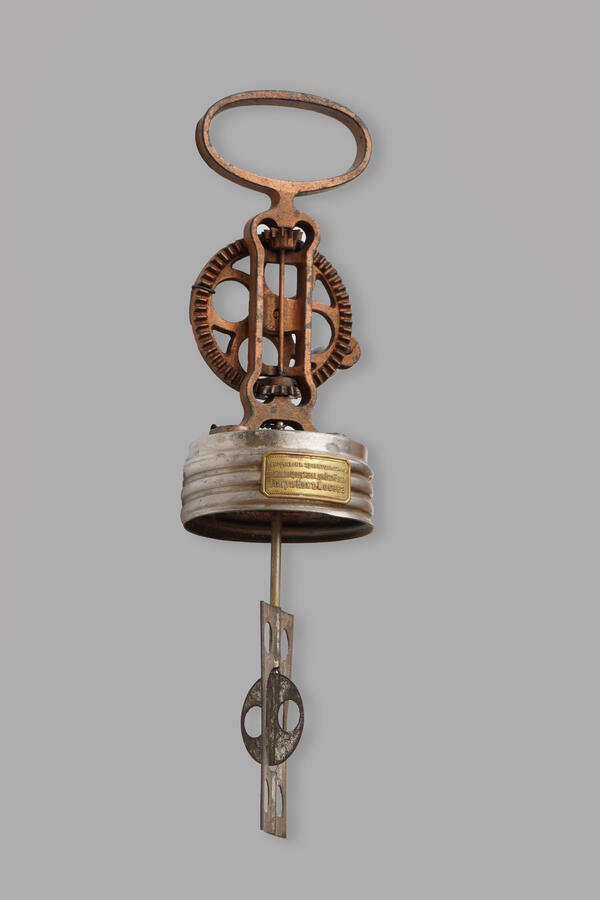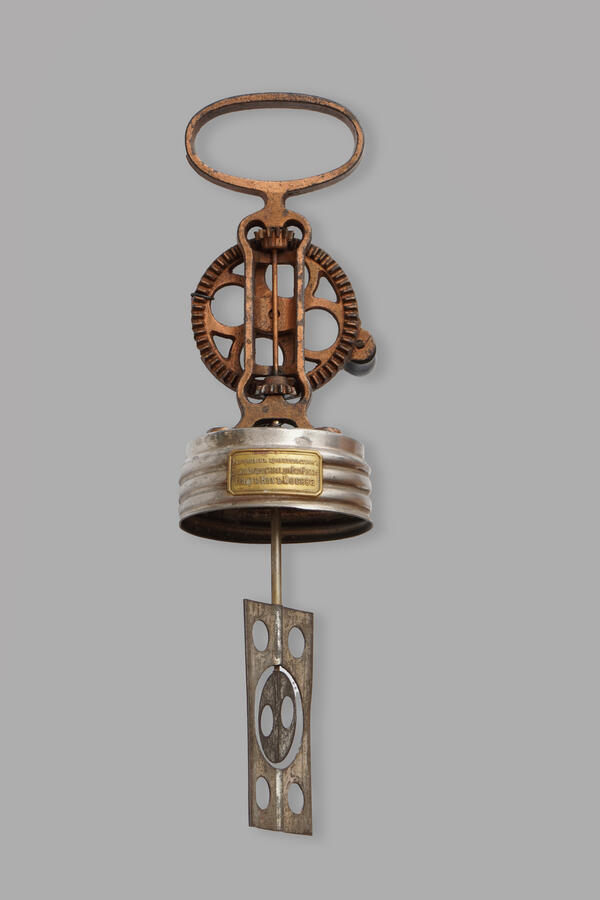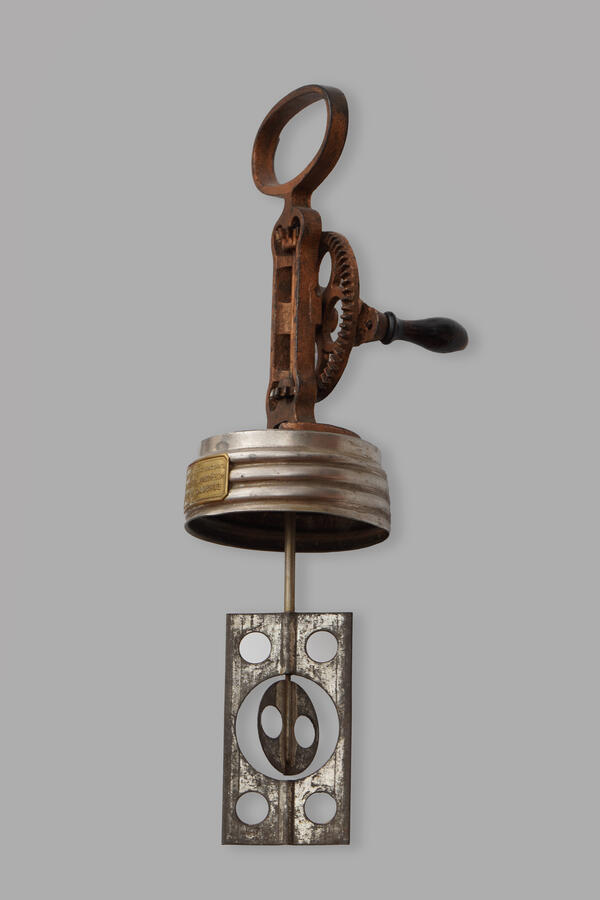
Common cooking utensils include devices for preparing various mixtures. Today mixers and whisks are used to mix, whip and saturate the ingredients with air. A hand mixer, consisting of a working part and a handle, has been known in Russia since the 18th century. Long before, branches of fruit trees were used for this purpose, and later — the devices called whorls.
Whorls were made of a thin pine or spruce cross with a “fan” at the end. The trunk served as a handle, and the shoots that were 3–4 cm long served as a working part. The workpiece was cleaned of bark, its surface was leveled, dried and impregnated with vegetable oil. One of these whorls is on display in this hall. It turned out to be a convenient and multifunctional tool. With its help, the housewives made dough that was higher or lower in liquid content and was intended for pancakes, pies and bread. They also made sourdough, mixed mashed potatoes and jelly, and whipped egg whites. The whorl was also used to remove the film from caviar before salting. The whorl also served as a butter churn: for this, it was installed vertically and quickly rotated between the palms. It could be used to move the laundry in the process of boiling, or it could be hung from the ceiling and used as a hanger.
According to their purpose (“mutit” meant “to stir up”), the whorls also received the Russian name “mutovki”. The way whorls looked made people sometimes call them “slingshots”. There used to be about a dozen different whorls in a household, starting with large ones for rye dough and ending with small ones for eggs. This cooking utensil was used until the middle of the 20th century, continuing to serve the owners on a par with mechanical beaters.
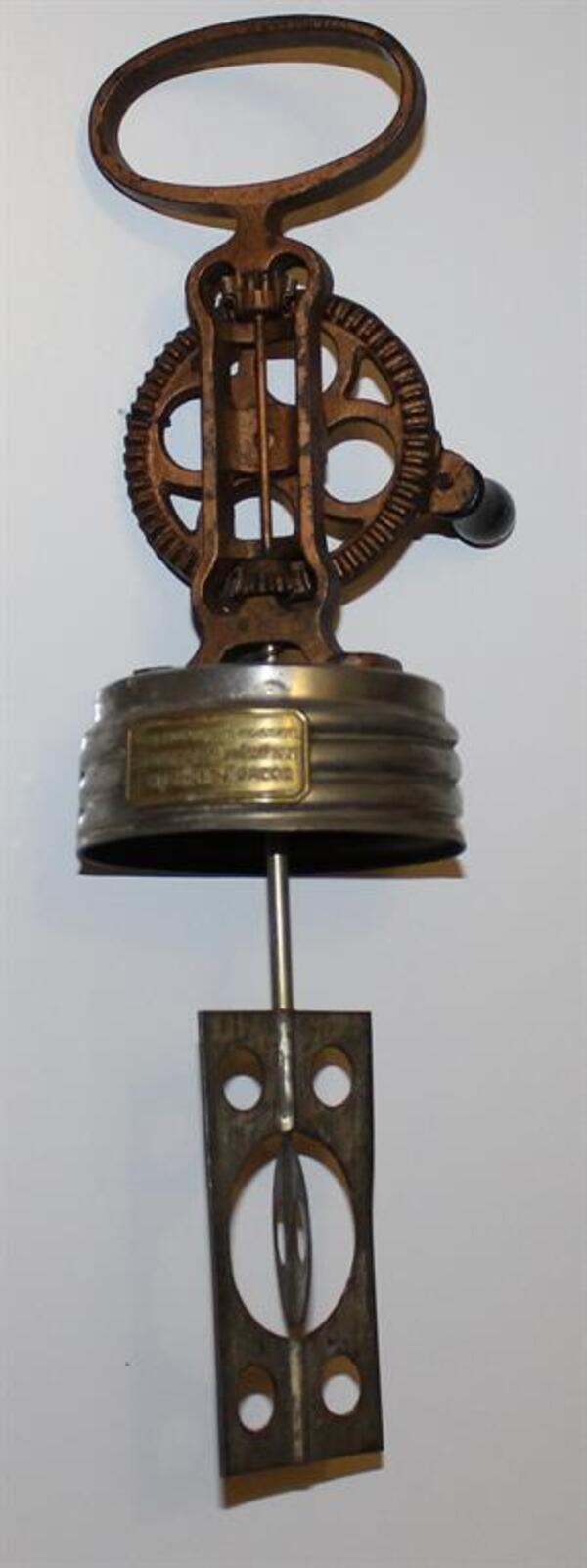
A patent for the first mechanical beater was issued in 1856 in England. It was intended for whipping eggs and looked like a wire loop with a mechanical hand drive.
In 1870, the American inventor Turner Williams developed a new model. It already used the principle of a modern mixer: two whisks rotated towards each other. Fifteen years later, the mixer itself was patented, though is was still mechanical.
The model of the electric mixer as we know it was developed in 1911 by the Hamilton Beach company. It was a heavy, bulky and expensive device, which was used only in factory production. But already in the 1930s, household mixers appeared in ordinary kitchens. Hand whisks were also in demand: they did not require electricity or special efforts.
Whorls were made of a thin pine or spruce cross with a “fan” at the end. The trunk served as a handle, and the shoots that were 3–4 cm long served as a working part. The workpiece was cleaned of bark, its surface was leveled, dried and impregnated with vegetable oil. One of these whorls is on display in this hall. It turned out to be a convenient and multifunctional tool. With its help, the housewives made dough that was higher or lower in liquid content and was intended for pancakes, pies and bread. They also made sourdough, mixed mashed potatoes and jelly, and whipped egg whites. The whorl was also used to remove the film from caviar before salting. The whorl also served as a butter churn: for this, it was installed vertically and quickly rotated between the palms. It could be used to move the laundry in the process of boiling, or it could be hung from the ceiling and used as a hanger.
According to their purpose (“mutit” meant “to stir up”), the whorls also received the Russian name “mutovki”. The way whorls looked made people sometimes call them “slingshots”. There used to be about a dozen different whorls in a household, starting with large ones for rye dough and ending with small ones for eggs. This cooking utensil was used until the middle of the 20th century, continuing to serve the owners on a par with mechanical beaters.
A patent for the first mechanical beater was issued in 1856 in England. It was intended for whipping eggs and looked like a wire loop with a mechanical hand drive.
In 1870, the American inventor Turner Williams developed a new model. It already used the principle of a modern mixer: two whisks rotated towards each other. Fifteen years later, the mixer itself was patented, though is was still mechanical.
The model of the electric mixer as we know it was developed in 1911 by the Hamilton Beach company. It was a heavy, bulky and expensive device, which was used only in factory production. But already in the 1930s, household mixers appeared in ordinary kitchens. Hand whisks were also in demand: they did not require electricity or special efforts.