Font
Color
Graphics
Изображение точки

To see AR mode in action:

1. Install ARTEFACT app for iOS or Android;

2. Find the exhibition «Exhibition of Lenin House-Museum»

3. Push the «Augmented reality» button and point your phone's camera at the exhibit;

Скрыть точки интересаПоказать точки интереса
Показать в высоком качестве

Fire samovar, Jam jars, Samovar tray

0
Open in app
#1
Fire samovar, Jam jars, Samovar tray
#2
Vorontsov Brothers factory
Fire samovar
#4
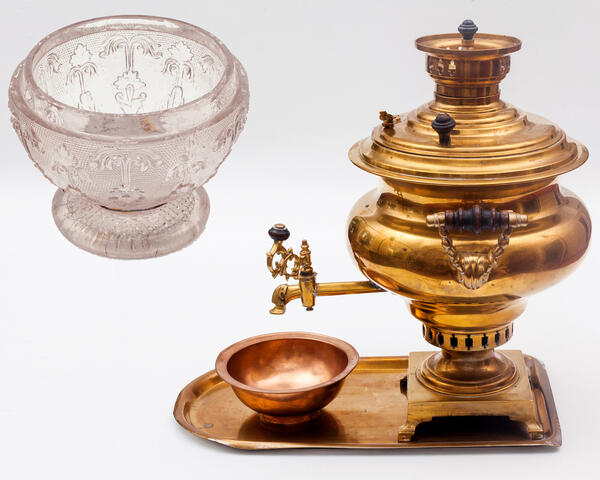
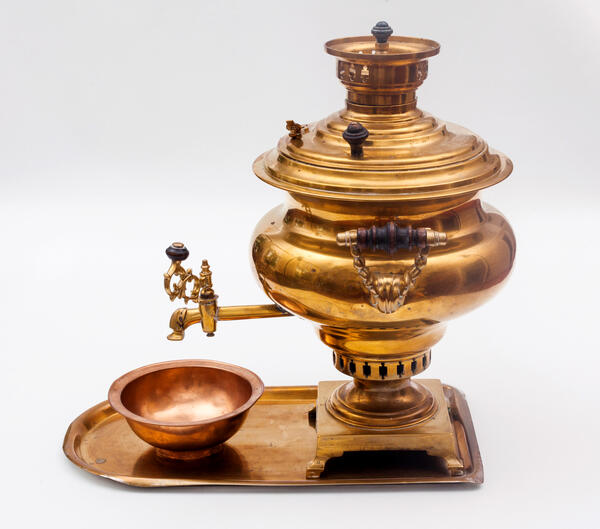
The brass samovar, standing on a small table near the window in the dining room of the House-Museum of Vladimir Lenin, was made at the Vorontsov Brothers Factory in the second half of the 19th century in Tula. This is a duplicate of a samovar that belonged to the Ulyanovs. The original is kept in the Vladimir Lenin Museum in Moscow.

The body of the samovar is made in the form of a smooth-walled vase with a protruding rounded middle part and an intercept in the upper part. The base of the samovar is square, on four angular legs, in the lower part there is an ash-pit with shaped slits; such a samovar was heated with coals.

The sides of the product have small handles in the form of two shaped plates, connected by wooden holders. The tap has a figured massive drain and a relief rosette at the base. The faucet key is made in the form of a “branch” with a wooden cone. The lid is stepped with two wooden grips and a vaporizer — a hole to bleed steam. The lid bears the trademark of the Vorontsov brothers.

Usually, the samovar was placed on a tray so that the table was not heated. Samovar trays were not wide, rectangular in shape. The bowl was another obligatory part of the samovar set. It is a low and wide bowl, where they poured the rest of the water from the samovar and the remains of the brew from the cups. It was placed under the samovar faucet so that there was no puddle of water on the tray.

During the tea party, the samovar took center stage on the table. In the Ulyanovs’ house, tea was served with marshmallows, dried fruit, jam, and pastries.

Dmitry Ulyanov, Lenin’s younger brother, recalled, “When we decided to drink tea in the pavilion, we all worked together: Sasha would drag the samovar into the garden. Others would carry what they could; children would run to the house and back to the garden, to the pavilion, several times. Usually, it was customary not to disturb the servants, but to do everything ourselves. Usually, in our family evening tea was combined with a cold dinner, so there was a lot of fuss with these tea parties in the pavilion. When tea time was over there was enough work for everybody: the girls helped their mothers to wash dishes and we took everything back home from the pavilion.”
#5
Полное наименование: Fire Samovar of the Ulyanovs. Duplicate
Автор: Vorontsov Brothers factory
Дата создания: second half of the 19th century
Техника: forging, casting, soldering, carving
Место создания: Tula, Russia
Размеры: 40×40×50 cm
Коллекция: metal
Правообладатель изображений: Lenin Memorial
#3
Ivan Kolchugin
Поднос под самовар
#6
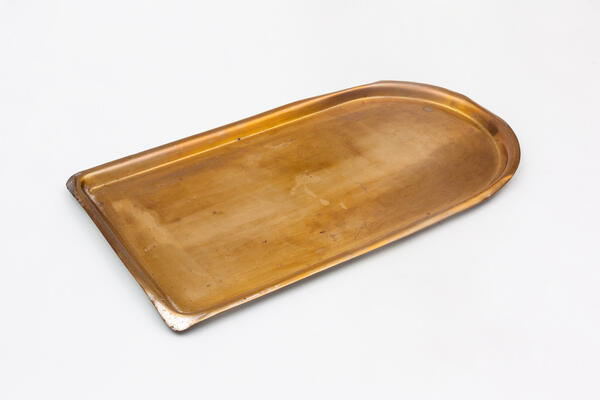
The charcoal-burning samovar stands on a metal tray in the dining room of the House-Museum. This samovar is a duplicate of the item that belonged to the Ulyanovs in the 1880s, but the tray itself is original. Its last owner was Anna Ulyanova-Elizarova, the eldest daughter of the Ulyanovs.

In the summertime, the Ulyanovs often took the samovar out to the summer house, which was situated in the garden, and in the wintertime, they had tea in the dining room. During the tea party, they always put the samovar on a metal tray. It prevented the heated legs of the samovar from burning and scratching the table surface.

Samovar trays had to be heat-resistant, that is why they were made of metal. Initially, masters used copper, but since the 18th century, it became more expensive, and production of such items ceased to be mass. For those who could not afford a copper tray, they made them from a cheaper metal. The alternative was brass — an alloy based on copper with an addition of zinc from 5% to 45% of the total amount, depending on the brand of alloy. In a special vessel made of refractory clay, a crucible, copper ingots were placed and heated in a furnace and raised to red heat. When the copper began to melt, the required quantity of zinc was added bit by bit. Coke, charcoal, or coal was used as fuel. When molten copper and zinc mixed well, they were cast into closed iron pots — molds for ingot production.

The pliable brass was easy to work with — it could be rolled from the ingot into thin sheets, of which trays were usually made. The brass was given the desired shape by blows of a hammer; if necessary it could even be drawn into a wire. Sometimes tin or manganese was added to the brass for greater resistance to hot steam and corrosion, iron for hardness, and other metals.

The brass tray from the collection of the Lenin House-Museum was made in the form of a vertical sheet of metal with a low two-step rim. The back of the tray is rectangular to hold a samovar, while the front, where a gargle bowl or cup was placed, is rounded. The item is not decorated.

The tray was donated to the museum by Klavdia Anokhina, who lived with Anna Ulyanova-Elizarova in her Moscow apartment on Manezhnaya Street from 1930. After Anna died in 1935, Anokhina kept her belongings.
#7
Полное наименование: Samovar tray
Автор: Ivan Kolchugin
Дата создания: 188(9)
Техника: brass, forging, extrusion
Размеры: 40×21 cm
Коллекция: Originals of the Ulyanovs
Правообладатель изображений: Lenin Memorial

#8
Jam jars
#9
In the dining room of the House-Museum of Vladimir Lenin, near the left window on either side of the brass samovar made in Tula, there are two jars. Maria Ulyanova, Lenin’s younger sister, donated one of them to the museum. 

These jars for jam were cast from transparent glass in Russia. The name of the factory where they were made, and the exact date of production is unknown. Researchers date them to the second half of the 19th century. Both exhibits are well preserved.

The first jar is in the form of a bowl with a glass lid; on its surface is a fine geometric ornament. The rim is wide and wavy, curved. The product stands on a high cylindrical faceted leg.

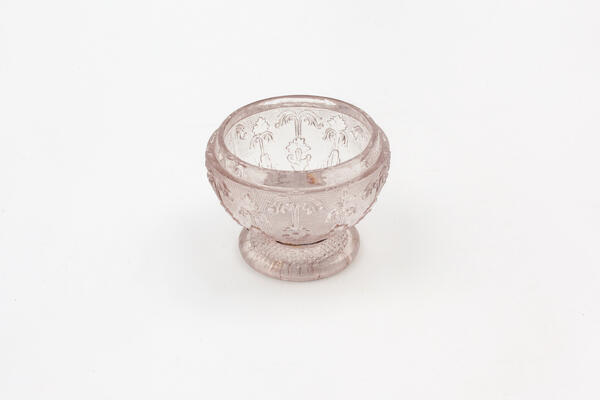
The second jar, original, smaller in size, is executed in the form of a hemisphere. On the walls applied in relief vegetative decor and frequent pattern in a small convex point. The leg of the jar is very low. The lid is lost.

Glass jars displayed at the exhibition of the Ulyanovs House-Museum, were dishes for homemade jam, which the family loved. Every summer Maria Alexandrovna cooked jellies and jams, made marshmallows and dried fruit from apples, cherries, plums, gooseberries, currants, and other fruits and berries from her garden.

Maria and Ilya Ulyanov had six children: Anna, Alexander, Olga, Vladimir, Dmitri, and Maria. Lenin’s elder sister Anna Ulyanov-Elizarova recalled,”…we were shown rows of strawberries or parts of raspberries. We ate berries and fruits to our heart’s content. But it was not haphazard. There was an order: from which trees to eat perishable varieties earlier — and which to collect for jam.”

A jar with cherry jam became a kind of symbol of the House-Museum because it was the favorite sweet treat of the Ulyanovs. The father of the family was particularly fond of it. In the summer the Ulyanovs often gathered in the garden pavilion, set a samovar to boil, and drank tea with a variety of treats.

Cherry jam became a symbol of the holiday in the Ulyanovsk region — Father’s Day, established in 2005. It is celebrated on July 26, the birthday of the teacher and educator Ilya Ulyanov. On this day the House-Museum traditionally hosts a tea party with cherry jam.
#10
Полное наименование: Jam Jars of the Ulyanovs
Дата создания: second half of the 19th century
Техника: casting
Место создания: Russia
Размеры: jar height — 7 cm, lower foot diameter — 5 cm, foot height — 1 cm
Коллекция: Originals of the Ulyanovs
Правообладатель изображений: Lenin Memorial
#11
read morehide
00:00
00:00
1x

Fire samovar, Jam jars, Samovar tray

0
Point your smartphone camera to open in the app
Share
VkontakteOdnoklassnikiTelegram
Share on my website
Copy linkCopied
Copy
Open in app
To see AR mode in action:
  1. Install ARTEFACT app for 
  2. iOS or Android;
  3. Find and download the «Paintings in Details» exhibition
  4. Push the «Augmented reality» button and point your phone's camera at the painting;
  5. Watch what happens on your phone screen whilst you flip through the pictures.
 
We use Cookies
Cookies on the Artefact Website. We use cookies to ensure that we give you the best experience on our website. If you continue without changing your settings, we'll assume that you are happy to receive all cookies on the Artefact website. However, if you would like to, you can change your cookie settings at any time.
Learn more about cookie useHide
Content is available only in Russian

X

Нашли опечатку?...

%title%%type%