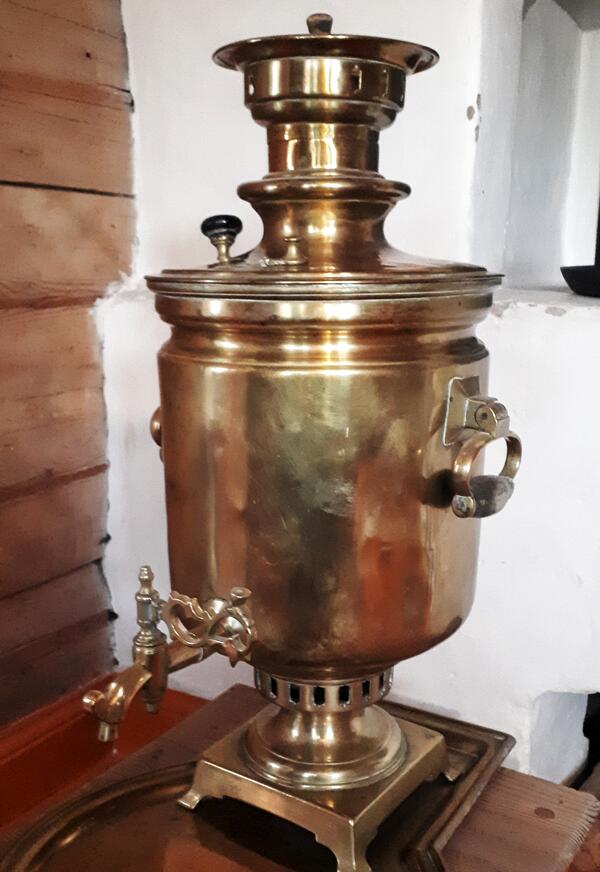
A samovar is a metal vessel for boiling water and making tea.
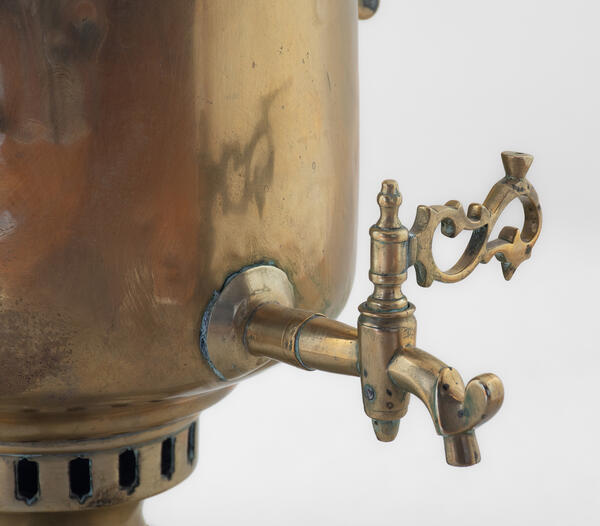
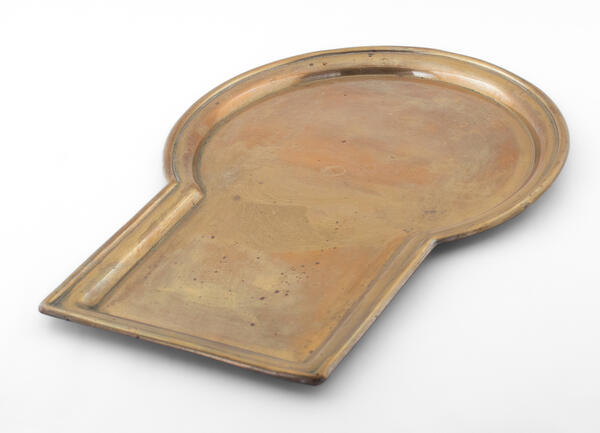
The body of the samovar presented in the collection has a jar shape with a narrowing in the upper part. The base of the item is square and has stepped legs. The blower has shaped slots. The samovar is equipped with hanging handles with wooden holders, which are connected to the body by swivels, or intermediate links. There is also a faucet with a curl at its tip and a smooth rosette at the base. The faucet key is made in the form of a “grid”. There are steam outlet holes in the lid also used for fixing the “grips” — removable handles. The crown is decorated with figured slots. The knob, that is, the device for removing the lid, is missing; instead, a bolt on a nut is inserted there.
The first metal samovar, according to researchers, was created in Russia in the first half of the 18th century. It was a household device with autonomous operation on charcoal. After a century of changes and transformations, the samovar turned from a piece of kitchen utensils into one of the symbols of Russian culture and became its calling card.
At first, samovars were small in size and intended for travel. Over time, as popularity among the population grew, their volumes also began to increase. For example, it became possible to warm up a small room with the heat of a samovar. Whole settlements could be engaged in the manufacture of samovars. The process took a lot of resources, but the business was profitable.
Initially, samovars were made of pure copper of red or green color, then manufacturers began to use nickel silver, an alloy of copper and nickel. Customized gold and silver models were made for wealthy customers.
The shape of the water heaters also differed. Tula alone, the center of samovar production since the first half of the 19th century, offered more than 150 types. Over time, so many factories that produced samovars appeared that they began to put the brand of the manufacturer on the lids of the products.
The most expensive samovars today are those that
were produced at the beginning of the last century in Fabergé workshops. Silver
and gilding were used to create them, as well as unique techniques for
stamping, gouging, casting and cutting.