Font
Color
Graphics
Изображение точки

To see AR mode in action:

1. Install ARTEFACT app for iOS or Android;

2. Find the exhibition «Apartment-Museum of the Ulyanov Family»

3. Push the «Augmented reality» button and point your phone's camera at the exhibit;

Скрыть точки интересаПоказать точки интереса
Показать в высоком качестве

Kitchen mortar and pestle

Creation period
the end of the 19th — beginning of the 20th century
Place of сreation
the Russian Empire
Dimensions
16x14x12 cm
Technique
bronze, casting
Collection
0
Open in app
#2

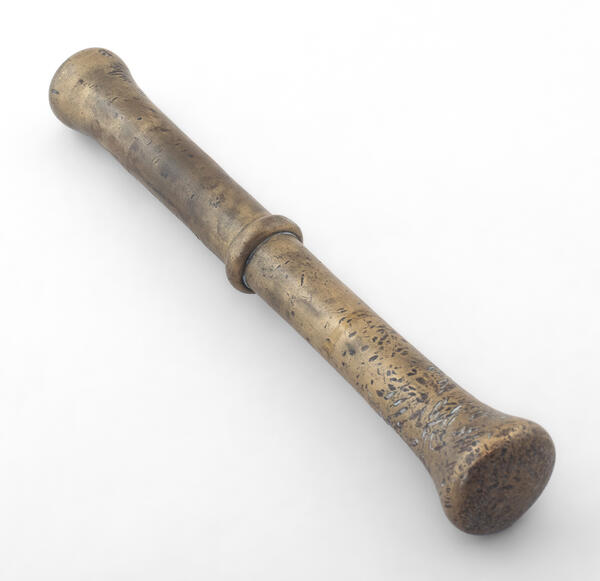
Mortar and pestle are one of the oldest human tools, which were originally used for grinding grain and other food products. The word “stupa” (mortar) comes from the Old Russian word “to step”, that is, “to move one foot from place to place”. A pestle is a club made of durable material, such as metals or alloys; this one has an embossed ring in the middle part.

The very first tools were made of wood, then of rocks such as granite, later bronze and brass bowls appeared.

In the old days, a homemade mortar was not only a simple household utensil. In particular, it was believed to have healing properties: people tried to “grind” the disease away of both humans and domestic animals in a mortar, and fever was “worn out” under it. In Russian folklore, this everyday object is an attribute of Baba Yaga. She “rides in a mortar, drives with a pestle, sweeps the road ahead with a broom.”

As civilization developed, mortars with pestles began to be used in the pharmaceutical business for the preparation of powders and mixtures, and then in the chemical industry.

Modern mortars are made of various materials: hardwood, metal, such as cast iron or brass, porcelain, stone and plastic. Mortars can have different shapes and sizes — from shallow to tall, reaching more than a meter in height. The standard size of the mortar does not exceed 20 centimeters. Nowadays, a mortar and pestle are rarely used in the household, they have been replaced by electric mills and coffee grinders.

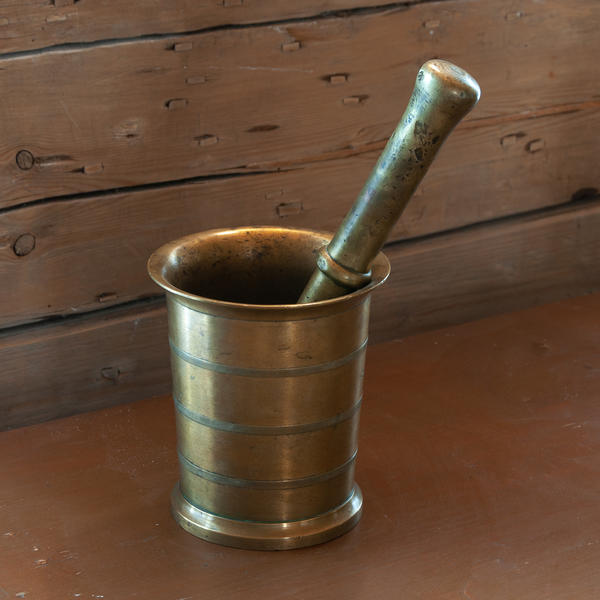
The pestle, which is featured in the collection, is made of bronze and was used in the kitchen. This alloy is quite heavy, which makes it easier to grind products.
0
 Advanced issues found
▲
 
#5
Kitchen mortar and pestle
#6

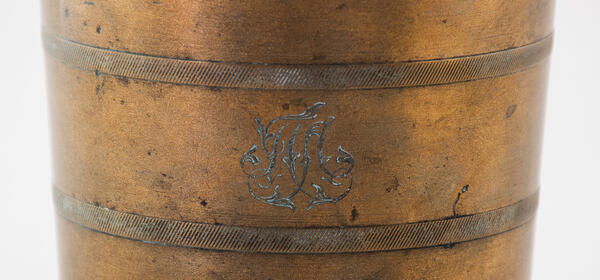
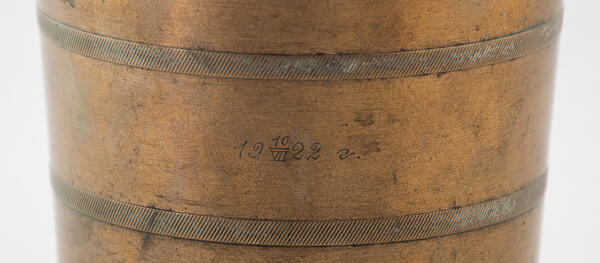
The body of the bronze mortar has the shape of a cylinder, which slightly expands upwards and ends with a curved lip. The mortar is decorated with three relief decorative belts. The item bears an engraving in the form of a monogram.

The mortar and the pestle from the collection were donated to the museum by Anastasia Nikolaevna Kapranova, lecturer at the House-Museum of Vladimir Ilyich Lenin.

These kitchen tools were common for 19th-century Simbirsk, modern Ulyanovsk.

#7
Kitchen mortar and pestle
#4
read morehide
00:00
00:00
1x

Kitchen mortar and pestle

Creation period
the end of the 19th — beginning of the 20th century
Place of сreation
the Russian Empire
Dimensions
16x14x12 cm
Technique
bronze, casting
Collection
0
Point your smartphone camera to open in the app
Share
VkontakteOdnoklassnikiTelegram
Share on my website
Copy linkCopied
Copy
Open in app
To see AR mode in action:
  1. Install ARTEFACT app for 
  2. iOS or Android;
  3. Find and download the «Paintings in Details» exhibition
  4. Push the «Augmented reality» button and point your phone's camera at the painting;
  5. Watch what happens on your phone screen whilst you flip through the pictures.
 
We use Cookies
Cookies on the Artefact Website. We use cookies to ensure that we give you the best experience on our website. If you continue without changing your settings, we'll assume that you are happy to receive all cookies on the Artefact website. However, if you would like to, you can change your cookie settings at any time.
Learn more about useHide
Content is available only in Russian

X

Нашли опечатку?...

%title%%type%