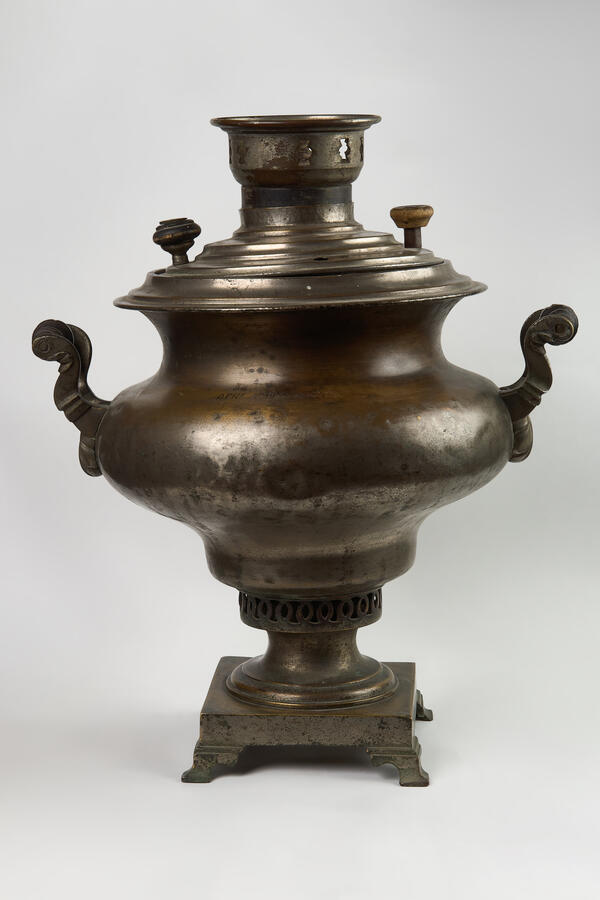
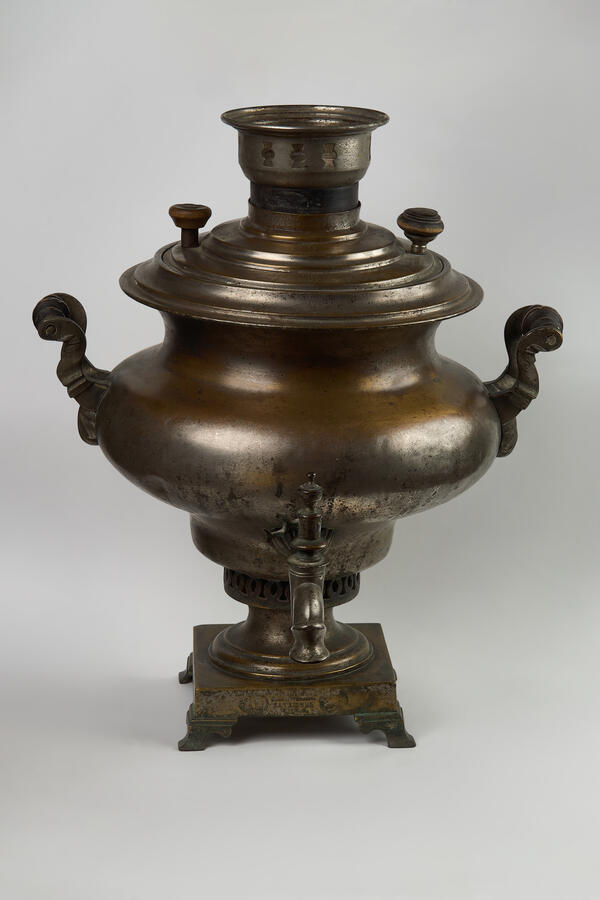
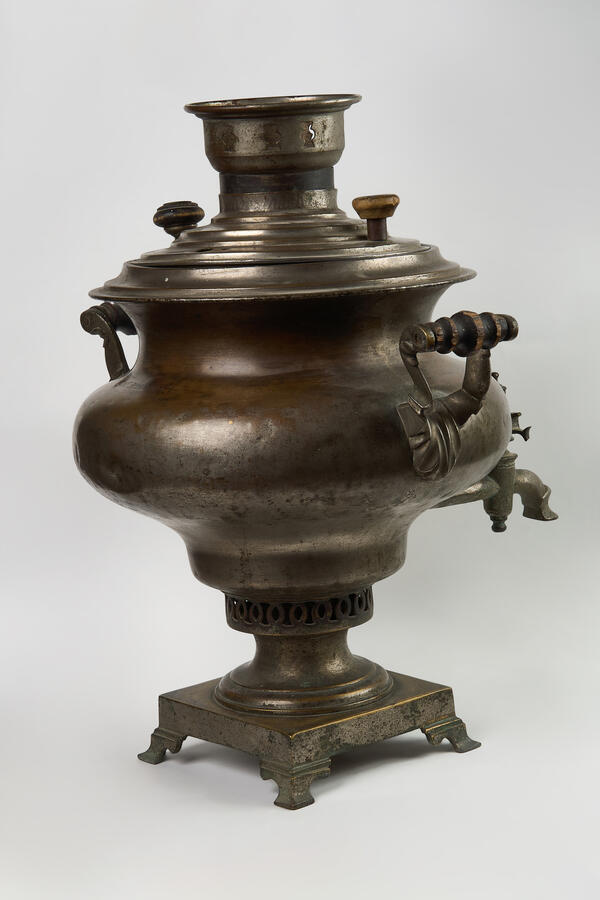
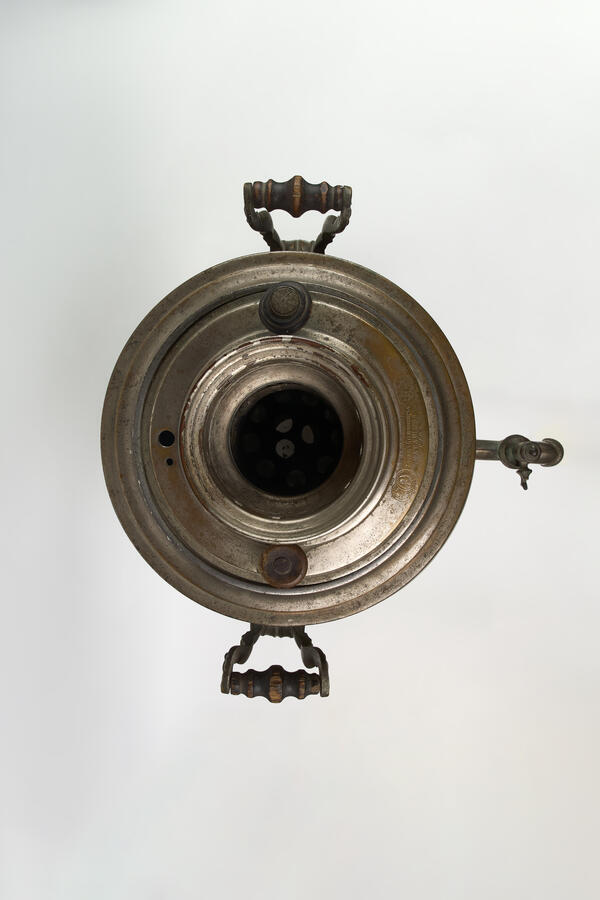
Russian samovars appeared in the Urals in the first half of the 18th century, and already in the 1760s large manufactories, including those in Moscow, established their production. It is difficult to determine precisely when the first water heater of this kind was invented, but researchers find it interesting that in the early 1730s, cauldrons and distillery cubes with pipes were used in monasteries and large estates.
Mass production of samovars was established in the late 18th century, after brothers Ivan and Nazar Lisitsyn opened their samovar factory in Tula. By the middle of the 19th century there were 28 enterprises of this type. It was then that the city of Tula became the center of the samovar industry of the Russian Empire. By the end of the 19th century, there were “samovar kings” in Russia: the Lomovs, Lisitsyns, Batashyovs, Vorontsovs and others.
The samovar from the museum’s exhibition was made at the Batashyovs’ factory in Tula, as follows from the stamp on the lid: “Heirs of Vasily Stepanovich Batashyov. Tula.”
The gunsmith Stepan Fedotovich Batashyov founded his samovar business in 1840. The enterprise gradually grew, but in 1861 the factory and the house burned down. Batashyov’s sons Vasily, Alexander and Pavel began to restore the production.
Under highly competitive conditions, the brothers turned the factory into a profitable and promising enterprise. Their products often won prizes at various national and international competitions and exhibitions. At the All-Russian manufactory exhibition in 1870 the products of the enterprise received a silver medal. For all the time of its existence the factory managed to earn more than 20 honorary awards.
At the end of the 19th century the factory produced about 70 thousand products a year, and by 1915 there were more than 120 thousand of them. More than 160 types of samovars were presented in the company’s catalog. In addition to expensive models, the Batashyov brothers produced small and cheap samovars, which were in great demand. High-quality products were in demand among consumers and spoke for themselves, but the popularity of Batashyov samovars was also promoted by advertising, in which the owners invested a lot of money. Buyers were attracted by information posters and photos of the products.
The samovar factory of Batashyov’s heirs worked
successfully until 1918. After the October Revolution the enterprise was
nationalized, and the Tula Cartridge Factory was established on its basis in
1919.