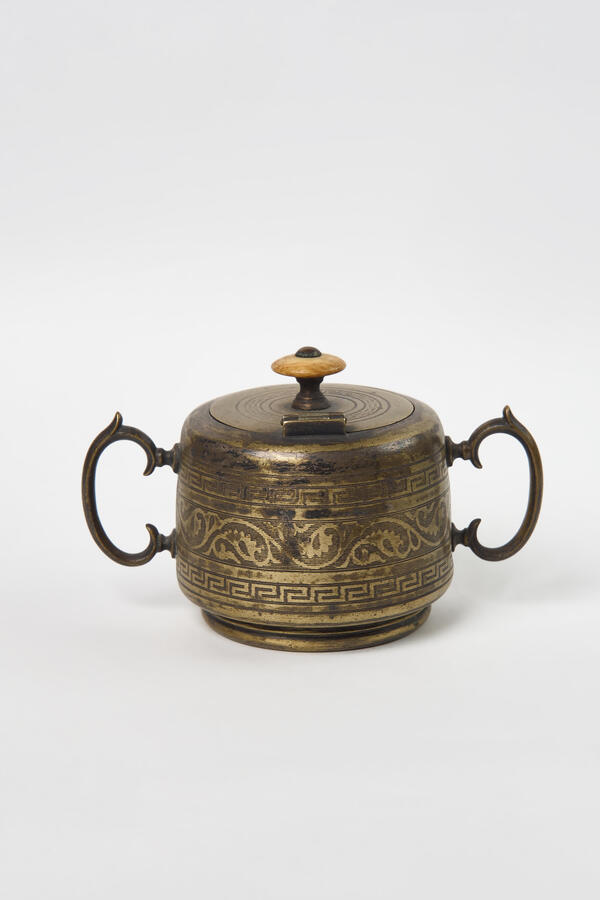
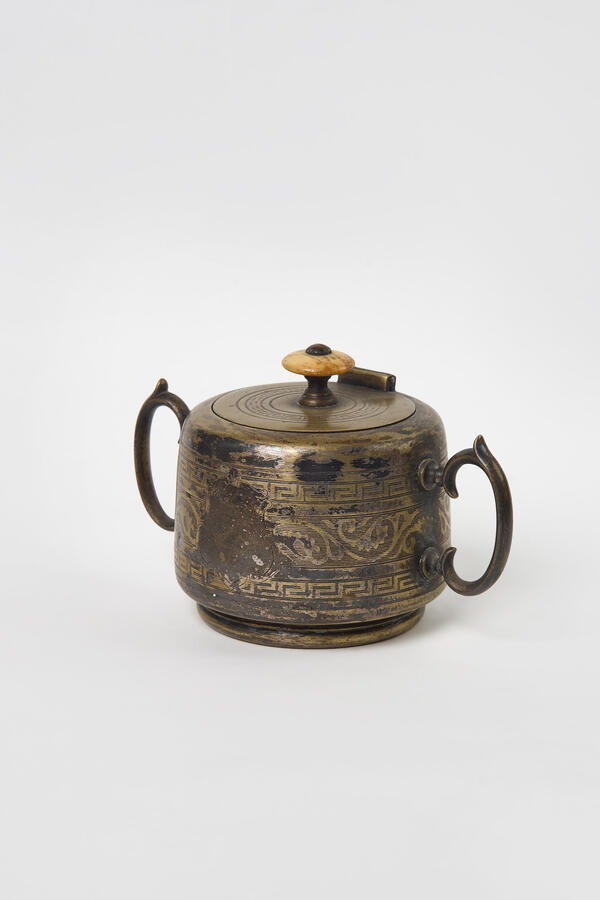
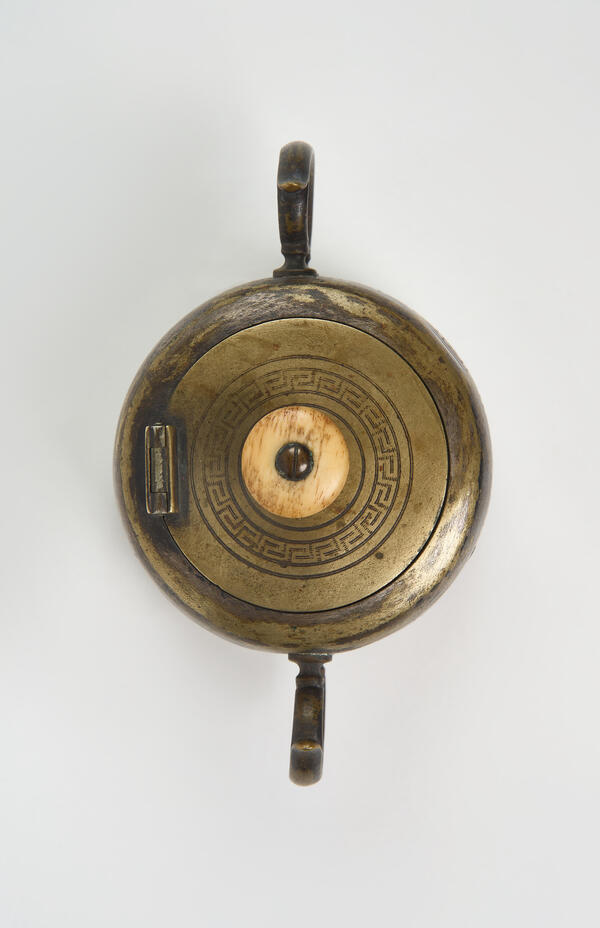
The sugar bowl from the museum collection is made of silver-plated copper. The bottom of the sugar bowl bears the inscription FABR.WOLSKA WARSZAWA, which indicates that the item was produced at the factory in the village of Wola.
In 1885, in the village of Wola, merchants A. Lurie and S. Kronghold founded a company with a small range of products limited mainly to cutlery. Over time, the assortment was expanded: the factory began to produce trays, teapots, samovars, biscuit dishes, cup holders and other products.
The kitchen utensils of the Wola factory were notable for their high quality and interesting decorative design. All products were branded FABR.WOLSKA WARSZAWA and supplied to the domestic market of the Russian Empire.
Initially, the Wola factory produced items made of plated silver, that is, covered with a solid thick layer of the precious metal. Later, silver plating — the process of galvanic deposition of silver film on the surface of products — was actively used in production. The factory also produced goods made of brass and silver alloys.
Little is known about the enterprise. According to the data for 1904 there were 74 workers employed at the factory. According to some reports, it closed in 1910, according to others it was shut down just as World War I broke out.
The turnover of the Wola factory was small, and not many tableware and household items were produced during the short period of its operation. The products were characterized by unusual design and high quality of finishing, which determined their high cost. The factory’s goods were in demand, primarily among the wealthy, of course.
Nowadays, the products of the Wola factory take a
respectable place in museum collections all over Russia. For example, an Art Nouveau
style cup holder with engraving “Happy Angel’s Day” produced by the Wola
factory is on display in the Vladimir Lenin House-Museum in Kazan, Tatarstan. A
samovar-vase with figured handles produced by the Wola factory can be seen in
the Museum of samovars and bouillottes in the village of Grumant, Tula region.