Font
Color
Graphics
Изображение точки

To see AR mode in action:

1. Install ARTEFACT app for iOS or Android;

2. Find the exhibition «Gelendzhik: Past and Present»

3. Push the «Augmented reality» button and point your phone's camera at the exhibit;

Скрыть точки интересаПоказать точки интереса
Показать в высоком качестве

Saber, Flintlock rifle, Battle axe, Dagger

1
Open in app
#1
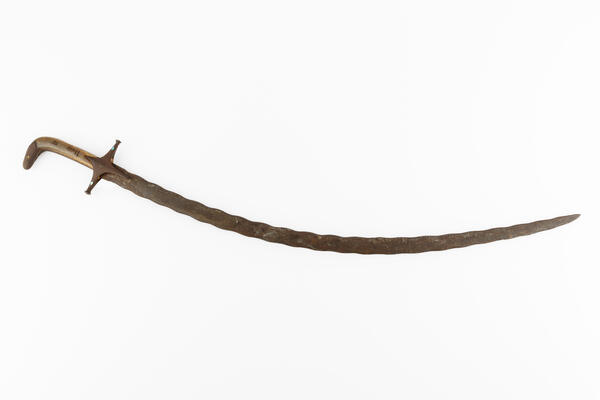
Bukhara saber
#2
A saber is a type of edged weapon that permits cutting and stabbing. This lightweight weapon, convenient for quick strikes, was widely used in the Caucasus. The most important difference between a saber and a sword is the location of the center of gravity. In a saber, the center of gravity is at a considerable distance from the handle, therefore, it can be used to cut. The blade of the saber is more curved. The curved blade increases not only the force of impact, but also the area of damage. The hilt of the sabers is to be held with one hand only, and the blade has a single cutting edge. Sabers were used both for attack and defense.

A saber consists of a hilt, a blade, a grip, a pommel, a cross guard, a langet (served to securely fix the saber in the scabbard), a spine (the back blunt side of the blade, although there were also sabers with double cutting edge), an edge, a false edge (expansion in the lower third of the blade, as a rule, it had an edge and was typical only for some sabers), and a point.

Sabers were usually carried in wooden scabbards. To avoid cutting the scabbards, the locket and the chape were bound with metal. Metal rings were attached in the middle and used to hang the scabbard from the belt.

In Russia, the saber has been known since the 9th century, and since the 14th century it has become the prevalent type of edged weapons. In the 15th–17th centuries, the Russian cavalry, archers, and Cossacks were armed with diverse types of sabers.

In the Circassian culture, weapons were of particular importance and were highly valued. In their tradition, it was customary to decorate them richly and take care of the weapons. The weapon was not only used in battle — it also emphasized the status of its owner in peacetime.

The saber on display in the Gelendzhik Museum is a wave-shaped, or flame-shaped, sword. Wounds incurred by “flame” blades healed much worse than from straight ones. The handle is made of two pieces of horn with an overlaid head bound with iron in the form of a snake’s head. The crosspiece is straight, with a crossguard, decorated with two large turquoise stones and green glass imitating emerald. The blade of the saber has traces of silvering.
#3
Наименование: Bukhara saber
Дата создания: the second half of the 19th century
Техника: steel, horn, forging
Размеры: 74,5×3×3 cm
#4
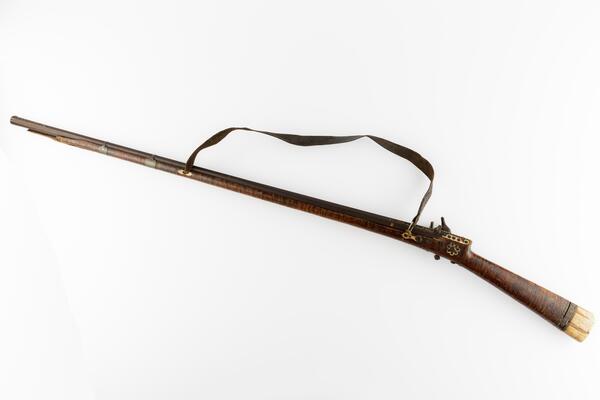
Caucasian flintlock rifle
#5
Firearms began to be used in Europe in the 15th–17th centuries. The first guns were matchlocks. They were extremely inconvenient, since the charge was set on fire manually with a special rod while holding the gun with one hand. In the 18th century, these weapons were replaced by guns with flintlock mechanisms, which came to the Caucasus from the Ottoman Empire.

The museum keeps a 13-mm smoothbore muzzle-loading rifle with a Hispano-Moorish flintlock. The lock is the part of the gun responsible for igniting the charge. The term “lock” is outdated and currently applies only to historical weapons. The Hispano-Moorish flintlock is only one of the options for igniting gunpowder. It was preceded by other variants of locks. But the introduction of the Hispano-Moorish flintlock caused a certain revolution in military tactics. This system favorably differed from the previous ones by its cheapness, simplicity and reliability.

Initially, this method of igniting gunpowder came from the Arab world. At the very beginning of the 16th century it came to Spain and later spread throughout Europe — hence the name of the flintlock. Flintlock rifles came to the Caucasus through the Ottoman Empire and were successfully and widely used until the 19th century.

Due to the geographical, economic and political isolation of the Northwest and Central Caucasus, firearms appeared among the Circassians much later than in Europe and Asia, approximately in the middle of the 17th century. At the same time, the preferences of the Circassian military elite turned out to be different than those of the Europeans. For more than two centuries, their weapon of choice was the long-barreled flintlock.

Rifles, as well as edged weapons, were usually richly decorated. Circassian artisans reached a high level of this craft. The octagonal steel barrel of the gun from the exhibition is decorated with a pattern made with a gold notch. Relatively light and durable walnut wood was used to make the forearm. The ends of the forearm are decorated with ivory. Also, the holes for the belt and the trigger are decorated with ivory and brass plaques. Until 1930 the rifle was kept in the Kuban District Museum, then in the Adyghe Regional Museum of Local Lore, and only in 1971 it was transferred to the Gelendzhik Museum.
#6
Наименование: Caucasian flintlock rifle
Дата создания: the first half of the 19th century
Техника: steel, ivory, handmade
Размеры: 137×80×75 cm; caliber — 13 mm
#7
Oriental battle axe
#8
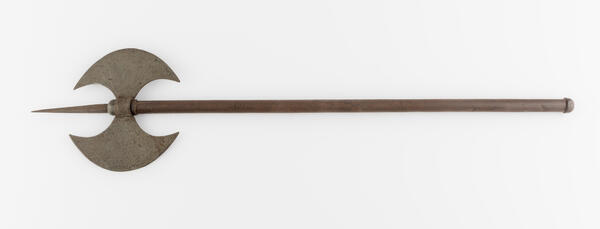
A battle-axe is an edged melee weapon. A battle axe occupies an intermediate position between an axe and a halberd. The weapon consists of a shaft, a blade and a counterweight. The shaft of a battle-axe is approximately 70–80 cm long, and the shaft of a halberd is 2.5 m long. The axe has a wide blade, curved in the form of a crescent, sharpened along the convex part, 30–35 cm long. A counterweight is a metal pommel or a spike which can be used to strike. A heavy axe blade on a long shaft would be too clumsy without a counterweight.

The battle axe from the museum exhibition was made in Azerbaijan. It consists of two semicircular wide blades mounted on a metal shaft. The blades are opposite each other. An axe with two identical blades is not the most common type of weapon. On the one hand, this made it possible to strike both forward and backward, but, on the other hand, it required a high level of training from the fighter. More often, a smaller blade, spike or hammer was located on the butt of the ax. The shaft is crowned with a tetrahedral head, smoothly tapering to the point, which made it possible to use the cutting battle axe as a stabbing weapon. The side surfaces of the blades are almost completely decorated with chased floral patterns, which are very characteristic of the Eastern culture.

Despite its formidable appearance, this battle axe has not been used for war and was not even intended for it. It was one of the ritual items and was used in religious holidays celebrated in a number of Muslim countries. Among many peoples, axes served as ceremonial or ritual weapons, for example, the ancient Greek double-sided axe called labrys. Such a weapon was similar in some respect to combat weapons, but differed significantly from it in other characteristics. It was decorated with engraving, gold, silver and inlays of semi-precious and precious stones. Also, it was often less durable and balanced than a military weapon, and was not used in combat.
#9
Наименование: Oriental battle axe
Дата создания: the middle of the 19th century
Техника: iron, forging
Место создания: Azerbaijan
Размеры: 66,5×14×3 cm
#10
Qama (dagger)
#11
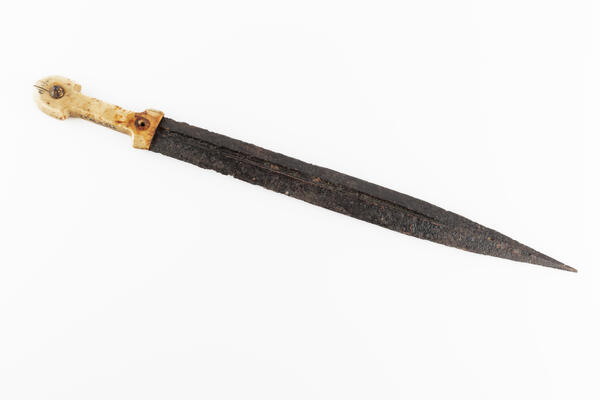
A type of dagger called a qama was widespread among the peoples of the Caucasus, Transcaucasia and the Middle East. For the Circassians, this type of edged weapons served as an indispensable attribute of a man and a warrior. A dagger was to be worn from adolescence. In fact, receiving a dagger was a kind of initiation, a symbol of entering adulthood. From the moment a young man received his dagger, the qama and its owner became inseparable. It is hard to imagine that a man would decide to leave the house without this narrow dagger on his belt. In addition, the Circassians considered a thin waist to be the standard of male beauty, and a belt with a dagger emphasized this aspect of appearance. It can be said with certainty that the dagger was an indispensable accessory of a man of any social stratum who had the right to carry weapons. The highlander ate, drank, worked, and had fun with a dagger on his belt and, even going to bed, put it under his headboard. Therefore, he was always armed. Thus, the dagger symbolized man’s dignity and his readiness to defend this dignity at any moment.

In addition to the enormous cultural significance in the life of the Circassians, the qama undoubtedly had a practical function. It was used not only as a combat and hunting weapon, but also as a household item for various household needs — to cut brushwood or meat. A dagger of this type would normally have a steel blade that would be lenticular or diamond-shaped in cross section, gradually tapering to the point. The blade was double-edged. In the middle of the blade there was a long narrow groove, a longitudinal recess, that made the dagger less heavy while keeping it strong. The handle of the qama did not have a cross, but was often solid. It is noteworthy that, despite the excellent penetrating ability, the qama was primarily used to cut and less often to stab.

During the Caucasian War, the Cossacks appreciated this type of edged weapons and adopted it from the highlanders. This very convenient type of dagger became an attribute of the Cossack uniform and also became known in Russia as the “Cossack dagger”.
#12
Наименование: Qama (dagger)
Дата создания: the 18th–19th centuries
Техника: steel, bone, forging, handmade
Размеры: 38,5×3,3 cm
#13
read morehide
00:00
00:00
1x

Saber, Flintlock rifle, Battle axe, Dagger

1
Point your smartphone camera to open in the app
Share
VkontakteOdnoklassnikiTelegram
Share on my website
Copy linkCopied
Copy
Open in app
To see AR mode in action:
  1. Install ARTEFACT app for 
  2. iOS or Android;
  3. Find and download the «Paintings in Details» exhibition
  4. Push the «Augmented reality» button and point your phone's camera at the painting;
  5. Watch what happens on your phone screen whilst you flip through the pictures.
 
We use Cookies
Cookies on the Artefact Website. We use cookies to ensure that we give you the best experience on our website. If you continue without changing your settings, we'll assume that you are happy to receive all cookies on the Artefact website. However, if you would like to, you can change your cookie settings at any time.
Learn more about useHide
Content is available only in Russian

X

Нашли опечатку?...

%title%%type%