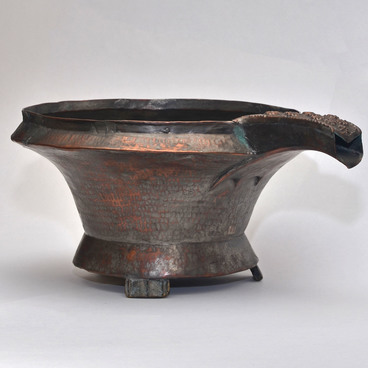
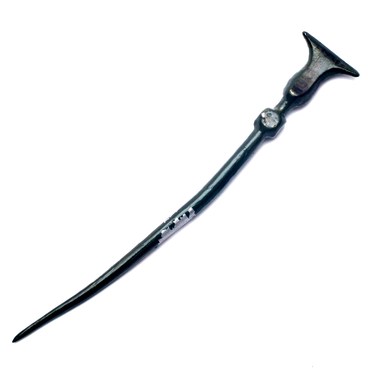
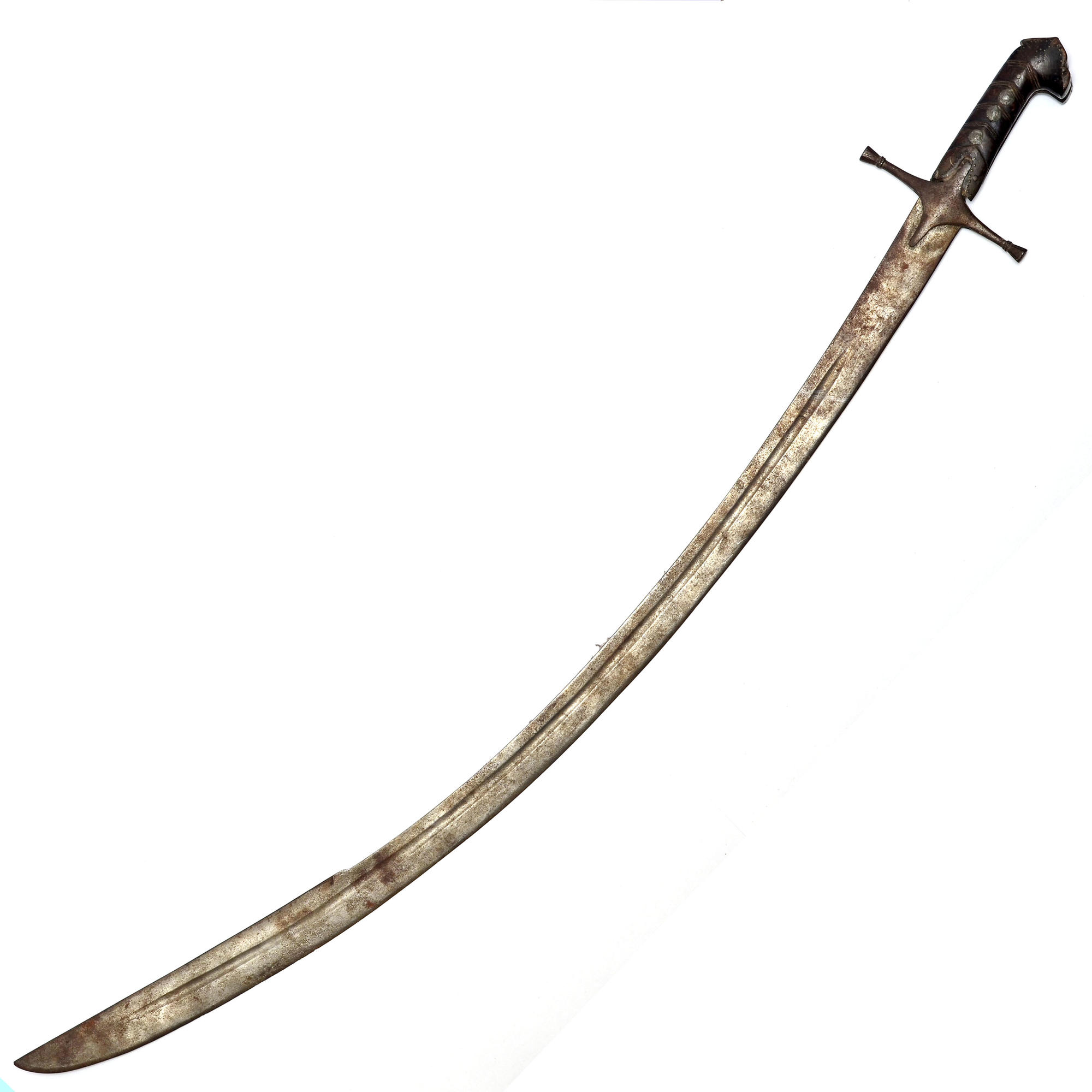
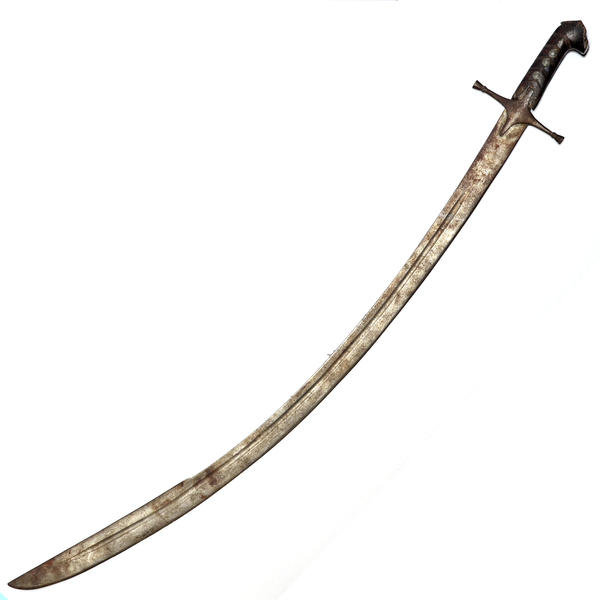
The Arched Karabela Swords were spread in the 16th — 18th centuries in Russia and in Western Europe: Poland, Hungary, Moldavia. They were worn mostly by Cossacks, Russian soldiers and cavalrymen. They were most popular with Polish and Lithuanian gentry. There even existed a proverb that says: Don’t leave your home without God, and don’t leave your bed without a karabela!


#1
The Karabela Sword
#2
#3
Originally the Karabela Sword was a ceremonial weapon, rarely used in battles. The handle was ornamented with engraving and precious stone inserts, the sheath was covered with ornamental metal plates. There was practically no décor on battle swords, since décor reduced inertia and the strength of the slash, distracted the soldier and the carved handle was not convenient to hold in the hand.
The word Karabela comes from Turkish and means Black Poison. The swords were given that name because they produced the most serious and dangerous wounds. According to another version, the sword was named after the Iranian city of Karbala. The first swords of such type were forged following the form of Turkish kylych sabers, however the Karabela had a flatter arch.
#4
Some of the sword blades were smoothly widened in the upper third, near the handle. This widening was called yalman. The blade was separated from the handle by a simple crosspiece with small bulbs at the ends. Such a handle would not protect the hand, therefore, a new type of sword fight appeared: the crisscross art of fighting. The Karabela was held with a sharp side up, so that the enemy weapon, having slid off the blade, would not hit the hand. When fighting the swords met crisscross, hence the name of the technique.
#5
Karabelas were lighter than hussar sabers and other arched swords of that time. They were fit for both mounted and unmounted battles. They were used in close fighting to throw straight and round slashes.
Karabelas were most often made of Turkish or Persian Steel. There were also swords made in the German city of Solingen, that was a center of manufacturing most reliable and strong blades in Europe.
#6
The Karabela sword was transferred to the Bryansk Antiquities Collection by the State Museum of History. It has been kept in the Bryansk State Regional Ethnography Museum since 1950s.
#7
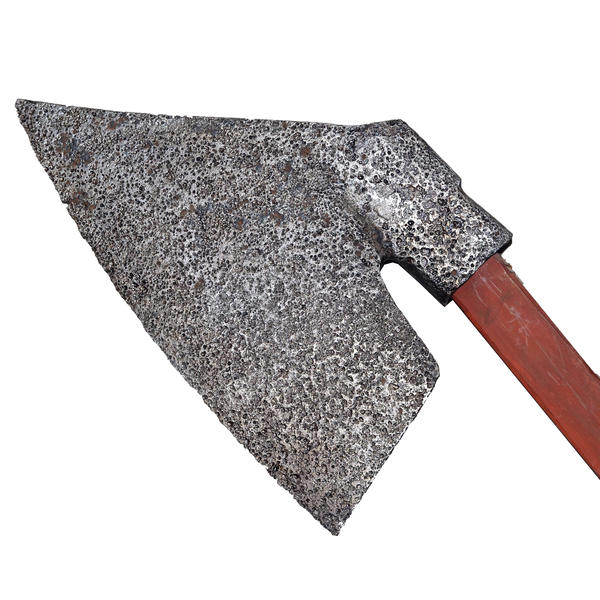
Hewing axe
#8
In ancient Russia, hewing axes were used to trim logs. Most of carpentry was done with this instrument, forged from solid steel that could sustain heavy and continuous load. Sometimes the quality of the metal used for those axes was even better than that used for making weapons. The handle was usually made from birch wood. Its length was determined based on the height of the artisan who was to use the instrument. The long handle served as a lever: during work, it balanced the heavy part so that the work was not so tiresome for the artisan. At the end of the handle there was a thickening that helped the axe not to slip out from the hand at the moment of a swing or a blow.
#9
The cutting edge of the axe was always displaced respect to the eye so that it would be easier to trim logs. Carpenters used both right-sided and left-sided axes. They chose the type of the instrument depending on the side on which the log had to be trimmed and the artisan’s dominant hand.
The first carpentry axes that looked like hewing axes appeared in the 14-15th centuries in Austria and Germany. There, they were called “Zimmermannbeil”. Later, those instruments became popular in Poland, Lithuania, Ukraine and Belorussia, and from there, they came to Russia. Such axes were also called “goosewing” because of the peculiar shape of the cutting edge.
#10
Hewing axes were not a weapon of war but could be used as such when necessary. The heavy and broad blade could easily cut ring-armour as well as plate-armour. The long upper part of the blade could be used to stab, like a lance. Sometimes, there was a narrow slit between the blade and the eye where the adversary’s sword could be caught in order to break it or knock it out from the enemy’s hands. When a hewing axe was used in a battle, the normal handle was usually substituted with a long one in order to make a kind of a heavy halberd.
#11
Hewing axes were treated in ancient Russia with great care and respect. Like other iron instruments, they were considered an amulet against illnesses and the evil spirit. In the Russian North, there was a belief among the shepherds that if one walks around a herd of cattle with an axe, it would not be attacked by predators.
After the work was finished, the axe was never left driven into the log or leaned against a wall. Someone could touch the instrument left in such a way and get wounded, and the blade could go blunt when treated like that. So the axe was left under a bench where it did not get in anybody’s way.
#12
State budgetary cultural institution Bryansk State Regional Ethnography Museum
read morehide
00:00
00:00
1x
The Karabela Sword, Hewing axe
Technique
Steel, forging
Collection
Exhibition
0
 Point your smartphone camera to open in the app
Open in app
Share