

#1

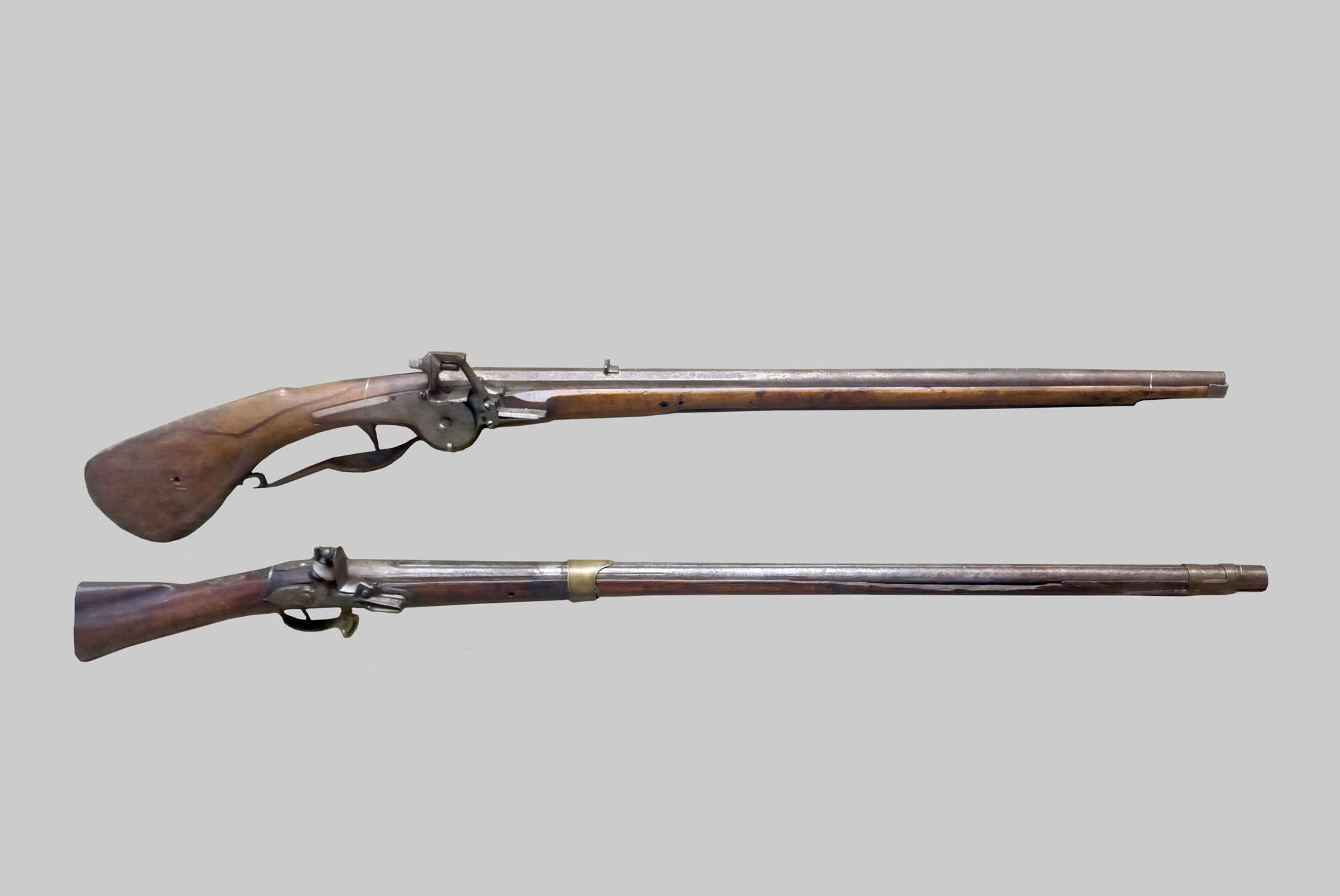
Flintlock, Wheellock rifle
#8
#9

#2
A flintlock is a special mechanism for igniting gunpowder in firearms. Sparks in it are generated as the flint strikes the steel. This type of lock was invented in the Middle East in the early 14th century. The weapon in which this device was used was called flintlock.
The Turkish flintlock became first known in Europe in 1504, in Spain. The chronology of the highest prohibitions on the use of a flintlock allows us to trace its further spread. The last time it was banned under pain of death by King Louis XIV of France in 1645. But this did not mean that the king found something reprehensible in the production, sale, storage, carriage and use of flintlock weapons under the laws. The ban applied only to the musketeers.
In the 17th century, soldiers received a salary, but had to buy weapons themselves. The weapon was determined by the contract. A musketeer with a musket that did not meet the requirements was not considered equipped, and was regarded as a deserter. The use of flintlock muskets was prohibited by the regulations.
The flintlock was based on the earlier wheellock. In the first models, the frizzen and the flashpan lid were a single unit. A part of the trigger and firing mechanism, the sear, moved vertically and went into two notches in the cocking handle: a disk mounted on one axis with the trigger. These notches allowed the hammer to be cocked either fully or halfway. The half-cock position of the hammer was safe.
Before shooting, the trigger was fully cocked, and then pulled. The flint struck the frizzen, opening the flashpan lid and generating a spark that would ignite the powder in the flashpan. The ignited powder would then ignite the main powder charge, which was placed in the barrel together with the ball.
As flintlocks became widespread throughout Western Europe after the 1630s, national characteristics began to appear in them. Each workshop developed its own, easily recognizable style. France was the main European supplier of firearms in the early 17th century. In Scotland, where the more archaic wheellocks were preferred, true flintlocks did not appear until around 1700. Scottish pistols have always had a very characteristic look; flintlocks were installed on pistols with grips, the end of which was decorated by gunsmiths with a stylized heart or a ram’s horn.
With the advent of flintlocks, weapons became more convenient to handle: loaded weapons did not require a smoldering fuse, diminishing the impact of the weather on reliability. Moreover, now the weapon could shoot at any moment, and not only when the fuse was smoldering.
By the middle of the 17th century, the design of the flintlock was well-established and changed very little over the next century. The only innovation that appeared in some later models was the stopper. It was a small hinged arm which prevented the sear from moving when the trigger was released in the half-cock position.
The Turkish flintlock became first known in Europe in 1504, in Spain. The chronology of the highest prohibitions on the use of a flintlock allows us to trace its further spread. The last time it was banned under pain of death by King Louis XIV of France in 1645. But this did not mean that the king found something reprehensible in the production, sale, storage, carriage and use of flintlock weapons under the laws. The ban applied only to the musketeers.
In the 17th century, soldiers received a salary, but had to buy weapons themselves. The weapon was determined by the contract. A musketeer with a musket that did not meet the requirements was not considered equipped, and was regarded as a deserter. The use of flintlock muskets was prohibited by the regulations.
The flintlock was based on the earlier wheellock. In the first models, the frizzen and the flashpan lid were a single unit. A part of the trigger and firing mechanism, the sear, moved vertically and went into two notches in the cocking handle: a disk mounted on one axis with the trigger. These notches allowed the hammer to be cocked either fully or halfway. The half-cock position of the hammer was safe.
Before shooting, the trigger was fully cocked, and then pulled. The flint struck the frizzen, opening the flashpan lid and generating a spark that would ignite the powder in the flashpan. The ignited powder would then ignite the main powder charge, which was placed in the barrel together with the ball.
As flintlocks became widespread throughout Western Europe after the 1630s, national characteristics began to appear in them. Each workshop developed its own, easily recognizable style. France was the main European supplier of firearms in the early 17th century. In Scotland, where the more archaic wheellocks were preferred, true flintlocks did not appear until around 1700. Scottish pistols have always had a very characteristic look; flintlocks were installed on pistols with grips, the end of which was decorated by gunsmiths with a stylized heart or a ram’s horn.
With the advent of flintlocks, weapons became more convenient to handle: loaded weapons did not require a smoldering fuse, diminishing the impact of the weather on reliability. Moreover, now the weapon could shoot at any moment, and not only when the fuse was smoldering.
By the middle of the 17th century, the design of the flintlock was well-established and changed very little over the next century. The only innovation that appeared in some later models was the stopper. It was a small hinged arm which prevented the sear from moving when the trigger was released in the half-cock position.
#3
Full name: Flintlock rifle
Date: 18th–early 19th centurys
Technique: iron, wood, copper
Place: Western Europe
Dimentions: 134×14 cm
Collection: Velikiye Luki Museum of History and Local Lore
Copyright: State Budget Cultural Institution Pskov-Izborsk United Museum Preserve
Date: 18th–early 19th centurys
Technique: iron, wood, copper
Place: Western Europe
Dimentions: 134×14 cm
Collection: Velikiye Luki Museum of History and Local Lore
Copyright: State Budget Cultural Institution Pskov-Izborsk United Museum Preserve
#4
Wheellock rifle
#10

#5
The wheellock design was first introduced in the Codex AtlAnticus by Leonardo da Vinci in 1478–1519. The sketches of the lock themselves are dated to 1480-1485, when the artist made some works for Gentile dei Borri, the ducal armorer at the court of Ludovico Sforza.
The wheellock operated like a large cigarette lighter. A rotating wheel with notches pressed against a piece of pyrite, a mineral also known as fool’s gold. The result was a cascade of sparks that ignited the powder.
The wheel, which was turned using a short chain, was mounted on a spindle - a special shaft. The mechanism was wound with a key, like a watch. This way, the spring was compressed, and the chain was wound on the spindle. The fully wound device was locked by a system of levers. Pulling the trigger released the lever, and the wheel would begin to rotate rapidly.
A piece of pyrite was fixed in a clamp at the end of the trigger; the trigger was moved toward the wheel manually. The flashpan was closed with a sliding lid with a small handle. In later wheellocks, the flashpan lid moved automatically when the trigger was pulled.
Weapons with a wheellock and a short barrel were fired from the cheek, the heavy barrel took on most of the recoil from the rather weak gunpowder, which was used in weapons by the wealthiest people of the 16th century. Ordinary hunters would make do with the simple and rather unreliable matchlock, which often gave itself away by emitting smoke.
Most rifles could be loaded with one or more bullets, as the shooter wished. In 1524, Benvenuto Cellini wrote of “a straight rifle for hunting birds, which he made himself and finished so carefully inside and outside that it had no equals”. Unlike other contemporary devices, Cellini carefully loaded his rifle with a single round bullet and shot at game and peacocks. He boasted that by applying a charge equal to a fifth of a ball he could accurately hit the target at a distance of two hundred steps.
The wheellock turned out to be a successful invention. Reliability and low dependence on the weather determined its long life. However, it was very expensive and difficult to manufacture and maintain. As a result, when, during the Thirty Years' War, the issue of mass armament of armies became acute, the old matchlock became the main mechanism. The wheellock was used for pistols as the only one suitable for them, as well as for expensive weapons, sporting or hunting rifles.
After mass production of the battery modification of the flintlock began, it became preferred for all types of weapons and replaced the matchlock. Nevertheless, hunting weapons with a wheellock were produced in Munich workshops until the middle of the 18th century.
The wheellock operated like a large cigarette lighter. A rotating wheel with notches pressed against a piece of pyrite, a mineral also known as fool’s gold. The result was a cascade of sparks that ignited the powder.
The wheel, which was turned using a short chain, was mounted on a spindle - a special shaft. The mechanism was wound with a key, like a watch. This way, the spring was compressed, and the chain was wound on the spindle. The fully wound device was locked by a system of levers. Pulling the trigger released the lever, and the wheel would begin to rotate rapidly.
A piece of pyrite was fixed in a clamp at the end of the trigger; the trigger was moved toward the wheel manually. The flashpan was closed with a sliding lid with a small handle. In later wheellocks, the flashpan lid moved automatically when the trigger was pulled.
Weapons with a wheellock and a short barrel were fired from the cheek, the heavy barrel took on most of the recoil from the rather weak gunpowder, which was used in weapons by the wealthiest people of the 16th century. Ordinary hunters would make do with the simple and rather unreliable matchlock, which often gave itself away by emitting smoke.
Most rifles could be loaded with one or more bullets, as the shooter wished. In 1524, Benvenuto Cellini wrote of “a straight rifle for hunting birds, which he made himself and finished so carefully inside and outside that it had no equals”. Unlike other contemporary devices, Cellini carefully loaded his rifle with a single round bullet and shot at game and peacocks. He boasted that by applying a charge equal to a fifth of a ball he could accurately hit the target at a distance of two hundred steps.
The wheellock turned out to be a successful invention. Reliability and low dependence on the weather determined its long life. However, it was very expensive and difficult to manufacture and maintain. As a result, when, during the Thirty Years' War, the issue of mass armament of armies became acute, the old matchlock became the main mechanism. The wheellock was used for pistols as the only one suitable for them, as well as for expensive weapons, sporting or hunting rifles.
After mass production of the battery modification of the flintlock began, it became preferred for all types of weapons and replaced the matchlock. Nevertheless, hunting weapons with a wheellock were produced in Munich workshops until the middle of the 18th century.
#6

Wheellock scheme
#7
Full name: Wheellock rifle
Date: first half of the 18th century–19th century
Technique: iron, wood
Place: Western Europe
Dimentions: 104×11 cm
Collection: Velikiye Luki Museum of History and Local Lore
Copyright: State Budget Cultural Institution Pskov-Izborsk United Museum Preserve
Date: first half of the 18th century–19th century
Technique: iron, wood
Place: Western Europe
Dimentions: 104×11 cm
Collection: Velikiye Luki Museum of History and Local Lore
Copyright: State Budget Cultural Institution Pskov-Izborsk United Museum Preserve
read morehide
00:00
00:00
1x
Flintlock, Wheellock rifle
Collection
Exhibition
0
 Point your smartphone camera to open in the app
Open in app
Share