#1

Gun, Astronomical chronicle
#2
#3
#4
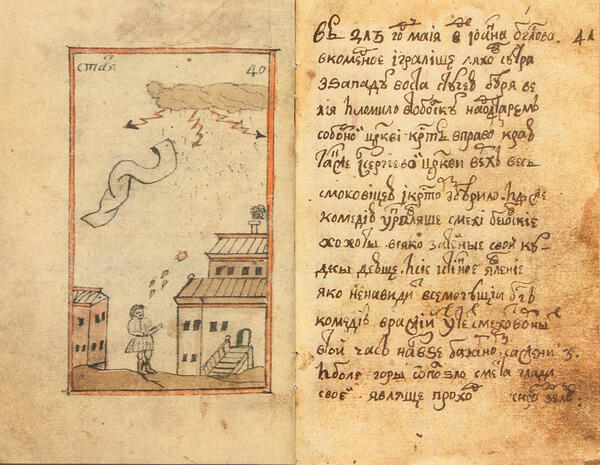
The manuscript is a diary records about the phenomena seen by an unknown author in the sky over the city of Tobolsk in the early 18th century. It is known that they were kept in 1696 by order of the Tobolsk voivode Andrey Fyodorovich Naryshkin. Not all the pages of the chronicle have survived to our days, there are 111 pages in the book of the mid 18th century – from 26 to 148.
The chronicler clearly, carefully and correctly recorded observations of the sky. This written monument consists of two parts: there is a detailed description of the astronomical phenomenon that the author observed, on the spreadsheet of the book on the right side of most pages. And on the left side — a graphic drawing with partial comments about the location of the stars and planets of the solar system, the trajectory of the meteorite hit, a fragment of a solar eclipse, and so on. Such presentation of the material clearly, reliably and convincingly states the pictures seen in the night sky.
The entire text is also divided into logical parts. Each paragraph starts on a new page and contains information about a celestial phenomenon. Although the paragraphs are not titled, they have an opening sequence, which usually begins a fragment of diary records. The author dated each new celestial phenomenon: he indicated the date and time of the fact described.
The chronicle consists of brief notes and drawings relating to various events, such as phenomena related to changes in the weather, urban accidents, fires, urban development progress and so forth. The author explains many events and incidents by the intervention of the celestial powers, to explain the particular incidents, the author of the chronicle has made instructions to the celestial signs and wonders as a manifestation of the miraculous or diabolical forces: for example, the cloud carried by the ‘serpent’ over the Irtysh caused a fire in the city, and the wrath of God sent a thunderstorm to the earth.
‘Record of astronomical phenomena’ belongs to the original genre of old Russian script, similar to notebooks, salary and census books, diaries, in the form of presentation of material, that recorded events that took place in the country and city.
#5
Date: 18th century
Technique: manuscript, seaming, gluing
Place: Tobolsk, Russia
Dimensions: 17×11 cm
Copyright: Tyumen Province State Autonomous Cultural Institution ‘Tyumen Museum and Educational Association’, Structural Division ‘Tobolsk Historical and Architectural Museum Reserve’
Collection: Documents
Technique: manuscript, seaming, gluing
Place: Tobolsk, Russia
Dimensions: 17×11 cm
Copyright: Tyumen Province State Autonomous Cultural Institution ‘Tyumen Museum and Educational Association’, Structural Division ‘Tobolsk Historical and Architectural Museum Reserve’
Collection: Documents
#6
Rifle flint gun
#8
#9
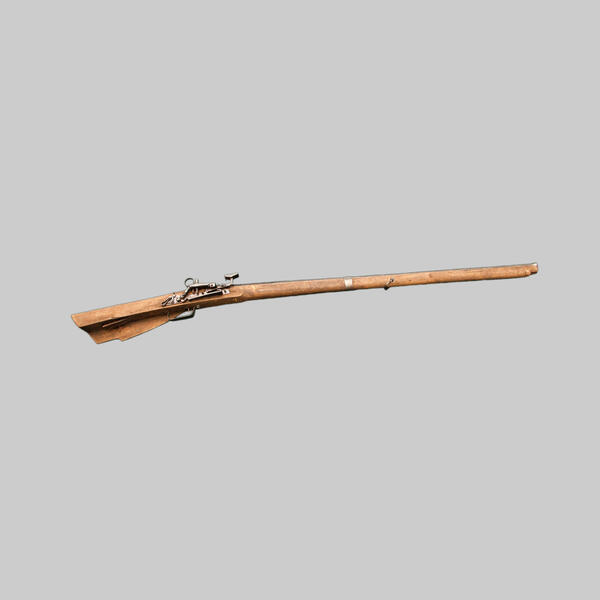
At the end of the 16th–17th centuries, during the annexation of Siberia to the Moscow state, firearms were widely used. In many ways, it determined the victories won by Yermak’s militia unit in the battles with the troops of Khan Kuchum. There was no domestic production in Siberia, so the garrisons were supplied from Moscow – the government sent large quantities of guns to Tobolsk, from where they were sent to other places. At the same time, however, not only ready-made firearms were imported to the Urals, but also some parts, in particular, barrels and arquebus locks were delivered to the Tobolsk market, and, consequently, there were craftsmen in the city who had been repairing guns.
A large military arsenal was stored both in the city treasury and in the hands of local residents, especially since in the 17th century the main population in the city was made up of service people. Interesting information is contained in the Estimated cost list of 1678, describing the military arsenal of Tobolsk, where the state balances are: “45 arquebus barrels and musket burned, 23 rifled barrels burned; 518 pistol barrels burned, 464 arquebus locks and rifled musket guns.”
That is, the entire arsenal of small arms known then was represented in the city at that time. And such a type of weapon as an arquebus with a shock-flint lock and a caliber of 1-1.5 centimeters was the most widespread in Tobolsk in the 17th century. Residents of Tobolsk have sought to acquire universal weapons that combined both combat and commercial use, to the extent possible.
The muzzle-loading arquebus was loaded as follows: a powder charge and a round lead bullet were lowered into the breech end of the barrel through the muzzle section. Additionally, the powder was poured on a pan located next to the fire hole, through which the fire hit the breech end of the barrel. The flint, which gives a spark when hitting, was clamped in the jaws of the trigger in lead or leather gaskets. When pulling the trigger, it fell down, hitting the flint on the firesteel fixed next to the powder pan, which caused the powder burn and the gun shoot out.
At the very beginning of the 18th century, Siberia had its own production. According to the decree of Tsar Peter I, the Tobolsk weapons factory started operation.
#7
Date: 18th century
Place: Tobolsk, Russia, Tobolsk weapons factory
Technique: forging, engraving
Dimensions: 140×11,5 cm
Copyright: Tyumen Province State Autonomous Cultural Institution “Tyumen Museum and Educational Association”, Structural Division “Tobolsk Historical and Architectural Museum Reserve”
Goskatalog Number: 5901418
read morehide
00:00
00:00
1x
Gun, Astronomical chronicle
Collection
0
 Point your smartphone camera to open in the app
Open in app
Share