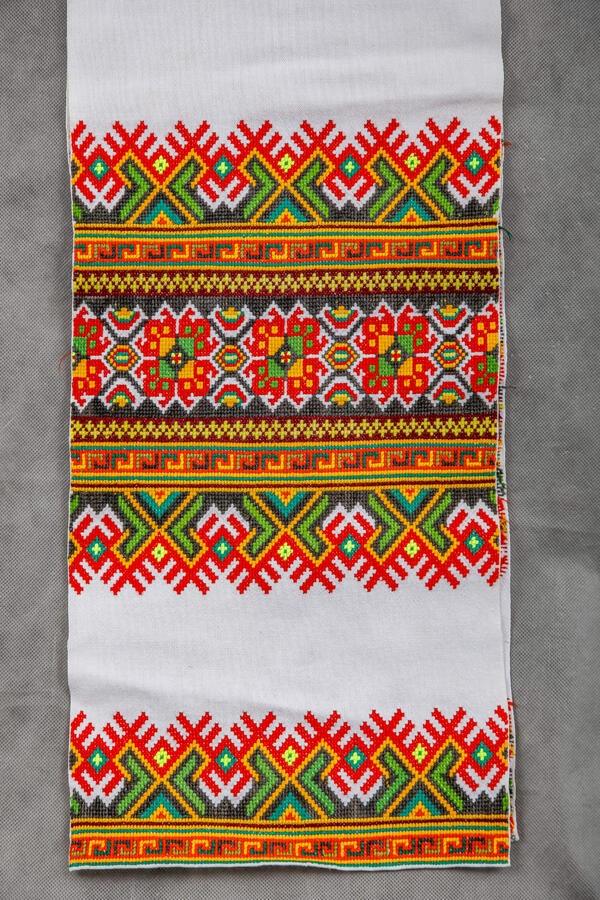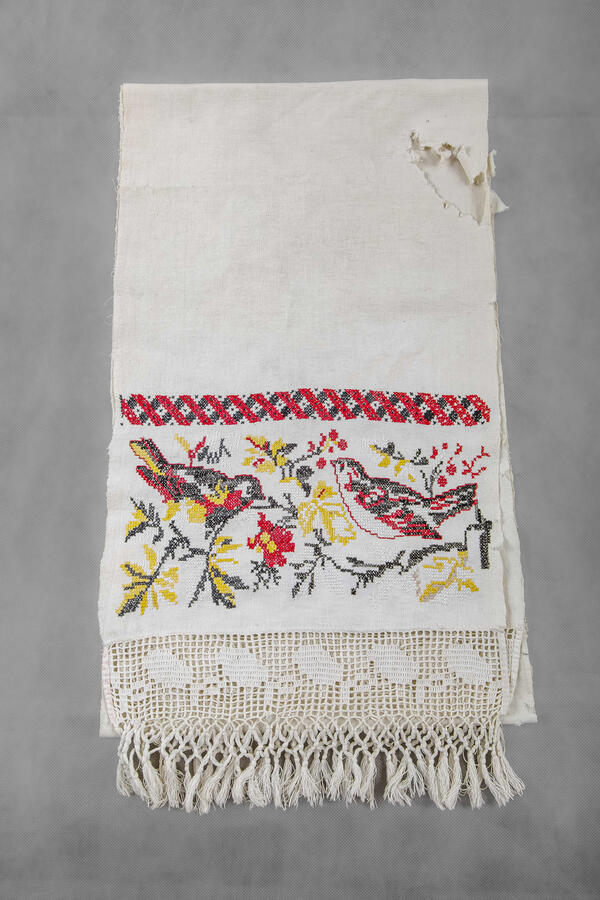
The rushnyk is an object with a deep symbolic meaning. It not only adorned the everyday life of people, but was also a reminder of the ties that connected people with their ancestors. Patterns of embroidered towels are an encrypted story about the life of people and nature.
There were a large number of varieties of towels, each of which carried its own meaning and had a clear purpose. It took one day to embroider ordinary items. Such towels were believed to have protective properties. They were created exclusively during the day, when the evil forces of darkness could not harm them. They were used in various rituals, for example, in the event of a drought or loss of livestock. They were never woven in advance, but only on the day when they were to be used in the ritual.
If we recall the well-known proverb “let the road be like a tablecloth”, which now has a negative meaning, it had been previously used to wish a happy journey. The saying was associated with special, road towels. They were small, with little embroidery, and were given to those who left their home and went on a journey: warriors, merchants, and travelers. The travel towel personified the wish for an easy journey and a speedy return.
A midwife wrapped a newborn in a maternity towel, and a baptismal towel was embroidered for christening. The child was carried to the church and wiped with this towel after immersion into water. After the christening, the child’s first shirt could be sewn from this towel, or it could be kept until the person’s wedding or even funeral. After death, towels accompanied people during their burial. These household items were also used to carry the coffin. In addition, they were hung on a tomb cross.
On Maslenitsa, in gratitude for the treat, the owners of the house were presented with a towel called “blinnik”. Easter towels were intended for baked Easter cakes, they were similar to welcome towels, but differed in ornament: they often featured the abbreviation ХВ (Christ is Risen) and egg symbols.
The towel, which framed the icons, was called “bozhnik”. There were about 40 wedding towels. However, only five types were considered the main ones: parental, union, “bozhnik”, wedding and welcome towels.
There were a large number of varieties of towels, each of which carried its own meaning and had a clear purpose. It took one day to embroider ordinary items. Such towels were believed to have protective properties. They were created exclusively during the day, when the evil forces of darkness could not harm them. They were used in various rituals, for example, in the event of a drought or loss of livestock. They were never woven in advance, but only on the day when they were to be used in the ritual.
If we recall the well-known proverb “let the road be like a tablecloth”, which now has a negative meaning, it had been previously used to wish a happy journey. The saying was associated with special, road towels. They were small, with little embroidery, and were given to those who left their home and went on a journey: warriors, merchants, and travelers. The travel towel personified the wish for an easy journey and a speedy return.
A midwife wrapped a newborn in a maternity towel, and a baptismal towel was embroidered for christening. The child was carried to the church and wiped with this towel after immersion into water. After the christening, the child’s first shirt could be sewn from this towel, or it could be kept until the person’s wedding or even funeral. After death, towels accompanied people during their burial. These household items were also used to carry the coffin. In addition, they were hung on a tomb cross.
On Maslenitsa, in gratitude for the treat, the owners of the house were presented with a towel called “blinnik”. Easter towels were intended for baked Easter cakes, they were similar to welcome towels, but differed in ornament: they often featured the abbreviation ХВ (Christ is Risen) and egg symbols.
The towel, which framed the icons, was called “bozhnik”. There were about 40 wedding towels. However, only five types were considered the main ones: parental, union, “bozhnik”, wedding and welcome towels.