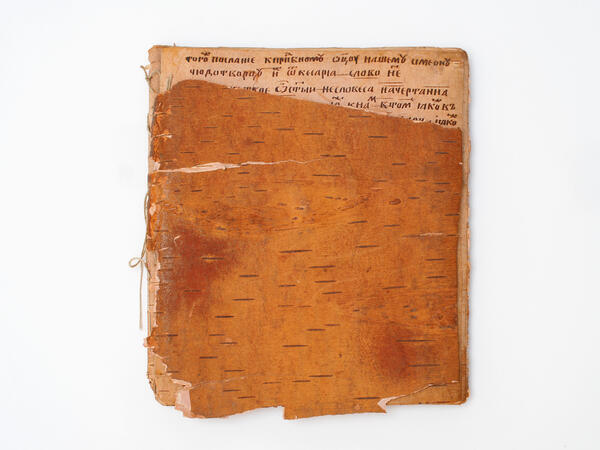
The museum exposition presents a rare exhibit — the handwritten text ‘The Epistle to our Venerable Father Simeon the Wonderworker.’ It is known that this manuscript was made in an Old Believer monastic community in the Tomsk district. It was created in the middle of the 20th century.
There are still some Old Believer monastic communities called ‘sketes’ in the rural territory of the closed administrative-territorial formation of Seversk. Anna Bobrova, who has a Ph.D. in history and works as a researcher of Tomsk Regional Museum of Local Lore, is a descendant of the Old Believers who used to live in the Tomsk region. She donated the manuscript to the museum. The text is written on thin layers of birch bark, which are bent in the shape of a book and stitched at the fold with thick threads. The cover was also made of birch bark.
To make such a book it was necessary to harvest birch bark in the spring, during the sap flow in the trees. The bark was stripped of the outer white layer. Then it was steamed in hot water and separated into some thin paper-like layers. The Old Believers used such ‘paper’ to rewrite texts taken from the old printed books ‘votively’. It means they did this work very hard and during a definite time. This kind of work was believed to be especially valuable in the eyes of God.
The manuscript consists of 62 pages. It contains the famous ‘Ascetic words’ written by Isaac Sirin, one of the Fathers of the Church, a Christ ascetic writer. He lived in Assyria and Syria in the second half of the 7th century and was the bishop of Nineveh (the capital of the Assyrian state).
One of the main themes of such epistles was the prayer contemplation of God. Many Holy Fathers also informed about the aims of ascetic deeds, about the limits of the spiritual path and its steps.
There are still some Old Believer monastic communities called ‘sketes’ in the rural territory of the closed administrative-territorial formation of Seversk. Anna Bobrova, who has a Ph.D. in history and works as a researcher of Tomsk Regional Museum of Local Lore, is a descendant of the Old Believers who used to live in the Tomsk region. She donated the manuscript to the museum. The text is written on thin layers of birch bark, which are bent in the shape of a book and stitched at the fold with thick threads. The cover was also made of birch bark.
To make such a book it was necessary to harvest birch bark in the spring, during the sap flow in the trees. The bark was stripped of the outer white layer. Then it was steamed in hot water and separated into some thin paper-like layers. The Old Believers used such ‘paper’ to rewrite texts taken from the old printed books ‘votively’. It means they did this work very hard and during a definite time. This kind of work was believed to be especially valuable in the eyes of God.
The manuscript consists of 62 pages. It contains the famous ‘Ascetic words’ written by Isaac Sirin, one of the Fathers of the Church, a Christ ascetic writer. He lived in Assyria and Syria in the second half of the 7th century and was the bishop of Nineveh (the capital of the Assyrian state).
One of the main themes of such epistles was the prayer contemplation of God. Many Holy Fathers also informed about the aims of ascetic deeds, about the limits of the spiritual path and its steps.