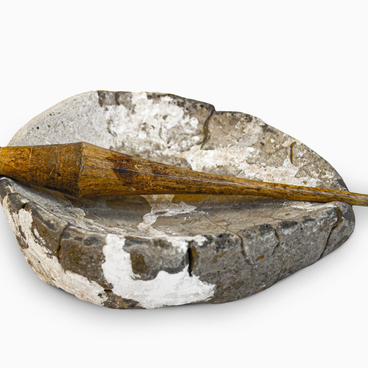
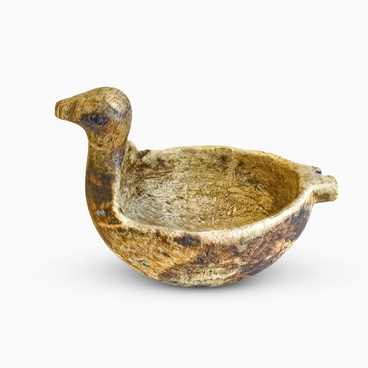
A hand wash is a vessel with water designed for washing face and hands. The collection includes a hand wash of the simplest form, also called a “ram”. As a rule, the shape of such water pots is rounded, with a wide neck, one or two spouts for pouring water. Eyes for hanging the pot were placed on the sides.
In the 19th century, the hand wash was made of various materials: clay, earthenware, or cast iron — as in this case. In earlier periods, water pots were chiseled out of wood.
Cast-iron hand washes were distributed at the Nizhny Novgorod Fair among the well-to-do population in the central Russian provinces, as well as in the Volga region and Siberia. Such items were especially often used by residents of cities and large villages.
In the dwelling space, a hand wash was usually placed near the stove (closer to the mouth), at the stove pole or at the entrance door. In the summer, it was hung by the porch. When the water pot was hung in the hut, then a wide wooden tub was necessarily placed under it — a water container made of wood or metal. Nearby, a svetets — a holder for a luchina — was placed. In it a luchina was put — a long wooden chip that was set on fire to illuminate the room. Embers from it fell into the water. A piece of cloth was hung near the water pot to wipe hands and face. The towels as we know them today started to be used only in the 20th century.
In historical sources, the Russian word meaning “hand wash” (rukomoynik) appears from the 16th century, in parallel with the word meaning “washbasin” (umivalnik). However, among the old-timers of Siberia, as a rule, the first variant was used more. To use such a water pot, it was necessary to tilt it by pressing on one of the spouts. It wasn’t very convenient. It is not surprising that when metal hand washes with a conical valve appeared in the everyday life of Siberians in the 20th century, in connection with the development of industry, classical “hand washers” were abandoned. Thus, these items are currently found only in the collections of local history museums.
This water pot was donated to the museum in 2019 by
N.N. Gulko, a resident of the Bolsherechye work settlement. The condition of
the item is good. The location and details of the discovery are unknown.