As you can guess, the word roubel’ originated from the word “to cut”. It appeared in Russia seven centuries ago and went out of use only in the second quarter of the XXth century. In divers places of the country this item was called differently: pral’nik, raskaka, roubchataya kachulka, rebrak, granchak, stick for mangling linen.


Roubel’ with the plant ornament
Creation period
The XIXth century
Dimensions
51x10x2,8 cm
Technique
wood, handicraft
0
Open in app#5
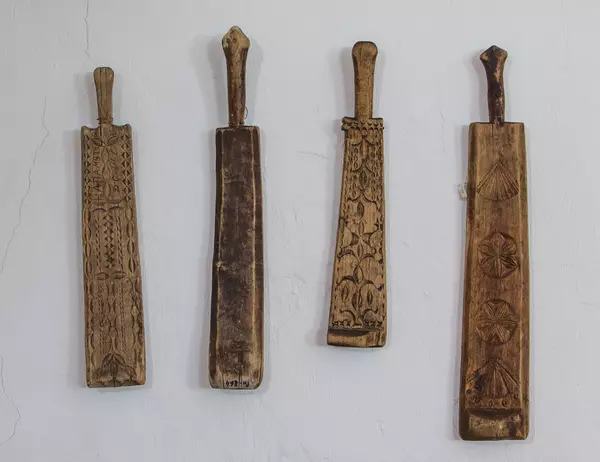
Roubel’ with the plant ornament
#1
#2
Washed and dried item (linen, clothes, a table-cloth, a towel) was folded in several thicknesses, then the item was wound tightly and neatly on the special mangle. If there were not a special mangle, an ordinary rolling-pin was used. As a result, a tight compact bundle without creases was made.
Remains of water were wrung out the linen. So, after sufficiently long mangling the linen became even, smooth as after steam treatment. The linen became so fresh and neat that minor defects from washing were imperceptible. Mangled linen became soft and snow-white.
#4
It was easy for any villager to make a roubel’. Ordinary tools which were in every household were used: a saw, an ax, a chisel, a file. As a rule, the material for work was hardwood: oak, maple, mountain ash, beech, birch.
Indeed, close-woven and coarse towels, bedsheets, table- cloths made of hemp and flax handmade fabric got rid of creases after washing in the process of mangling.
But it was rather difficult to iron clothes perfectly in that way. The result left much to be desired. As spinning machines improved textile goods were getting softer and it was easier to iron them.
Manufacture of more complicated cut of clothes led to the necessity to buy different household appliances for ironing- coal irons, then electric irons. But since many villagers could not afford to buy a cast-iron iron, a roubel’ remained the main ironing tool in the rural household for a long time.
read morehide
00:00
00:00
1x
Roubel’ with the plant ornament
Creation period
The XIXth century
Dimensions
51x10x2,8 cm
Technique
wood, handicraft
0
 Point your smartphone camera to open in the app
Open in app
Share