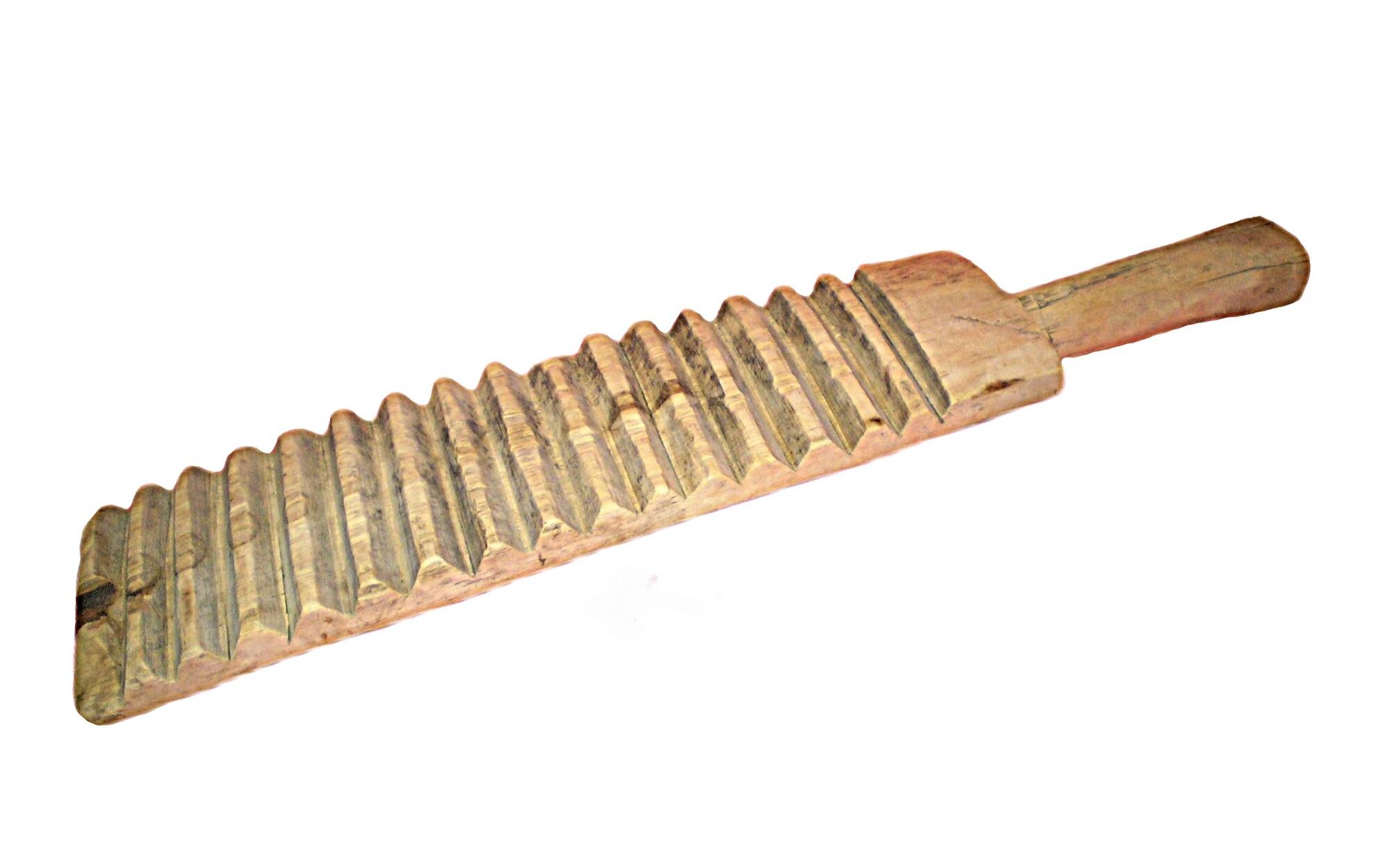


Rubel is a wooden ironing board of rectangular elongated shape with one or two handles at the ends. On the lower side, transverse rounded notches-notches were cut or cut down, and the upper, front side was decorated with carvings or ornaments.
In our exhibit, one side of the product is smooth, smoothly lined, curved. On the other side, the teeth are sawn -16 pcs. A semicircular handle, 12 cm long, is built from one end of the rubel.
To make a rubel for any villager was not a tricky thing. The tools used were the usual ones available in any household — a saw, an axe, a chisel and a file.
And the working material, as a rule, was hardwood — oak, maple, rowan, beech or birch. Sometimes the handle was made hollow and peas or other small objects were placed inside so that they rattled when rolling out and drove away evil spirits. Thus, an artfully made ironing tool served, among other things, as a talisman of the house and household.
The washed and dried thing (linen, clothes, tablecloth or towel) was folded in several layers and carefully tightly wound on a special roller roller. If there was no such roller in the household, the usual rolling pin for rolling out the dough was used. As a result, a tight, dense and crease-free bundle should have been formed.
The rubel was placed on top and from the edge of the table and rolled forward along the bundle with the strongest possible pressure. The ribbed surface of the rubel kneaded the stiff and coarse fabric and smoothed wrinkles. The remnants of water were squeezed out of the laundry, and after a sufficiently long ride it became smooth, smooth, as after steam treatment. The laundry acquired such a fresh and neat appearance that minor defects from washing (pellets, irregularities, small debris) were hidden. The linen rolled out in this way became soft and snow-white.