The birth of a genius
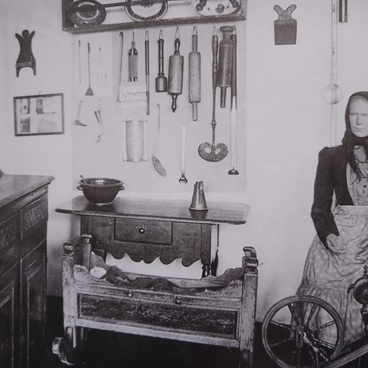
Alfred Garrievich Schnittke was born on 80, Krasnaya Street in the town of Engels on November 24, 1934. Leo Kassil’s father, the best doctor in Engels, helped Schnittke’s mother deliver Alfred.
In the composer’s memory, the town he left at the age of 12 always remained a one-storey town: “The town of Engels, near Saratov, where I lived, was small”
It is difficult to imagine that the town changed its shape significantly. According to Ilya Ehrenburg, the writer, elected a deputy of the Supreme Soviet of the RSFSR from Engels, there were no pavements to speak of in 1951. There were a few stone buildings; including two-storey ones, but mostly wooden houses prevailed in the landscape.
However, the locus, where the genius arose, undoubtedly affected his future view of the world. Anatoly Skripai, a famous pianist who was also born in Engels and went to the same school as Shnittke, drew parallels between Shnittke and Mark Chagall ‘Engels meant the same to Alfred Schittke as Vitebsk to Mark Chagall’. Alfred transformed from a child to a teenager soaking the impressions of the surrounding world. It was then that he gained the certain knowledge and sense of everyday lives of ‘the common Soviet citizens’.
It is easy to assume that the feeling, one way or another, would encourage the composer to turn in his work to the resources of everyday musical life with the corresponding specifics of “popular language” and triviality. It is likely that even then in his musical intuition the grains of the elements of the banal and mundane-sentimental Russian provincialism were ripening, always actual and especially resilient in the context, including the audio atmosphere that surrounded the future composer in his home town. Memories and impressions of the childhood spent on the Volga shores are clearly indicated in some of his music works.
Moving from Engels to Vienna (where his father was assigned as a translator and an employee of the newspaper published by Soviet occupation authorities) in his teens turned out to be not only a breakthrough to a fundamentally new reality in terms of musical impressions, but also in terms of something universally human and unattainable, to the spirit of the great historical tradition of the Austrian capital.
It was the breakthrough to the great German-speaking culture, which he drank with his mother’s milk. The memoirs of the composer from the early 1980s say how much those two years in Vienna meant to his subsequent developments.
All his life, Schnittke was pursued by the excruciating dilemma of ‘national identity’. Perhaps it was even a trilemma as his Russian German mentality was affected by being half Jewish. Solomon Volkov, a Russian journalist and musicologist, outlined the symbiosis of the Schnittke music: ‘Russian maximalism coexists with Jewish skepticism, deeply coloured by the German cultural tradition’. The composer himself attempted to resolve such a tangle of contradictions as follows: ‘I am not Russian, I am semi-German, semi-Jewish, but my Motherland is Russia’.
As fate would have it, Schnittke’s nature was woven from all sorts of entangling threads. Well, we will be grateful to fate for making him an incredibly inconsistent and synthetic person. Due to those circumstances, to a certain extent, Schnittke was able to say his weighty word in the world music of the end of the XX century.