Font
Color
Graphics
Изображение точки

To see AR mode in action:

1. Install ARTEFACT app for iOS or Android;

2. Find the exhibition «A Composer Ahead of His Time»

3. Push the «Augmented reality» button and point your phone's camera at the exhibit;

Скрыть точки интересаПоказать точки интереса
Показать в высоком качестве

Grand piano, Sonata

0
Open in app
#1
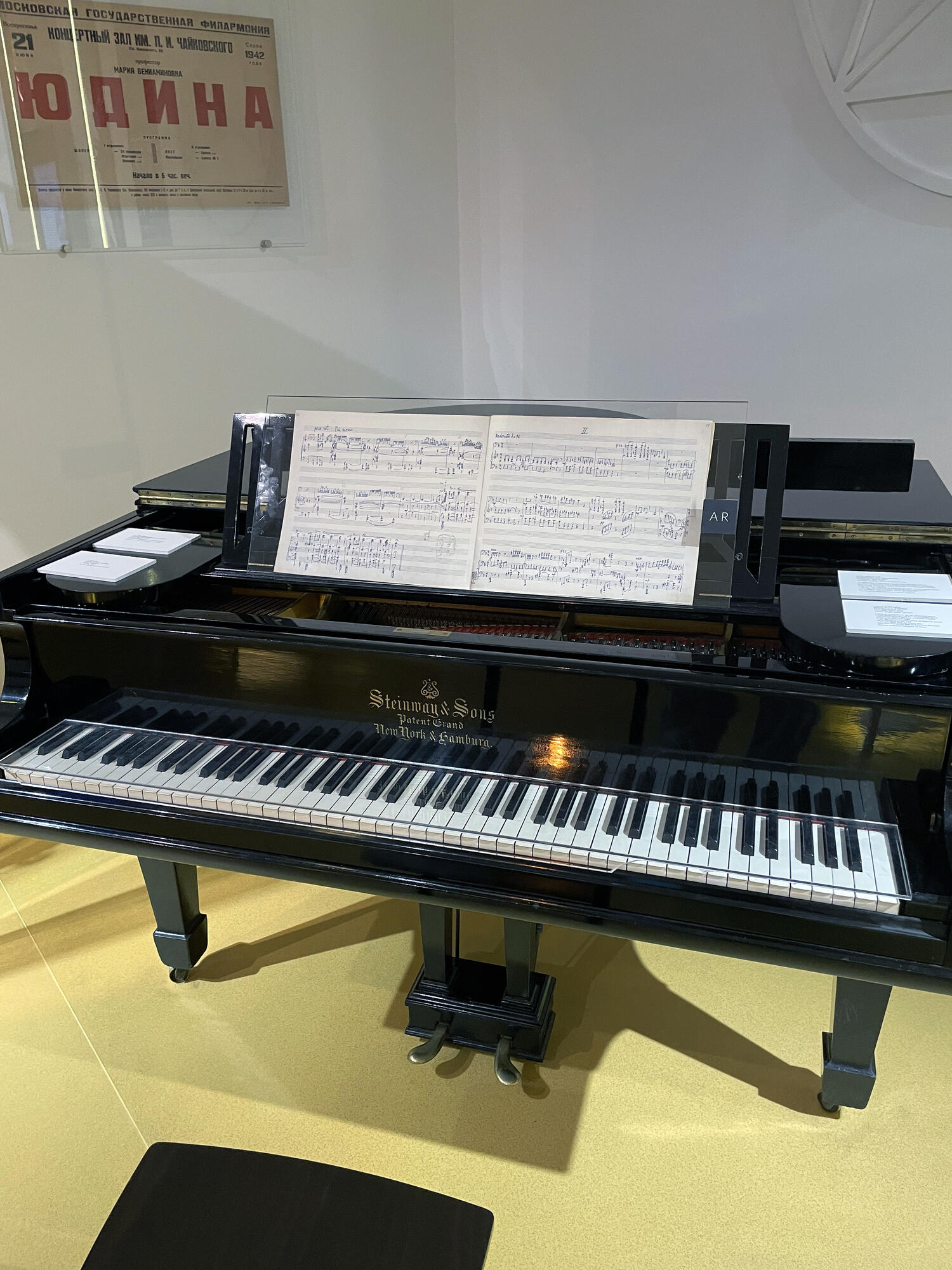
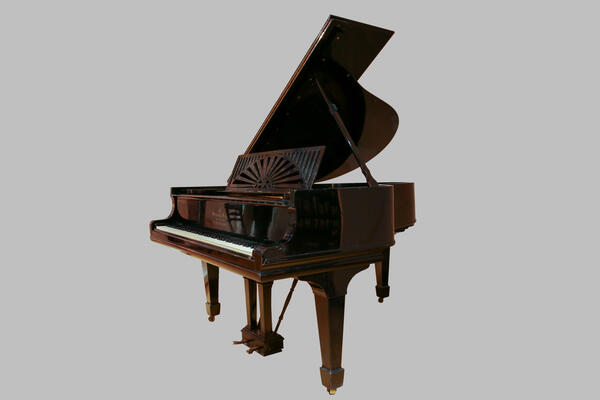
Grand piano
#4
Sergei Prokofiev was not only a great composer but also a virtuoso pianist who gave concerts in the Soviet Union and abroad. His repertoire included pieces by Franz Liszt, Ludwig van Beethoven, Frédéric Chopin, Robert Schumann, Johannes Brahms, and other composers.

Newspaper reviews of Prokofiev’s concerts were published under such titles as “A Titan Pianist”, “A Piano Cubist and Futurist”, “The Russian Chaos in Music”, “A Volcanic Eruption Behind a Keyboard”, “A Carnival of Cacophony”, and “A Mammoth Attack on the Asian Plateau”. His lively playing was often compared to the poems by Vladimir Mayakovsky.
#5
Only Prokofiev’s music excites me now. No sooner do the first sounds ring out than life bursts in… a rushing mountain stream, such torrent that you feel like jumping under it and shouting, ‘Oh, how wonderful! More, more! ’
Vladimir Mayakovsky
#6
Prokofiev was at his best when performing his own compositions. “The best performance of Prokofiev’s music, or of any other good music for that matter, is one in which the personality of the performer does not obtrude in any way. That is precisely what one could say of Prokofiev’s playing, ” said the violinist David Oistrakh. The Soviet writer Vladimir Lyovshin described his impressions of seeing the composer on stage, “Having given a somewhat sideward bow, Sergei Sergeyevich sat down and spend a lot of time getting settled in front of the piano. He moved the chair back and forth. He adjusted the tails of his coat. Then he inspected the piano keys carefully as if checking whether all of them were in place and started rubbing his hands as if he was washing them carefully. Finally, he looked somewhere above — maybe at Schubert or Mozart — and gave a slight nod as if saying hello to them. On stage, he behaved in his own unique manner: he did not sway, close his eyes, or shake his head as most musicians. Instead, throughout his playing, he stayed perfectly impassive on the outside. The audience, on the contrary, was completely electrified and broke into tumultuous applause over and over again! How did he achieve that? That was a mystery, the artist’s professional secret. He seemed to be saying, ‘Everything is quite simple. You can see the piano, its strings, keys, and pedals. What I do with them to touch your hearts is no business of yours! ’”
#3
Name: Grand piano
Author: Sergei Prokofiev
№: 4734874
Date of creation: 1907–1908
Place of creation: Hamburg, Germany
Dimensions: 180×145 cm
#2
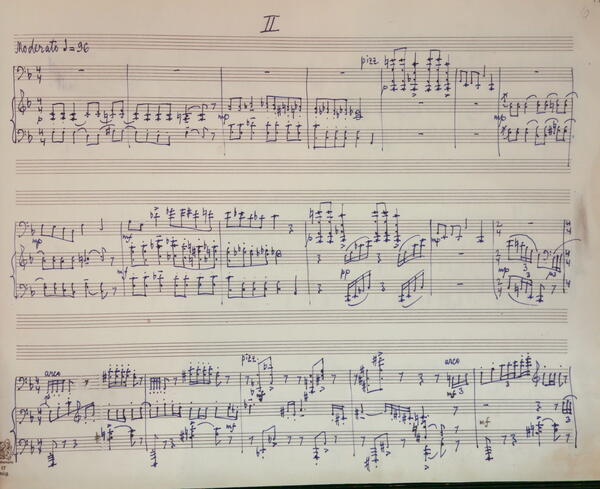
Sonata for Cello and Piano
#8
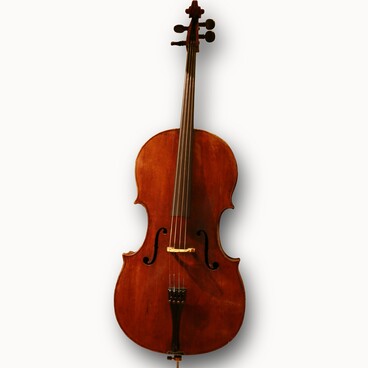
The sketches for the Cello Sonata emerged after Prokofiev heard the young cellist Mstislav Rostropovich playing for the first time. It was 1947, and Rostropovich performed the Cello Sonata by Nikolai Myaskovsky. Apparently, Prokofiev was so inspired by this performance that he conceived the idea of writing a cello composition specifically for Rostropovich.

The Sonata for Cello and Piano in three movements was completed in 1949. The premiere was performed the following year by Mstislav Rostropovich, with Sviatoslav Richter at the piano. Before the premiere, Prokofiev invited the young cellist for a dress rehearsal. Rostropovich recalled many amusing stories about that time.
#9
We started playing and I sometimes stopped to tell Prokofiev that he was playing false notes. Five or six times he took it fine, but the next time he stopped me and said: Slava, did I compose this piece or did you? I play exactly what I wanted to play, even if there are false notes!
Mstislav Rostropovich
#10
The Cello Sonata was the beginning of a friendship between the two musicians. After the successful premiere, Prokofiev composed another work for Rostropovich — the Symphony-Concerto.

“Some time after the performance of the Cello Sonata (on March 1, 1950), Prokofiev decided to start working on the Symphony-Concerto. He always strived to make his music interesting from the point of view of all instruments and tried to make the best use of their technical and expressive possibilities. Sergei Sergeyevich asked me to bring him some repertoire pieces for cello ‘of any quality’ which would serve as examples of interesting virtuoso passagework and contain a range of diverse and modern cello techniques. I duly took along a pile of works by Popper, Davydov, and other similar cellists. For some time, Sergei Sergeyevich studied the technical aspects of cello in these compositions, and each time we met, he remarked sardonically, ‘Well, that’s quite some music you gave me, isn’t it…’”

The Concerto was premiered on February 18, 1952 and was marked by unique cooperation: Mstislav Rostropovich was soloing, and Sviatoslav Richter conducted his first and only concert.
#7
Name: Sonata for Cello and Piano
№: 4734874
Date of creation: 1950
Technique: autograph; paper, cardboard, faux leather, writing ink, pencil
Dimensions: 34,5×27,2 cm
#11
read morehide
00:00
00:00
1x

Grand piano, Sonata

0
Point your smartphone camera to open in the app
Share
VkontakteOdnoklassnikiTelegram
Share on my website
Copy linkCopied
Copy
Open in app
To see AR mode in action:
  1. Install ARTEFACT app for 
  2. iOS or Android;
  3. Find and download the «Paintings in Details» exhibition
  4. Push the «Augmented reality» button and point your phone's camera at the painting;
  5. Watch what happens on your phone screen whilst you flip through the pictures.
 
We use Cookies
Cookies on the Artefact Website. We use cookies to ensure that we give you the best experience on our website. If you continue without changing your settings, we'll assume that you are happy to receive all cookies on the Artefact website. However, if you would like to, you can change your cookie settings at any time.
Learn more about useHide
Content is available only in Russian

X

Нашли опечатку?...

%title%%type%