Font
Color
Graphics
Изображение точки

To see AR mode in action:

1. Install ARTEFACT app for iOS or Android;

2. Find the exhibition «History and Culture of the Jews in Russia»

3. Push the «Augmented reality» button and point your phone's camera at the exhibit;

Скрыть точки интересаПоказать точки интереса
Показать в высоком качестве
#2
Torah mantle
#3
The Torah is the core of Judaism, the Hebrew Scriptures. The word “Torah” in Hebrew comes from the verb “leorot”, which means “to instruct”. According to tradition, God gave the Torah to the Jewish people on Mount Sinai more than a thousand years before Christ. For forty days Moses recorded God’s commandments, and for promising to follow them, the people of Israel were granted a blessing.

The text of the Torah on parchment, the Scroll, is intended to be read in the synagogue. As one of the main sacred objects in Judaism, the Torah Scroll is surrounded by ritualistic decorations that emphasize its importance. It is kept in a special cabinet behind an embroidered velvet curtain. It is forbidden to touch it with hands; there is a special silver pointer for this purpose. The scroll itself is tied with an embroidered ribbon and with a cover.

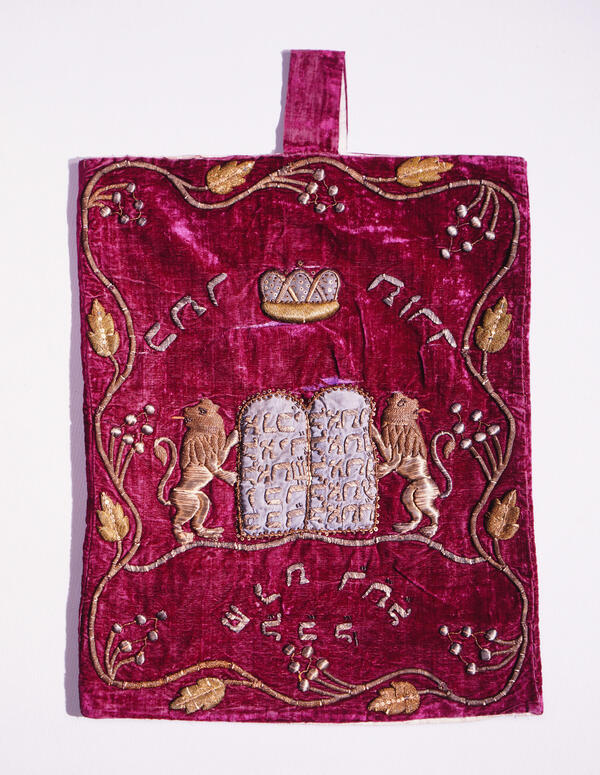
In the Jewish communities of Central and Eastern Europe, the cover of the Scroll was called a mantel or Torah mantle, from the German word mantel, “garment, coat”. The cover for the Torah Scroll is usually decorated with the traditional symbols of Judaism: tablets, crowns, lions, the “tree of life”, and floral patterns.

Embroidery has always been the main decorative element of synagogue textiles. Its style and design were influenced by artistic borrowings from the traditions of different peoples among whom Jews lived. So, the Torah mantle from the collection of the Russian Museum of Ethnography has a vine embroidered along its perimeter, which is a decorative element of the Greco-Roman period of Jewish art.

The scroll was made in the late 19th century in Mogilev, and the vine pattern repeats the winding line of “hops”. This decorative border element was widespread in the folk art of the Eastern Slavs, it was used in the embroidery of rustic towels, tablecloths, and shirts. The same influence on the embroidery of the parokhet inspired the motif of a “vase with a flower” which symbolized the “tree of life” in the peasant art of the East Slavs. On the parokhet, the image of the “vase with a flower” is located above the tablets that represent the Torah. In religious practice, the scroll is wound around two handles, the “tree of life”. The commandments are held and guarded by two lions, symbols of power, strength, and victory.
#4
Наименование: Torah mantle
Дата создания: 1870
Место создания: Mogilev
Техника: velvet, linen, silk and silver embroidery
Размеры: 49×40 cm
#5
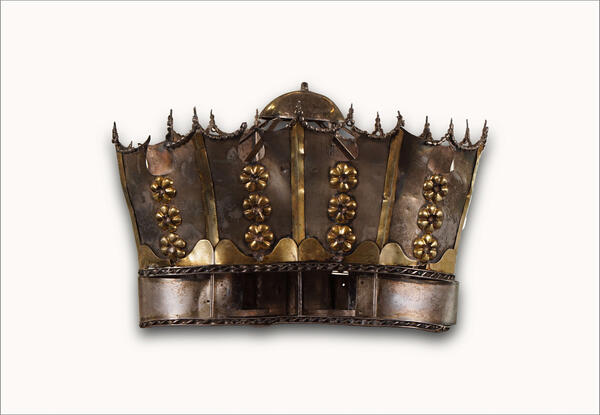
Torah Crown — the finial for the Torah scroll
#6
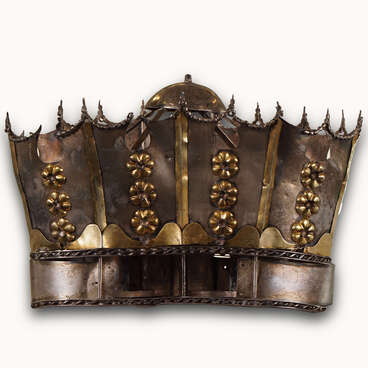
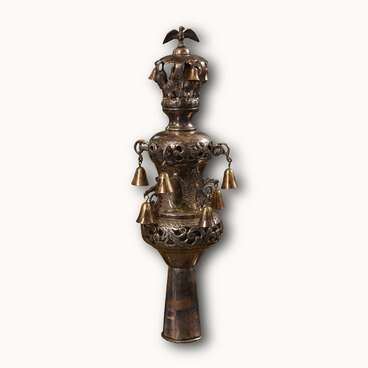
A Keter (Torah crown) is an ornament in the form of a crown that covers the Torah Scroll, the parchment on which Ten Сommandments are inscribed. The bells on the crown, either gilded or silver-plated, mark the sacred act of removing the Torah Scroll from the sacred ark in the synagogue. It is a display of sacramentality of the Torah and respect for it as the most important relic of Judaism. It is traditionally kept behind a special embroidered curtain, in an ornate case, and is only touched with a silver or ivory pointer. According to tradition, God spelled out the contents of the Torah Scrolls to Moses the Prophet over 3,000 years ago, and this was the beginning of the national identity of the people of Israel.

The custom of decorating the Torah Scroll with a crown was known since the early Middle Ages, but became widespread in the 17th century. The shape of the crown became one of the popular symbols of Judaism, but it was not strictly canonized. Craftsmen and artisans had a free choice of decorative patterns and jewelry techniques. Most often the crown was decorated with floral designs and traditional sacred symbols: eagles, lions, unicorns, pomegranates, grapes.

Torah crowns could have been copies of the original royal crowns of the European rulers. In Central and Eastern Europe a crown in the form of a hoop with bands attached to it was widely known. They were curved in the form of volutes and connected at the top point under the tier of the crown or the figure of a sacred symbol. Congregants or communities presented Torah crowns as gifts to the synagogue, they raised money for them and commissioned them from the finest jewelers. The crowns were engraved with the names of the donors, wishes, blessings, names of communities, and dates.

The multi-tiered crowns were often engraved with the text from the The Mishnaic tractate “Avot”: “Crown of Torah, Crown of Priesthood, Crown of Kingship”. This proclaimed the idea of the three Jewish crowns with which the Children of Israel were crowned. The crown of priesthood was given to Aaron: “And he shall have it, and his seed after him, even the covenant of an everlasting priesthood.” The crown of kingship was given to David: “His seed shall endure for ever, and his throne as the sun before me”. And the crown of Torah was destined for the entire Jewish people as a common and free heritage: “Moses commanded us a law, even the inheritance of the congregation of Jacob.” Only one of the three crowns has survived in the new era — the Keter Torah, which is worn on the sacred scroll on holidays.
#7
Наименование: Torah Crown — the finial for the Torah scroll
Дата создания: the 19th century
Место создания: the Austro-Hungarian Empire
Техника: silver, embossing, forging, gilding
Размеры: 15.5×20 cm
#8
Torah scroll case
#9
The Torah scroll is one of the main sacred objects in Judaism. It is a parchment with the text of the Pentateuch of Moses, the commandments that the Prophet received from God on Mount Sinai after the Exodus of the Jews from Egypt. There are many traditions and rituals surrounding the Torah Scroll.

The Torah scroll was always the centerpiece of the synagogue. It was kept in a special wooden cabinet behind an embroidered velvet curtain. It was forbidden to touch the Scroll of the Torah with bare hands, so a silver pointer with the figure of an index finger was used for reading, and the parchment itself was kept in a special case.

“He is my God, and I will exalt Him” — this quote from the Bible was interpreted by the Jews as the need to make all religious ceremonial objects beautiful, worthy of God’s glory. The cases for the Torah Scrolls have always been works of Jewish applied art and reflected people’s understanding of aesthetics.

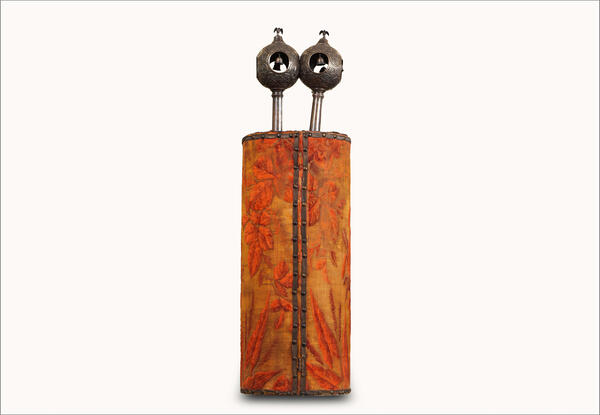
Kokand, which is situated on the territory of present-day Uzbekistan, is one of the oldest cities in Central Asia, where the community of Bukharian Jews prospered for several centuries. The hard case for the Torah made in this city is unique. It has a cylindrical wooden frame traditional for oriental communities. The case is upholstered on the outside with luxurious fabric, fabulous velveteen, decorated with large red flowers on the golden background.

Vegetal patterns are a favorite decorative motif for decorating the Torah cases in eastern communities. Bright flowers, large leaves, grape bunches, and the pomegranate, which often features on the silver knobs of the handles.

The inside of the case is upholstered in dark red sateen, which protected the scroll from mechanical damage and moisture. The cloth was fastened to the frame with thin metal plates and elegant flat-topped nails. The fabrics were of European manufacture, which indicates the close trade ties of the Central Asian Jewish community with the major textile centers of Europe.

The case opens into two halves. In the upper and lower lids on the ends of the cylinder there are holes, into which the staves are inserted, on which the parchment scroll is wound.
#10
Наименование: Torah scroll case
Дата создания: the 18th — 19th centuries
Место создания: Kokand, Central Asia
Техника: wood, fabric, metal, bending, weaving, drawing, trimming
Размеры: 54×24 cm
#11
read morehide
00:00
00:00
1x

Religious attributes

0
Point your smartphone camera to open in the app
Share
VkontakteOdnoklassnikiTelegram
Share on my website
Copy linkCopied
Copy
Open in app
To see AR mode in action:
  1. Install ARTEFACT app for 
  2. iOS or Android;
  3. Find and download the «Paintings in Details» exhibition
  4. Push the «Augmented reality» button and point your phone's camera at the painting;
  5. Watch what happens on your phone screen whilst you flip through the pictures.
 
We use Cookies
Cookies on the Artefact Website. We use cookies to ensure that we give you the best experience on our website. If you continue without changing your settings, we'll assume that you are happy to receive all cookies on the Artefact website. However, if you would like to, you can change your cookie settings at any time.
Learn more about useHide
Content is available only in Russian

X

Нашли опечатку?...

%title%%type%