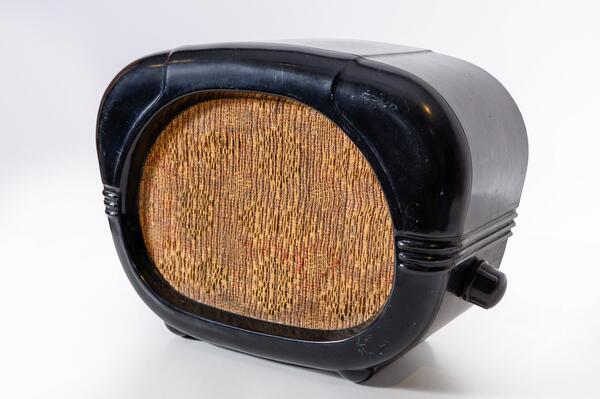
The radio receiver “Oktava” refers to the type of subscriber devices for wired broadcasting: in everyday life, they were usually called radio streams, subscriber loudspeakers or reproducers. In order to plug it indoors, it was necessary to install a special subscriber outlet. Such devices could be individual or for mass use. The first type was installed in private houses and apartments, most often in kitchens. The second worked in various state institutions — hotels, hospitals, dormitories.
The home receivers could be tuned to either one or three channels. In the first case, they received only the All-Union Radio, which transmitted news and socio-political programs. In the second case, users could switch to a musical or educational channel. The mass use devices were only three-channel.
The first wired radio receivers appeared in the USSR in the 1920s. During the Great Patriotic War, the loudspeakers were used to issue an air alert.
The “Oktava” receiver was manufactured in 1953 at the Novosibirsk Low Voltage Equipment Plant. It belonged to single-channel receivers of the third-class —inexpensive devices that were available to the general public, although their transmission was not as clear as in the first and second-class models. The classification of radio devices was based on the All-Union state standard, which took into account the range of received waves, sound quality, sensitivity to the radio signal, and other parameters.
The “Oktava” radio receiver was compact and weighed only about a kilogram, which allowed to install it anywhere in the apartment. The speaker’s case was made of carbolite — this is what bakelite, a kind of plastic that was durable and resistant to mechanical influences, was called in the Soviet Union. The cases of telephone sets, table lamps, knife handles, and other objects were made of carbolite. At the Konigsberg manufactory, it was even used as an inexpensive analog of natural amber.
The Novosibirsk Low Voltage Equipment Plant produced the “Oktava” devices from 1953 to 1962. Later, they were replaced by improved models — “Atmosfera”, “Sport”, “Yunost”.
The home receivers could be tuned to either one or three channels. In the first case, they received only the All-Union Radio, which transmitted news and socio-political programs. In the second case, users could switch to a musical or educational channel. The mass use devices were only three-channel.
The first wired radio receivers appeared in the USSR in the 1920s. During the Great Patriotic War, the loudspeakers were used to issue an air alert.
The “Oktava” receiver was manufactured in 1953 at the Novosibirsk Low Voltage Equipment Plant. It belonged to single-channel receivers of the third-class —inexpensive devices that were available to the general public, although their transmission was not as clear as in the first and second-class models. The classification of radio devices was based on the All-Union state standard, which took into account the range of received waves, sound quality, sensitivity to the radio signal, and other parameters.
The “Oktava” radio receiver was compact and weighed only about a kilogram, which allowed to install it anywhere in the apartment. The speaker’s case was made of carbolite — this is what bakelite, a kind of plastic that was durable and resistant to mechanical influences, was called in the Soviet Union. The cases of telephone sets, table lamps, knife handles, and other objects were made of carbolite. At the Konigsberg manufactory, it was even used as an inexpensive analog of natural amber.
The Novosibirsk Low Voltage Equipment Plant produced the “Oktava” devices from 1953 to 1962. Later, they were replaced by improved models — “Atmosfera”, “Sport”, “Yunost”.