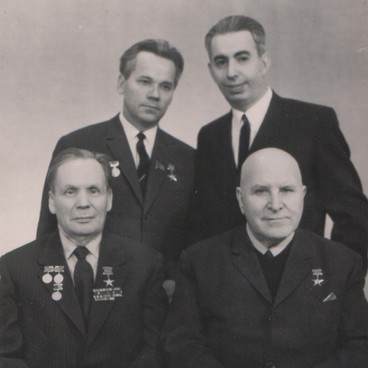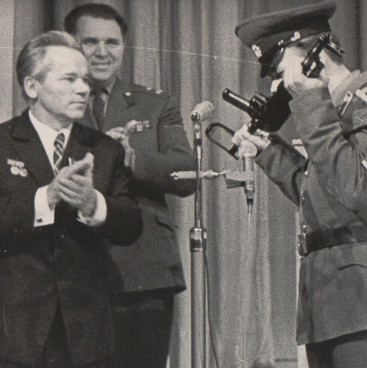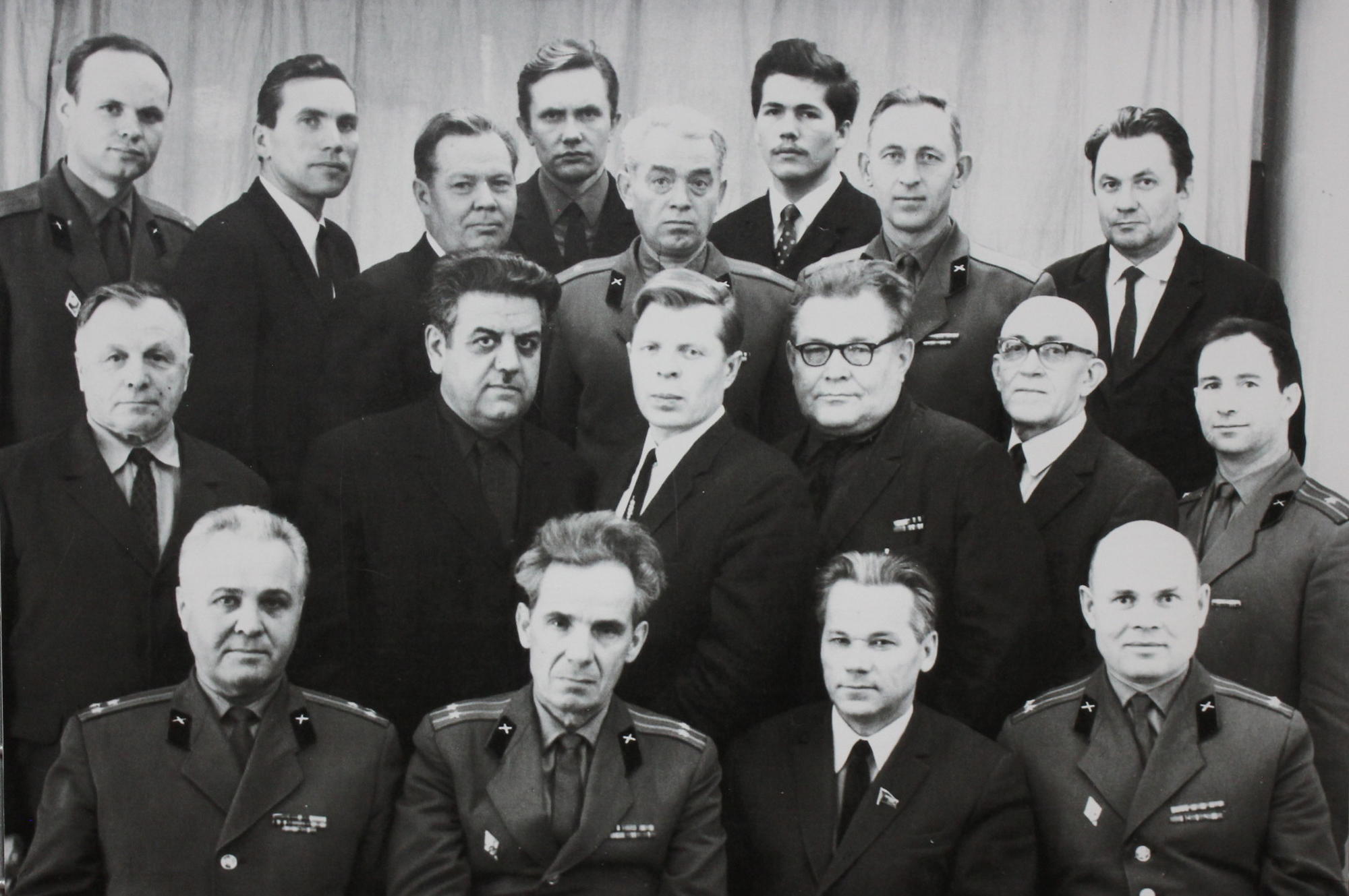


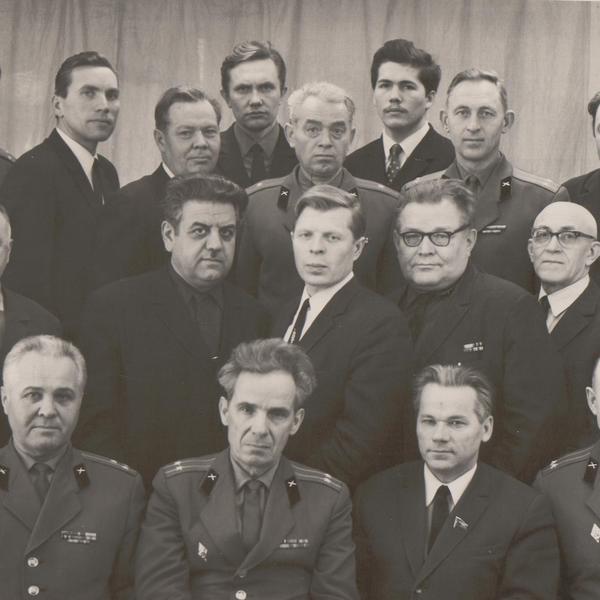
Pictured (from left to right): the first row — Stepan Yakovlevich Sukhitskiy, Alexander Andreevich Malimon, Mikhail Timofeevich Kalashnikov, Nikolai Nikolaevich Shklyaev; second row — S.N. Furman, Ivan Efimovich Semenovykh, Evgeniy Fedorovich Dragunov, N. N. Kolpikov.
There were special requirements to products designed for the defence complex of the USSR. This area was financed on a first-priority basis, so there were high expectations from the point of view of achievements. Control over all the production cycles was organized on working places, and the quality of the final product was checked at the stage of military acceptance. It was needed as the majority of defence complex enterprises produced dual-use items, i.e. both for the military as well as for civilians. The same Izhmash Plant was famous for its motorcycles, and only few ordinary citizens could guess that the enterprise produced assault rifles and machine guns too.
Normally, the same equipment was used for different types of products. And there were the same people in production. For instance, designer Vitaliy Nikolayevich Pushin, who was responsible for design documentation, was not only successful in modernizing the Kalashnikov assault rifle, but also created several models of the legendary ‘Iz’ motorcycle. This is why for the Ministry of Defence it was important that the production cycles operate without failures, and the military acceptance was the final stage of measures to provide for the impeccable quality of products for the defence complex.
Izhmash is one of the oldest Russian plants producing weapons. The first rifle was produced there back in 1807, and on the eve of World War I, the enterprise launched serial production of the legendary Mosin rifle. The volume of its production made up 2200 pieces a day, which was an absolute record for Russia.
After the revolution, the enterprise was nationalized, but kept its activity profile, i.e. the plant still was producing weapons. The first trial prototype of the Kalashnikov assault rifle was produced there, at the plant. During the Great Patriotic War the enterprise manufactured several dozens of firearm types, including machine guns. The daily volume of production composed over 10 000 pieces. By the end of the war, when its outcome was obvious, the volumes of production for the defence complex reduced abruptly, and already in 1945 the portfolio of the enterprise included shotguns for hunting, for which the plant was so famous before the revolution.
As the years went by, new production lines were created at Izhmash. The enterprise manufactured vehicles and motorcycles, machines and equipment for various industries. At the same time the firearms producing facility, a part of the production group, was not idle. There they created new weapon systems on the basis of Mikhail Kalashnikovʼs inventions. His name, though, was not made public until 1989, and the museum of the enterprise did not have a single photograph of the man, to whom the whole word owed the appearance of the assault rifle, which was unique from the point of view of its technical characteristics.
Now, Izhmash continues to produce weapons, and its catalogues have dozens of models of sporting and hunting rifles, constructed on the AK basis, which are supplied for more than 60 countries in the World.
There were special requirements to products designed for the defence complex of the USSR. This area was financed on a first-priority basis, so there were high expectations from the point of view of achievements. Control over all the production cycles was organized on working places, and the quality of the final product was checked at the stage of military acceptance. It was needed as the majority of defence complex enterprises produced dual-use items, i.e. both for the military as well as for civilians. The same Izhmash Plant was famous for its motorcycles, and only few ordinary citizens could guess that the enterprise produced assault rifles and machine guns too.
Normally, the same equipment was used for different types of products. And there were the same people in production. For instance, designer Vitaliy Nikolayevich Pushin, who was responsible for design documentation, was not only successful in modernizing the Kalashnikov assault rifle, but also created several models of the legendary ‘Iz’ motorcycle. This is why for the Ministry of Defence it was important that the production cycles operate without failures, and the military acceptance was the final stage of measures to provide for the impeccable quality of products for the defence complex.
Izhmash is one of the oldest Russian plants producing weapons. The first rifle was produced there back in 1807, and on the eve of World War I, the enterprise launched serial production of the legendary Mosin rifle. The volume of its production made up 2200 pieces a day, which was an absolute record for Russia.
After the revolution, the enterprise was nationalized, but kept its activity profile, i.e. the plant still was producing weapons. The first trial prototype of the Kalashnikov assault rifle was produced there, at the plant. During the Great Patriotic War the enterprise manufactured several dozens of firearm types, including machine guns. The daily volume of production composed over 10 000 pieces. By the end of the war, when its outcome was obvious, the volumes of production for the defence complex reduced abruptly, and already in 1945 the portfolio of the enterprise included shotguns for hunting, for which the plant was so famous before the revolution.
As the years went by, new production lines were created at Izhmash. The enterprise manufactured vehicles and motorcycles, machines and equipment for various industries. At the same time the firearms producing facility, a part of the production group, was not idle. There they created new weapon systems on the basis of Mikhail Kalashnikovʼs inventions. His name, though, was not made public until 1989, and the museum of the enterprise did not have a single photograph of the man, to whom the whole word owed the appearance of the assault rifle, which was unique from the point of view of its technical characteristics.
Now, Izhmash continues to produce weapons, and its catalogues have dozens of models of sporting and hunting rifles, constructed on the AK basis, which are supplied for more than 60 countries in the World.