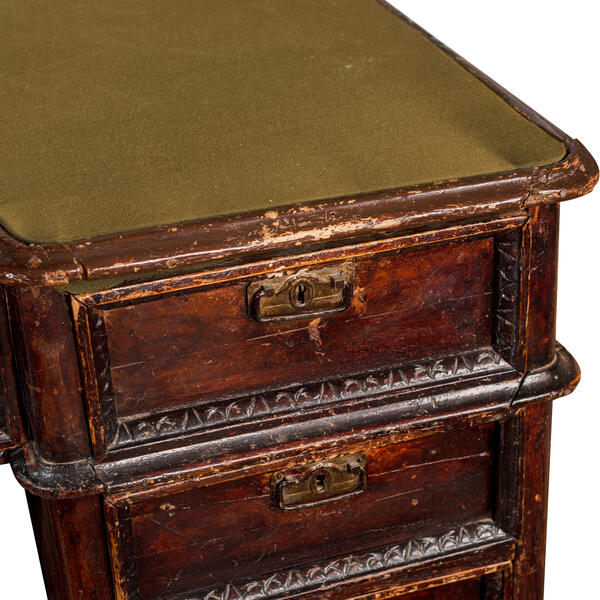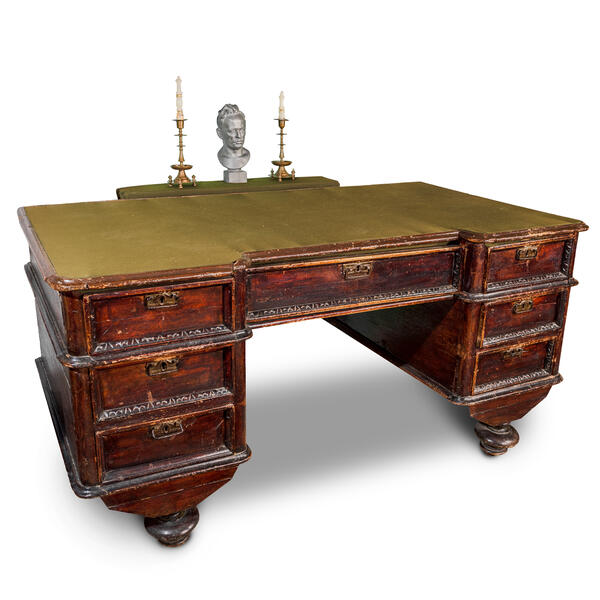
The exhibition features a desk with two drawer units on four carved legs. The tabletop is lined with green cloth. Each unit has three drawers, and the desk also includes one pull-out drawer in the middle. A stylized carved pattern runs along the edges of the tabletop and drawers.
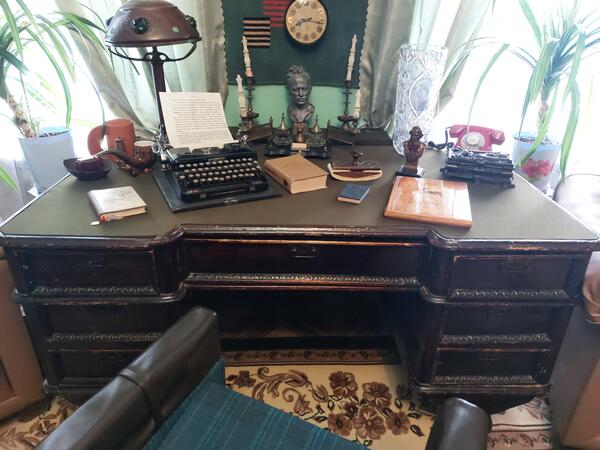
The desk that belonged to the writer Vitaly Zakrutkin holds many items that were dear to him: a captured German typewriter from Berlin, which he used during the war, along with books, manuscripts, and souvenirs. Among these souvenirs is a small mining torch, which was indispensable at various moments in his life. Vitaly Zakrutkin often said, “Being like a flashlight brings happiness and joy; it is an opportunity to overcome the darkness.“
This desk was the place where the writer brought his ideas to life and kept his favorite books, the latest magazines, letters and postcards.
Vitaly Zakrutkin purchased this item at the Rostov-on-Don editorial office of the newspaper “Boyets RKKA” (The Red Army Fighter) in late 1945. After the war, some editorial offices underwent renovations: new furniture was brought in, and the old furniture was sold at reduced prices. During this time, Zakrutkin visited his fellow friends and spotted the desk he had used while working at the newspaper. He often recalled that period as both tragic and heroic. Unable to resist, the writer took the desk home.
Later, Zakrutkin moved it to Kochetovskaya, to a new country house with a spacious, bright office featuring high ceilings and large windows. The desk was heavy and bulky, making it difficult to transport. However, its owner was pleased with the large tabletop and numerous drawers, which provided ample storage for a variety of items.
It was at this table that Zakrutkin wrote the novels “Floating Stanitsa” and “Creation of the World”, as well as the stories “The Milky Way” and “Mother of the Human”, along with other works. “Floating Stanitsa”, published in 1950, is dedicated to the work of collective farm fishermen and emphasizes the need to preserve the fish stocks of Russian rivers. For this work, the author received the Stalin Prize 3rd Degree.
Vitaly Aleksandrovich Zakrutkin’s desk takes pride of place in his memorial House-Museum.