


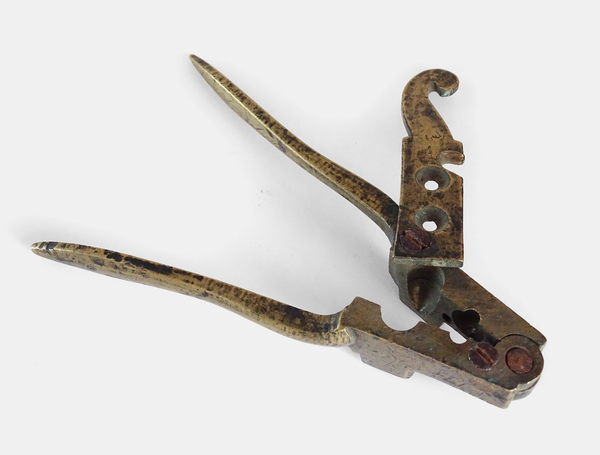
The use of bullet molds began in the early 15th century with the introduction of hand-held firearms. A bullet mold is a rather simple tool comprising two halves of a casting mold and special tongs to hold the mold. Over time, bullet molds were improved and became more convenient for casting bullets of different calibers.
The variety of the found lead bullets was determined not so much by their purpose as by the process of their manufacture, storage and subsequent use.
The first stage of production is the actual casting of the bullet. The lead mass, poured into molds, after cooling down takes the form of a smooth, round bullet with a geat and a seam. In addition to round bullets with geat, there were also bullets with two types of defects. It was either deformation of the bullet during casting, connected with displacement of the bullet mold halves, or simply a lack of lead.
Thus, at the very first stage of production, the bullet could be of three types: a normal deformed bullet with a geat and a rounded bullet with a cavity hollow or shrinkage hole due to lead shortage. Both normal and defective bullets could be used for shooting after the first stage of manufacturing without further processing.
The second stage of production involved trimming the geat to give the bullet a round shape. Trimming was carried out on normal rounded bullets. Depending on the quality of the bullet processing and the use of various tools for this operation, not only the geat, but also up to half of the bullet could be cut or chopped off. Such carelessness and irregularity are quite typical for bullets dated to the second half of the 16th century.
As a rule, fired bullets were flat with or without a clearly traceable thin casting seam. Bullets that had undergone the full cycle of manufacture, except for those defective bullets with a neatly cut off geat, had several frequently occurring variants with squeezing and filing marks. Squeezing marks were round flat not symmetrically arranged indentations on the bullet body. Sometimes such circles overlapped the casting seam, and some squeezing marks in the form of circles overlapped each other. From a functional point of view, the appearance of squeezing marks on bullets is difficult to explain. It is possible that the squeezing, which was done with a special tool, was an attempt to eliminate the cavity hollows formed on the bullet surface during casting.
Bullet molds should always be kept absolutely clean and well lubricated. They should not be dropped on the floor and should not be cleaned with a brick or an emery, but only wiped with a soft cloth. With careful production, it was possible to achieve uniformity of the cast bullets (although calibration was still very preferable). For this purpose, the lead must be of better quality.
When casting bullets, the metal should not be heated to red hot, but still, it should remain hot and liquid enough so that it does not solidify instantly in the bullet mold and remains liquid in the geat for a few seconds.
If the metal was not hot enough, the bullets came out with air holes and wrinkles, and if the metal was too hot, the surface of the bullets turned out matt or with patterns, as on frozen windows. Ordinary writing paper is a good indicator of the temperature of lead. If the metal is too cold, the paper only turns yellow but not charred, but if it is too hot, it smolders and even ignites.
To prevent the hot metal in the melting pot from oxidizing and spoiling during smelting, pieces of wax or lard were thrown in.


