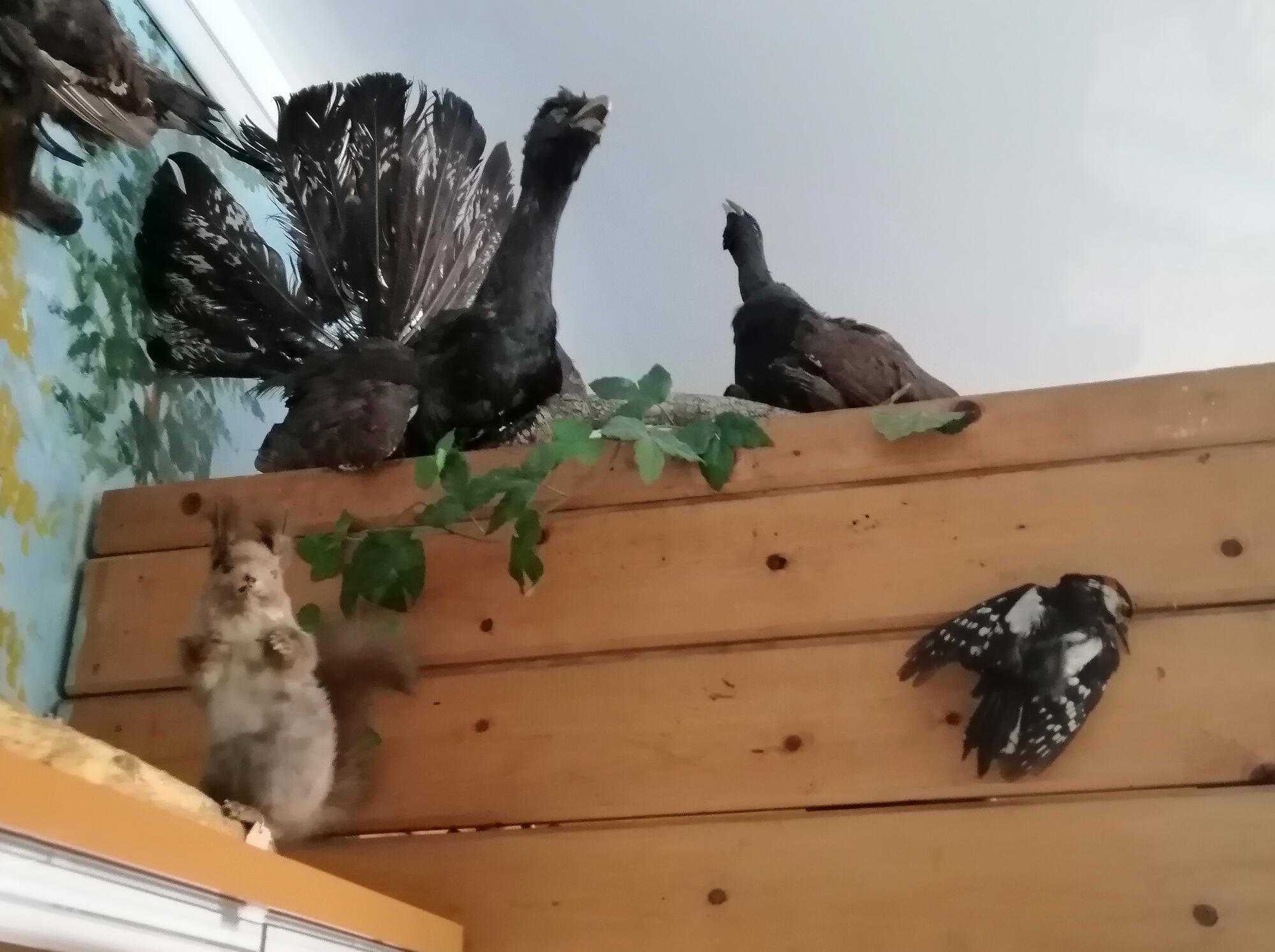


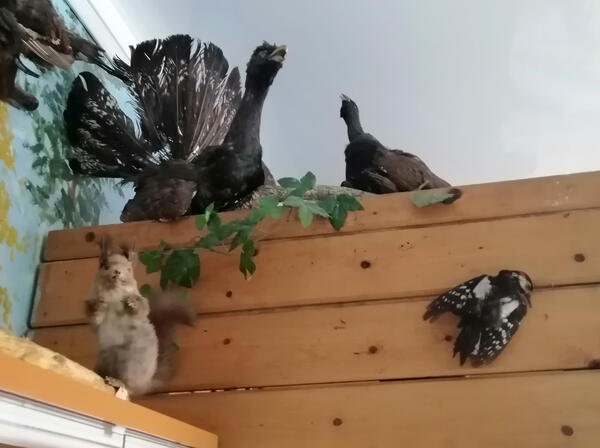
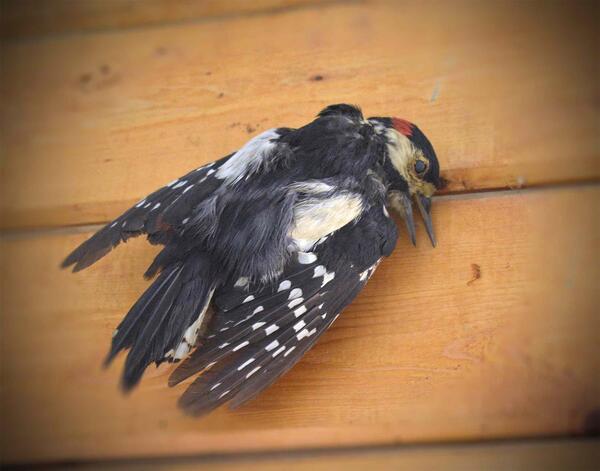
The great spotted woodpecker is one of the most well-known members of the Dendrocopos genus. It is not a large bird: its length is 22-27 centimeters, wingspan — 42-47 cm and weight — 60 to 100 grams. A male differs from a female: the former has a red stripe across its crown. Its tail is average in length. It is very stiff and pointed, and serves as support whenever this bird climbs up or down a trunk of a tree. Great spotted woodpeckers fly well and quickly, and yet they prefer to move along a trunk and only use their wings to travel to a neighboring tree. In winter, these birds become more active and often peck at cones, which are held tight within bark grooves that serve as an ‘anvil’ of sorts. At times, a flustered spotted woodpecker makes a chattering sound ‘kik’ or rattles out ‘krrarraarr’. Its drumming lasts a very short time, around 0.6 seconds, and comprises 12 to 13 strikes. In good weather, one can hear this sound over a 1.5 kilometer radius. Its bill strikes a trunk of a tree with a frequency approaching 25 times per second, and its head decelerates at a rate 1000 times the force of gravitational acceleration on impact. Very few other creatures on this planet are capable of handling such a strain on their bodies.
The woodpecker’s tongue, which is coated in sticky saliva and anchored in the right nostril, can extend from 5 to 15 centimeters past the tip of the bill, depending on sub-type, to reach insects in crevices. There are sharp bristles on the tip of its tongue that also help capture prey.
During the course of a day, the great spotted woodpecker is capable of “working” on dozens of trees and of striking them with its bill up to 1 million times.
Since this bird moves along tree trunks with the support of its tail, the latter constantly becomes shorter and shorter. The tail decreases by 1/10th of its length during the year.
Great spotted woodpeckers prefer living in parks and urban forests with an abundance of old trees; in gardens; in dry pine or swampy fir woods; in broad-leaved or mixed forests and those with conifers with dark needles. Their tree hollows are typically located at the height of up to 8 meters (and at times, from 0.3 to 26 m, as previously observed) above ground. Entrances to them are quite often under bracket fungi, serving as “awnings” of sorts. Great spotted woodpeckers protect their territory and do not let trespassers lay claim to it. If it encounters an intruder, the bird readies for an attack by opening its mouth and ruffling the feathers on its head. According to data collected by experts, these birds’ lifespans are around 10 years in the wild. There is a known specimen that almost lived until the age of 13.
Great spotted woodpeckers eat a variety of food, they have plant- and animal-based diets. They feed on seeds of various coniferous trees, acorns, nuts, etc. In early spring, when available food is scarce and far from varied, these birds pierce through the bark of some deciduous trees and drink their sap. Great spotted woodpeckers are true guardians of forest stands as they eradicate numerous pests, thus protecting them.
The woodpecker’s tongue, which is coated in sticky saliva and anchored in the right nostril, can extend from 5 to 15 centimeters past the tip of the bill, depending on sub-type, to reach insects in crevices. There are sharp bristles on the tip of its tongue that also help capture prey.
During the course of a day, the great spotted woodpecker is capable of “working” on dozens of trees and of striking them with its bill up to 1 million times.
Since this bird moves along tree trunks with the support of its tail, the latter constantly becomes shorter and shorter. The tail decreases by 1/10th of its length during the year.
Great spotted woodpeckers prefer living in parks and urban forests with an abundance of old trees; in gardens; in dry pine or swampy fir woods; in broad-leaved or mixed forests and those with conifers with dark needles. Their tree hollows are typically located at the height of up to 8 meters (and at times, from 0.3 to 26 m, as previously observed) above ground. Entrances to them are quite often under bracket fungi, serving as “awnings” of sorts. Great spotted woodpeckers protect their territory and do not let trespassers lay claim to it. If it encounters an intruder, the bird readies for an attack by opening its mouth and ruffling the feathers on its head. According to data collected by experts, these birds’ lifespans are around 10 years in the wild. There is a known specimen that almost lived until the age of 13.
Great spotted woodpeckers eat a variety of food, they have plant- and animal-based diets. They feed on seeds of various coniferous trees, acorns, nuts, etc. In early spring, when available food is scarce and far from varied, these birds pierce through the bark of some deciduous trees and drink their sap. Great spotted woodpeckers are true guardians of forest stands as they eradicate numerous pests, thus protecting them.