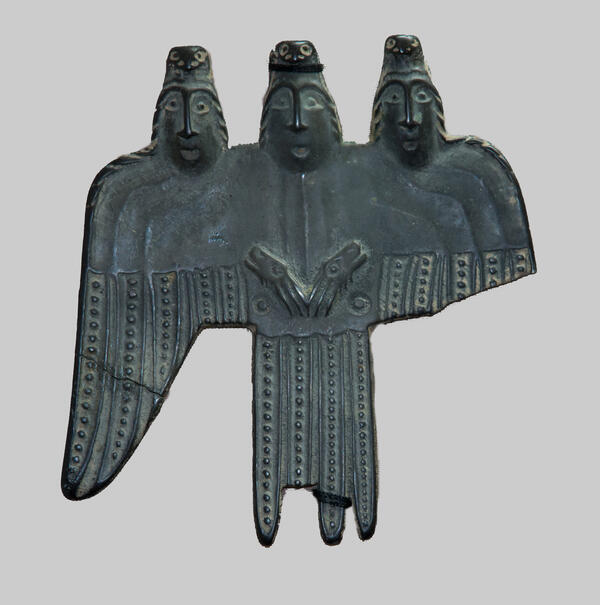
The worship cast items of the Perm animal style are valuable assets of the archaeological collection of the BereznikI Museum. Among them there is a truly unique exhibit — a three-headed bird-shaped idol. No similar items have been found so far. Archaeologists date it to the 8th–9th century.
This amulet was found near VolOdin KAmen village in the UsOlsky District of the Perm Region and donated to the museum in 1996. The amulet is a flat bronze figure of a bird with three convex human heads, each of which is crowned with the head of a bird of prey. The idol’s wings are lowered almost at a right angle downward. There is a convex image of two lizard heads in the middle of the amulet.
The idol’s tail has four feathers. The wings and tail are covered with false grain ornaments — small ornaments in the form of balls. There were three eyes for fastening on the back side at the top of the heads.
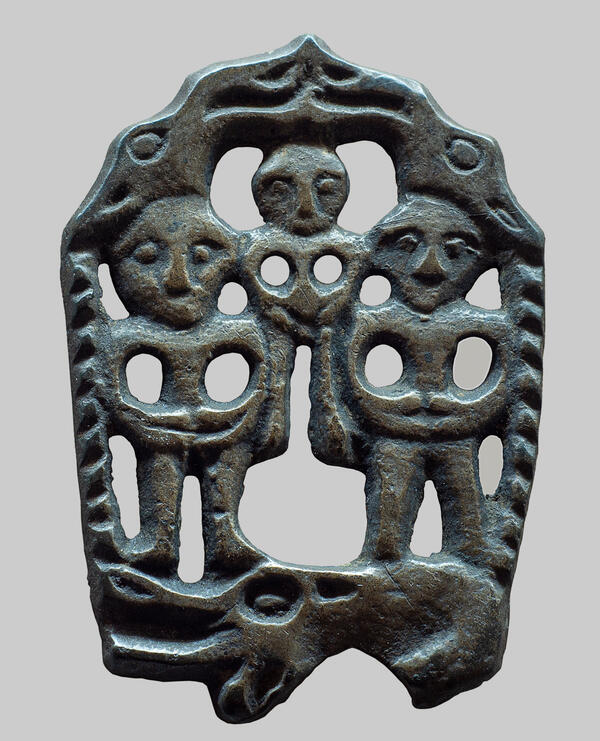
The animal style is a conventional name for artistic styles in ancient and medieval decorative arts. The animal style is based on stylized, that is, simplified, images of real and fantastic animals and parts of their bodies. This style is characterized by naturalistic emphasis of individual anatomical details — heads, eyes, claws.
Those animal style samples found within the Perm province are attributed to the Perm animal style. Historians devoted a lot of time to study this curious art style of the KAma region. Such ‘miracle antiquities’ are used by the scientists to study the worldview of the ancient KOmi-Permians. However, the final meaning of the animal style has not been clear yet.
It is known that, like the ancient Egyptians, the ancestors of the Komi-Permians were sun worshipers and deified the animal world. Perhaps the image of a bird in an amulet is associated with the mythology of the ancient Komi, in which the duck was the mother-progenitor of all living things.
According to the Finno-Ugric story about the creation of the world, the duck took the earth out from the bottom of the ancient ocean or laid an egg from which the earth, the sky, and the luminaries originated. In fact, the duck symbolized the cosmic power responsible for the universe. The ancient Komi-Permians considered the duck as a symbol of fertility and well-being.