#1
Red Army Barbed Wire, Casing of a POMZ-2 mine
#3
#4
#2
By the end of the 19th century, wire with fixed sharp spikes, or ‘hedgehogs’, was widely used in farming. Farmers used wire fences to enclose their pastures so that the cattle could not leave them. The poles to which the wire was attached were set 3 to 50 meters apart, depending on the terrain: long sections were able to withstand the pressure and temperature changes.
Soon, inexpensive and effective barbed wire began to be used against people as well. In World War I, there were many kilometers of antipersonnel barriers made of several rows of wire. There were 2-3 times more spikes fixed on them than on the wire used for agricultural purposes.
Both World Wars showed that it was impossible to organize an attack along the entire front at once. It was only possible to break through the defenses in very few places. In such gaps, the defenders put up artificial obstacles. Their design included wire barriers, both straight and twisted in spirals. They were set up so that the enemy could not see the wire from a long distance. It took a team of 6 to 8 men about an hour to install 100 meters of the barrier.
The spikes made it difficult for enemy infantry to move, scattering their fighting formations, forcing soldiers to stop in order to break through the wire or throw bridges woven from twigs over it. At these moments the enemy suffered serious losses under machine-gun and artillery fire. The distance between the rows of wire was one and a half steps, so after getting out of one row a soldier would get into the next one. During an attack, soldiers dismantled these barriers with special scissors: under fire, they crawled up to the wire barriers and cut them down.
According to the rules, wire barriers were set at such a distance from the trenches so that the enemy grenades could not reach them. Only the artillery could destroy the barbed-wire fences en masse without losses. This is why soldiers would build several rows of wire so that the artillery could only destroy one row per an attack. Hundreds of shells tore out the wooden poles and plowed through the ground, making small gaps in the barbed wall.
Soon, inexpensive and effective barbed wire began to be used against people as well. In World War I, there were many kilometers of antipersonnel barriers made of several rows of wire. There were 2-3 times more spikes fixed on them than on the wire used for agricultural purposes.
Both World Wars showed that it was impossible to organize an attack along the entire front at once. It was only possible to break through the defenses in very few places. In such gaps, the defenders put up artificial obstacles. Their design included wire barriers, both straight and twisted in spirals. They were set up so that the enemy could not see the wire from a long distance. It took a team of 6 to 8 men about an hour to install 100 meters of the barrier.
The spikes made it difficult for enemy infantry to move, scattering their fighting formations, forcing soldiers to stop in order to break through the wire or throw bridges woven from twigs over it. At these moments the enemy suffered serious losses under machine-gun and artillery fire. The distance between the rows of wire was one and a half steps, so after getting out of one row a soldier would get into the next one. During an attack, soldiers dismantled these barriers with special scissors: under fire, they crawled up to the wire barriers and cut them down.
According to the rules, wire barriers were set at such a distance from the trenches so that the enemy grenades could not reach them. Only the artillery could destroy the barbed-wire fences en masse without losses. This is why soldiers would build several rows of wire so that the artillery could only destroy one row per an attack. Hundreds of shells tore out the wooden poles and plowed through the ground, making small gaps in the barbed wall.
#5
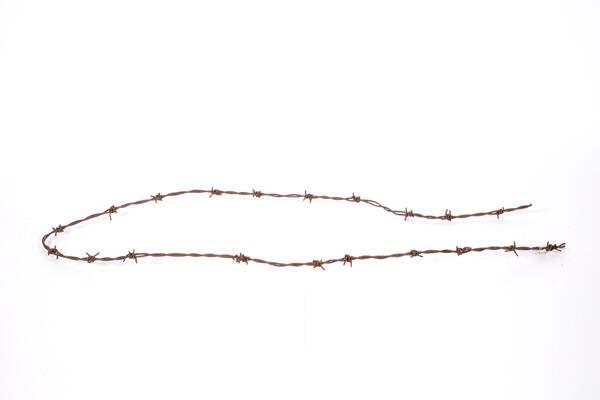
Full name: Protective Barbed Wire. The Workers' and Peasants' Red Army
Date: the first half of the 20th century
Technique: assembled
Place: USSR
Copyright: Museum Resource Center of Noyabrsk
Dimensions: length — 152 cm
Goskatalog Number: 8337723
Date: the first half of the 20th century
Technique: assembled
Place: USSR
Copyright: Museum Resource Center of Noyabrsk
Dimensions: length — 152 cm
Goskatalog Number: 8337723
#6
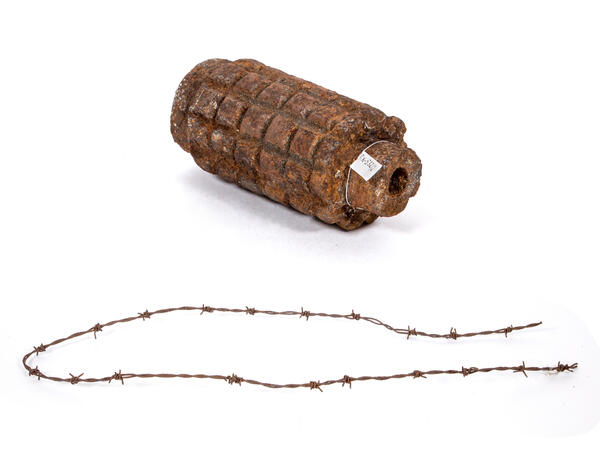
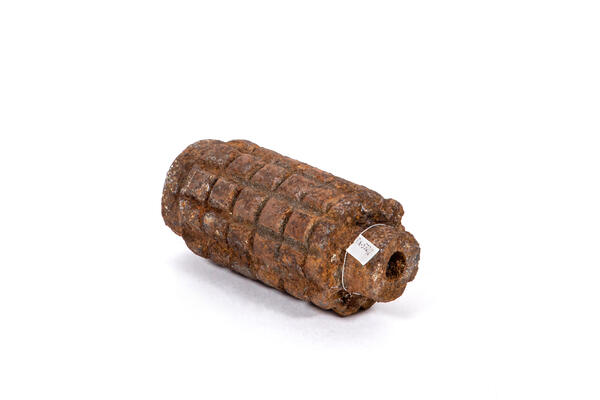
Casing of a POMZ-2 mine
#7
#8
The POMZ-2 anti-personnel fragmentation tripwire activated mine was developed in 1941 by engineers Pavel Radevich and Nikolai Ivanov. It was intended for disabling enemy troops and became one of the most common mines in 1941-1943.
The main element of the POMZ-2 was the cast-iron ribbed body. There were notches on its outer side so that when the mine is activated, it would explode into small similar fragments. A small TNT explosive charge, of about 75 grams, was inside the sleeve. To make the mine combat ready, TNT was laid in it, an igniter with a fuse, and a P-shaped firing pin was inserted through a vertical tube into the casing from above. The standard modernized simplified tripwire fuze (MUV) was most often used with the POMZ-2 mines.
The POMZ-2 was installed manually as part of minefields, and set up separately on different trails. The loaded cast-iron casing was fixed on a wooden peg driven into the ground. One or two thin wire extensions up to eight meters in length were connected to the fuse’s firing pin. They were positioned perpendicular to the likely path of the enemy troops. On the other side, the wires were tied to a second peg, fence stakes or trees, as soldiers tried to disguise the mines. The height of the tripwire was 15-20 centimeters. The mine exploded when an enemy soldier, snagging a wire with their foot, pulled out the firing pin.
During the explosion, the casing shattered into 400 lethal fragments, which created a continuous field of destruction with a radius of up to 20 meters.
The casing of the POMZ-2 mine presented in the exhibition was donated to the museum by Lyudmila Buryak, the chairman of the Noyabrsk ‘Committee of Soldiers' Mothers of Russia “. She brought it from a trip to Chebarkul, where soldiers from Noyabrsk served in 7th Separate Guards Red Banner, Order of Suvorov, Kutuzov and Alexander Nevsky of the Orenburg Cossack brigade.
The command of the brigade handed over to Lyudmila Buryak the finds from the excavations carried out in 1990-1993 in the Leningrad Oblast by the joint search team of schoolchildren of the Ural Federal District. The artifacts found at the battlefields, including the cast-iron body of the POMZ-3, were stored in a military unit.
The main element of the POMZ-2 was the cast-iron ribbed body. There were notches on its outer side so that when the mine is activated, it would explode into small similar fragments. A small TNT explosive charge, of about 75 grams, was inside the sleeve. To make the mine combat ready, TNT was laid in it, an igniter with a fuse, and a P-shaped firing pin was inserted through a vertical tube into the casing from above. The standard modernized simplified tripwire fuze (MUV) was most often used with the POMZ-2 mines.
The POMZ-2 was installed manually as part of minefields, and set up separately on different trails. The loaded cast-iron casing was fixed on a wooden peg driven into the ground. One or two thin wire extensions up to eight meters in length were connected to the fuse’s firing pin. They were positioned perpendicular to the likely path of the enemy troops. On the other side, the wires were tied to a second peg, fence stakes or trees, as soldiers tried to disguise the mines. The height of the tripwire was 15-20 centimeters. The mine exploded when an enemy soldier, snagging a wire with their foot, pulled out the firing pin.
During the explosion, the casing shattered into 400 lethal fragments, which created a continuous field of destruction with a radius of up to 20 meters.
The casing of the POMZ-2 mine presented in the exhibition was donated to the museum by Lyudmila Buryak, the chairman of the Noyabrsk ‘Committee of Soldiers' Mothers of Russia “. She brought it from a trip to Chebarkul, where soldiers from Noyabrsk served in 7th Separate Guards Red Banner, Order of Suvorov, Kutuzov and Alexander Nevsky of the Orenburg Cossack brigade.
The command of the brigade handed over to Lyudmila Buryak the finds from the excavations carried out in 1990-1993 in the Leningrad Oblast by the joint search team of schoolchildren of the Ural Federal District. The artifacts found at the battlefields, including the cast-iron body of the POMZ-3, were stored in a military unit.
#9
Full name: Casing of a stake mounted anti-personnel fragmentation tripwire activated mine POMZ-2. Armament of the Workers' and Peasants' Red Army during the Great Patriotic War
Date: 1941
Technique: factory-made
Place: USSR
Copyright: Museum Resource Center of Noyabrsk
Dimensions: 13,5×6,5×6,5 cm
Goskatalog Number: 8337720
Date: 1941
Technique: factory-made
Place: USSR
Copyright: Museum Resource Center of Noyabrsk
Dimensions: 13,5×6,5×6,5 cm
Goskatalog Number: 8337720
#10
Ministry of Culture of the Russian Federation
read morehide
00:00
00:00
1x
Red Army Barbed Wire, Casing of a POMZ-2 mine
Collection
Exhibition
0
 Point your smartphone camera to open in the app
Open in app
Share