Font
Color
Graphics
Изображение точки

To see AR mode in action:

1. Install ARTEFACT app for iOS or Android;

2. Find the exhibition «A Composer Ahead of His Time»

3. Push the «Augmented reality» button and point your phone's camera at the exhibit;

Скрыть точки интересаПоказать точки интереса
Показать в высоком качестве

Examples of compositions, autobiography

0
Open in app
#1
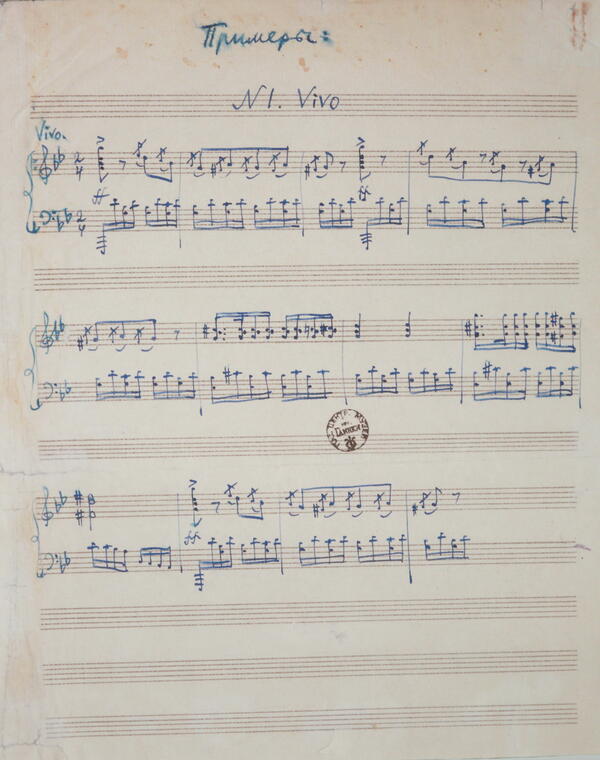
Examples of childhood compositions
#4
Sergei Prokofiev started composing his own music at a very early age. There was a piano at his family’s house in Sontsovka, and his mother Maria Grigoryevna often played music. She became the first teacher of the future composer.

At the age of five, fascinated by the playing of his mother, the young genius composed his first piece. Interestingly, he started composing even before he mastered notation and could write down his music. This is why his first composition “Indian Gallop” was written down by his mother. Prokofiev specified the “nationality” of the dance because he decided to dedicate his first composition to the Indian people who had lost their lives in a natural disaster: the river Ganges overran its banks and flooded numerous villages in its vicinity.

After the young boy had written his first composition, his mother decided to teach him music notation and give him daily twenty-minute lessons. The first compositions Prokofiev learned to play were children’s pieces by Tchaikovsky and Schumann. This is why many of the early works by Prokofiev were heavily inspired by the two great predecessors. The boy’s musical talent developed rapidly.

In 1900, the nine-year-old Prokofiev went to the opera theater in Moscow for the first time in his life. He saw two operas — “Faust” by Charles-François Gounod and “Prince Igor” by Alexander Borodin. He also attended the ballet “Sleeping Beauty” by Pyotr Ilyich Tchaikovsky. The young boy was so inspired by the music he had heard that having returned home, he announced to his mother that he would compose an opera of his own. This is how Sergei Prokofiev came to write his first opera “The Giant”. This important event was marked by a visit to a photographer.
#5
Aunt Tanya took me to a photographer, who posed me before a pasteboard piano with a blank sheet of paper on the music rack. When the photographs were ready, they were taken to a colleague of Aunt Tanya’s who wrote a very fine hand. On some of them, he inscribed: ‘The Giant: an Opera by Serezha Prokofiev’.
Sergei Prokofiev recalled that day
#6
Almost all of Prokofiev’s childhood compositions including the piano pieces and his first opera “The Giant” have been saved by his mother. She collected and treasured her son’s works.
#3
Name: Examples of childhood compositions
Author: Sergei Prokofiev
№: 5961549 
Date of creation: the autograph dates back to the mid-20th century, the pieces were composed in the early 20th century
Technique: notehead, writing ink
Dimensions: 27×22,7 cm
#2
Sergei Prokofiev’s short autobiography
#8
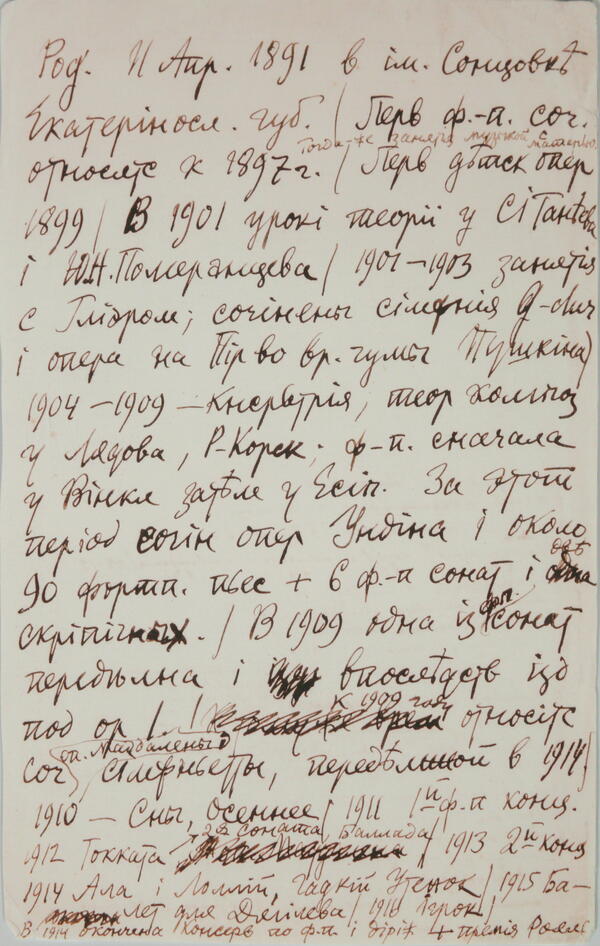
Sergei Prokofiev compiled a short and a long autobiography where he gave a detailed account of his childhood and youth. The composer finished working on the short version in 1941. It included information about his life until 1936.

Prokofiev described his childhood, conservatory years, life as an independent artist after graduation, his time abroad, and his return to the Soviet Union. The autograph from the museum’s collection dates back to 1916. The young Prokofiev applied an innovative approach to everything he did. Striving to be original, he introduced several signature traits into his spelling. In pre-reform Russian orthography, there was a Latin letter “i” that corresponded to the modern letter “и” and was used instead of the Cyrillic equivalent in certain environments, mostly before vowels. Prokofiev decided that two letters “и” were superfluous and used only the letter “i”. However, his choice happened to be wrong since the orthographic reform eliminated the Latin “i” several years later.
#9
Since I was finishing my course in the Russian language, I decided to introduce something new into spelling (my own, of course). It seemed to me that in the final analysis there was no sense in having two symbols to represent the letter “и”. I decided to use the Latin “i” everywhere. Of the two, it seemed to me that it took up less space and was more eye-catching, and besides it was found in the alphabets of other peoples. So, I chose it. Then years later the government legitimatized the other symbol: “и”. Nonetheless, the “i” continued to exist in my writing for about thirty years. Then, when I saw that the “и” had been firmly established in the Soviet Union, I switched to it.
Prokofiev described this situation in his long autobiography
#10
The autograph of Prokofiev’s short autobiography shows that the composer used the Latin “i” even when it was not required according to the pre-reform spelling rules: “урокi теорii у С.I. Танеева” (theory lessons with Sergei Taneyev), “Глiэр” (Glière), “сiмфонiя” (a symphony). At the same time, Prokofiev dropped the use of the Russian hard sign (the letter “ъ”) at the end of all words that would otherwise end in a consonant. In this case, he was correct and anticipated the reform: several years later, the rule was changed. Another one of Prokofiev’s innovations was the elimination of vowels. He did this in his diaries and letters to friends as well as in his signature “С. Пркфв” (S. Prkfv). In this autograph, Prokofiev also eliminated some letters: “кнсрвтрiя” (cnsrvtry), “теор композ” (compos thry), “сочiн опер” (cmpsd the oper).
#7
Name: Sergei Prokofiev’s short autobiography
Author: Sergei Prokofiev
Technique: writing ink
Dimensions: 18×11,5 cm

#11
read morehide
00:00
00:00
1x

Examples of compositions, autobiography

0
Point your smartphone camera to open in the app
Share
VkontakteOdnoklassnikiTelegram
Share on my website
Copy linkCopied
Copy
Open in app
To see AR mode in action:
  1. Install ARTEFACT app for 
  2. iOS or Android;
  3. Find and download the «Paintings in Details» exhibition
  4. Push the «Augmented reality» button and point your phone's camera at the painting;
  5. Watch what happens on your phone screen whilst you flip through the pictures.
 
We use Cookies
Cookies on the Artefact Website. We use cookies to ensure that we give you the best experience on our website. If you continue without changing your settings, we'll assume that you are happy to receive all cookies on the Artefact website. However, if you would like to, you can change your cookie settings at any time.
Learn more about useHide
Content is available only in Russian

X

Нашли опечатку?...

%title%%type%