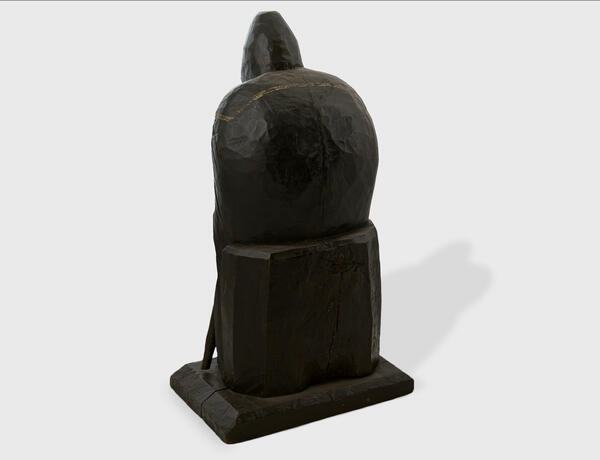
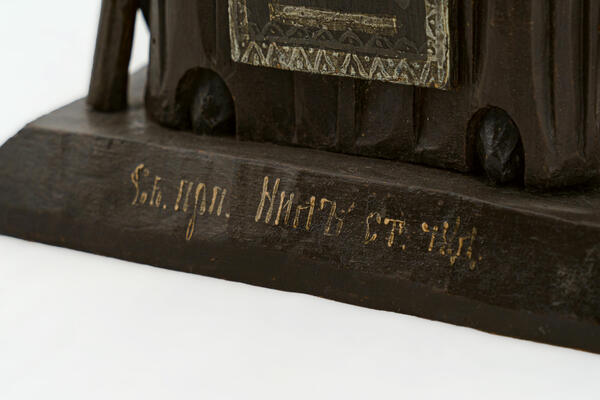
Figurines with a height of 15 to 43 centimeters, depicting the founder of the monastery on Stolobny Island in Lake Seliger, St. Nilus (who died in 1554), form a unique category of religious sculpture. They were created during the modern era in the Tver Governorate when the saint’s cave was discovered at the St. Nilus Stolobensky Monastery.
Such figurines were inspired by a statue of the saint painted with tempera. It was created in the last third of the 18th century and was kept at the Ascension Cathedral of the Znamensky Monastery in Ostashkov, Tver Oblast. The first statue was likely created by the Ostashkov carver Kondraty Konyagin who became known as Caesar after taking monastic vows. Nowadays, the statue is displayed at the museum “The Legacy of St. Nilus”. After the carved image was recognized as miracle-working in the late 18th century, monks of the St. Nilus Stolobensky Monastery started making both large statues for churches and smaller figurines for pilgrims.
Small figurines of St. Nilus were also created by Upper Volga villagers and residents of Ostashkov, Rzhev, Staritsa, and Zubtsov. In the second half of the 19th century, the tradition spread beyond the Ostashkov district. Craftsmen used local wood, mainly linden and pine, to create such wooden statues. The images of St. Nilus differ from old Russian brightly painted figurines of saints in terms of color palette. The figurines feature dark clothing, light-colored crosses, a light-yellow complexion with a reddish tint, and light gray, white, and sometimes light brown beards and eyebrows.
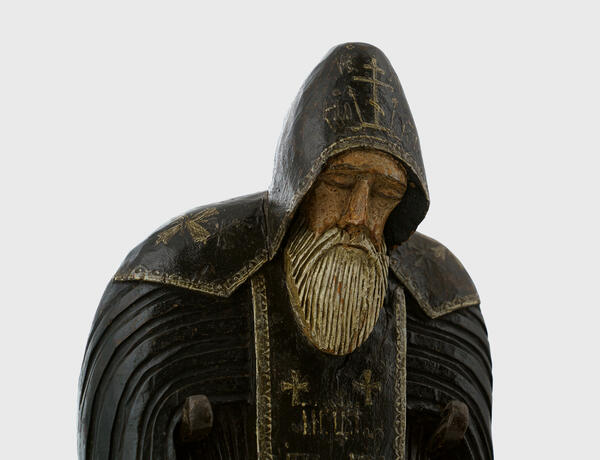
The figurine from the collection of the Andrei
Rublev Museum was created by an unknown sculptor in the 19th century. It depicts St. Nilus as an elderly man with sunken cheeks and a full
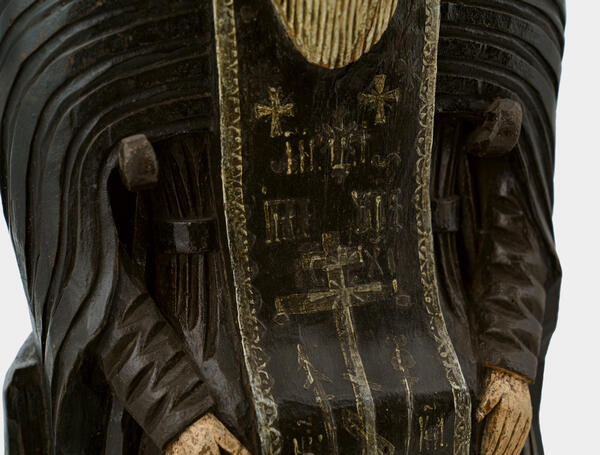
beard. His eyes are closed in prayer, and his arms are bent at the elbows and
resting on his knees. Legend has it that St. Nilus would never lie down and
would rather half sit or half stand while sleeping, leaning on hooks that were
driven into the walls of his cell. This is reflected in the figurine, as hooks
are visible under the saint’s arms. The monk wears a schema — monastic clothing
that consists of a cloak with a hood. The cloak that descends over his
shoulders has folds depicted using double grooves.