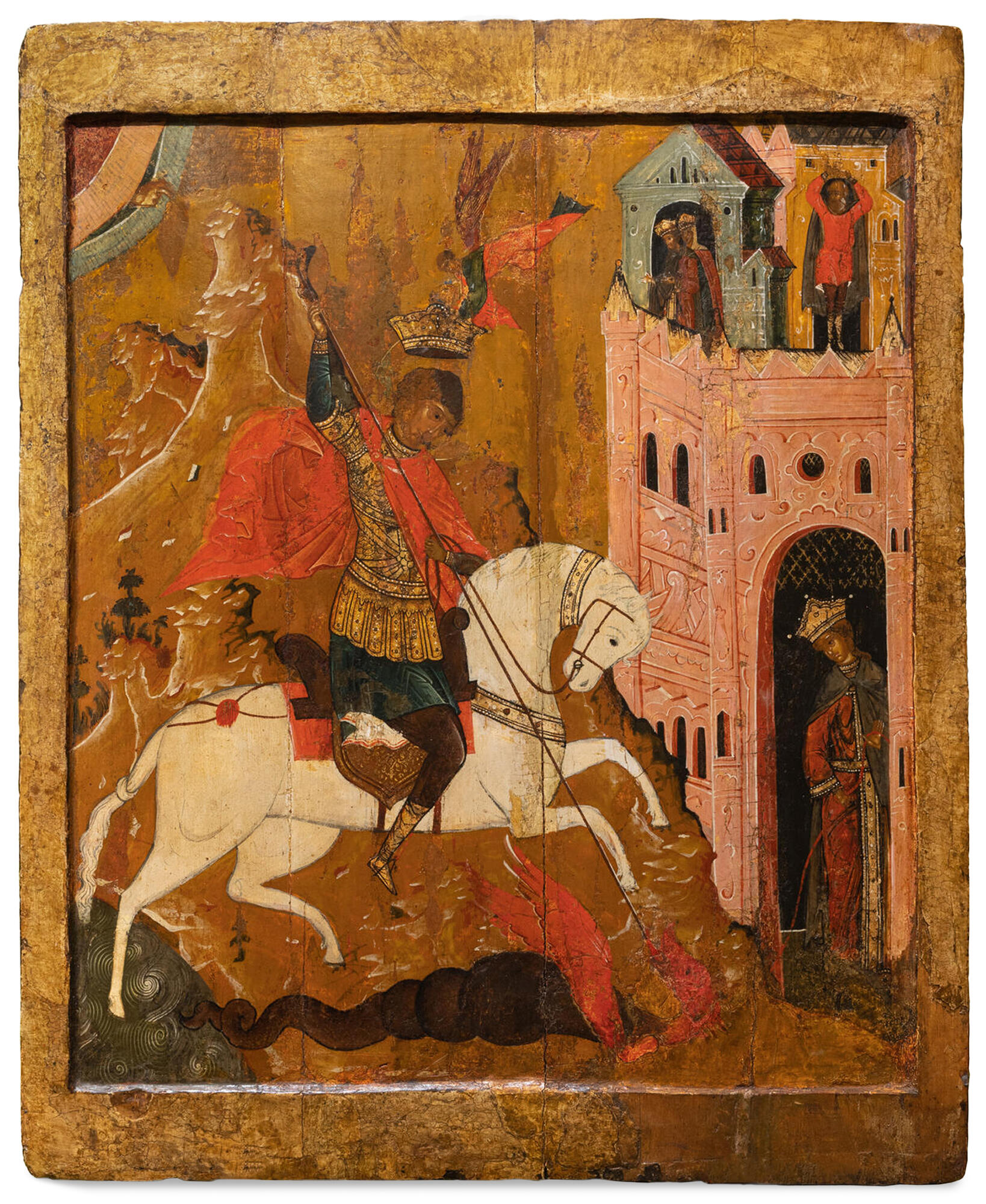


The Great Martyr George is one of the most venerated saints in Christianity. He was born into a noble family in the city of Lydda in Roman Palestine. As a young man, George became a soldier of the Roman army and made a brilliant career. However, when persecution of Christians began, he appeared before Emperor Diocletian and confessed his faith openly. As a result, George was tortured and beheaded.
George became the patron saint of Kievan Rus princes. For example, George was the baptismal name of Yaroslav the Wise who built the Saint Sophia Cathedral in Kiev and a church dedicated to Saint George nearby. The name “George”, or “Gyurgy” in Slavic transcription, was also given to Russian princes in the 12th century. For example, the first name of Yuri Dolgorukiy, founder of Moscow, is also a short Slavic form of the name George.
The most famous miracle attributed to Saint George is the defeat of the dragon. The earliest surviving image of this event dates back to the early 11th century, and the earliest texts — to the 12th and 13th centuries. “The Miracle of Saint George and the Dragon” became one of the most popular subjects in ancient Russian art.
The legend explores the circumstances of this miracle. A city (Lacia, Laosia, Geval, or another city according to various sources) was plagued by a dragon dwelling in a nearby pond. Every day, the city was supposed to offer a young man or woman to be eaten by the dragon. One day, the lot fell on Elisava, the ruler’s daughter. As she waited on the shore of the pond, waiting for her death, a young knight on horseback suddenly appeared.


