#1
Wehrmacht equipment
#12
#19
#13
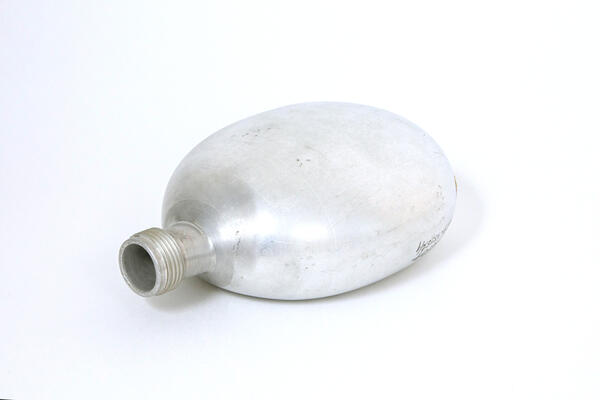
The German flask, displayed in the Museum Resource Center, was produced in 1941 based on the 1931 design. It was made of uncolored aluminum. The flask is flat, has a rounded shape. To make it more convenient to wear on the hip, a small dent was made on the flask wall. There is another indentation on the bottom which makes it more stable.
The kit consisted of the flask and the felt case for storage. Two halves of the case were stitched together and the seam was additionally reinforced with a braid. Thus, the flask could be worn on a waist belt. A narrow leather strap with a carabiner was attached to the case. The flask closed with a metal relief cap and a rubber gasket. So that the soldier would not lose the cap, it was fixed on the strap of a vertical leather fastening belt, which was attached to the case.
Since 1942, the design of the case was simpler, and the strap was made of cheaper leather. Over time, it was replaced with tarpaulin straps, and the number of buttons on the case was reduced from four to three.
The flasks of later models were made of painted and unpainted steel; woven cases painted in different colors (for instance, green and gray) were used for them. Some flasks were made of dark brown or brown plastic with Bakelite caps and cups.
For the units stationed on the Eastern Front, manufacturers produced flasks covered with spotted dark brown or brown phenol formaldehyde-based resins, which protected the liquid from frost. The caps were made of the same material. Soldiers of the German African Corps were supplied with wooden flasks.
Although the Wehrmacht equipment in World War II was standardized, even within the same military unit, the flasks were different. During battles, they, like other equipment items, were damaged by bullets and shell fragments. If a soldier could not get a new flask to replace the damaged one, he would try to quickly fix the old one, or try to buy a new one or get a captured flask.
In addition to the standard ones, Wehrmacht soldiers used the flasks of the Hitler Youth, old Reichswehr bottles (Weimar Republic Army), as well as various civilian models donated by volunteer organizations. At the end of 1944, the Nazi army attempted to establish an official design for the equipment, but by that time it no longer made sense — the war was lost.
The kit consisted of the flask and the felt case for storage. Two halves of the case were stitched together and the seam was additionally reinforced with a braid. Thus, the flask could be worn on a waist belt. A narrow leather strap with a carabiner was attached to the case. The flask closed with a metal relief cap and a rubber gasket. So that the soldier would not lose the cap, it was fixed on the strap of a vertical leather fastening belt, which was attached to the case.
Since 1942, the design of the case was simpler, and the strap was made of cheaper leather. Over time, it was replaced with tarpaulin straps, and the number of buttons on the case was reduced from four to three.
The flasks of later models were made of painted and unpainted steel; woven cases painted in different colors (for instance, green and gray) were used for them. Some flasks were made of dark brown or brown plastic with Bakelite caps and cups.
For the units stationed on the Eastern Front, manufacturers produced flasks covered with spotted dark brown or brown phenol formaldehyde-based resins, which protected the liquid from frost. The caps were made of the same material. Soldiers of the German African Corps were supplied with wooden flasks.
Although the Wehrmacht equipment in World War II was standardized, even within the same military unit, the flasks were different. During battles, they, like other equipment items, were damaged by bullets and shell fragments. If a soldier could not get a new flask to replace the damaged one, he would try to quickly fix the old one, or try to buy a new one or get a captured flask.
In addition to the standard ones, Wehrmacht soldiers used the flasks of the Hitler Youth, old Reichswehr bottles (Weimar Republic Army), as well as various civilian models donated by volunteer organizations. At the end of 1944, the Nazi army attempted to establish an official design for the equipment, but by that time it no longer made sense — the war was lost.
#14
Full name: Feldflasche 31 Flask. Part of a Set. Standard 1931 Field Model in a Felt Case. Wehrmacht
Date: 1941
Technique: factory-made
Place: Germany
Copyright: Museum Resource Center of Noyabrsk
Dimensions: 19,4×12,5×7,5 cm
Goskatalog Number: 16663702
Date: 1941
Technique: factory-made
Place: Germany
Copyright: Museum Resource Center of Noyabrsk
Dimensions: 19,4×12,5×7,5 cm
Goskatalog Number: 16663702
#15
Felt Case with Strap and Cap
#18

#2
The Feldflasche 31 kit — an aluminum flask in a felt case — was part of the official military equipment of the Wehrmacht soldiers during the Second World War. At that time, the cases were made of green and gray felt. Olive and feldgrau (the official basic color of German military uniforms) were considered the best colors for the flasks.
The case displayed in the museum was made of felt, which had a protective dark color, and was used as a small bag for a flask. The seam was secured with webbing along the edges. The felt case kept the water inside from freezing in winter. Furthermore, it could keep the water cold for a long time in summer, the case simply to be wetted.
There is a cut on the left side of the case which fastens with four metal snap fasteners. An image of a four-pointed star can be seen on them. By undoing the snap fasteners, the soldier could remove the flask to clean it or replace it with a new one.
Leather loops are attached to the front and back sides of the case; through them runs a black leather-fastening strap with a buckle. A screw cap made of aluminum is also attached to it. To prevent the flask from leaking, the cap has a brown rubber gasket. In addition, on the strap there is a shackle — a carabiner made of metal and painted in gray. Soldiers attached the flask to their bread bags or to a belt’s loop. They adjusted the belt length with a special buckle.
The German tactical gear was elaborate, functional and high quality at the beginning of the war. Many items were made of leather: belts, Sam Browne belts, ammunition pouches, holsters, harnesses, various sacks, knapsacks, and cases.
The quality of equipment remained high up until 1942; however, it noticeably declined by the end of the war. Flask cases were made of ordinary thick cotton cloth, and straps and loops were made of canvas or artificial leather. Black leather straps were supposed to be stitched with black threads according to the rules, but white threads were also used in 1944-1945.
The manufacturer’s ink mark was pressed on the inside, usually along the webbing. Sometimes leather or canvas straps were also labeled.
The case displayed in the museum was made of felt, which had a protective dark color, and was used as a small bag for a flask. The seam was secured with webbing along the edges. The felt case kept the water inside from freezing in winter. Furthermore, it could keep the water cold for a long time in summer, the case simply to be wetted.
There is a cut on the left side of the case which fastens with four metal snap fasteners. An image of a four-pointed star can be seen on them. By undoing the snap fasteners, the soldier could remove the flask to clean it or replace it with a new one.
Leather loops are attached to the front and back sides of the case; through them runs a black leather-fastening strap with a buckle. A screw cap made of aluminum is also attached to it. To prevent the flask from leaking, the cap has a brown rubber gasket. In addition, on the strap there is a shackle — a carabiner made of metal and painted in gray. Soldiers attached the flask to their bread bags or to a belt’s loop. They adjusted the belt length with a special buckle.
The German tactical gear was elaborate, functional and high quality at the beginning of the war. Many items were made of leather: belts, Sam Browne belts, ammunition pouches, holsters, harnesses, various sacks, knapsacks, and cases.
The quality of equipment remained high up until 1942; however, it noticeably declined by the end of the war. Flask cases were made of ordinary thick cotton cloth, and straps and loops were made of canvas or artificial leather. Black leather straps were supposed to be stitched with black threads according to the rules, but white threads were also used in 1944-1945.
The manufacturer’s ink mark was pressed on the inside, usually along the webbing. Sometimes leather or canvas straps were also labeled.
#16
Full name: Flask Felt Case with a Fastening Strap and Cap. Part of a Set. Standard 1931 Field Model in a Felt Case. Wehrmacht
Date: 1941–1944
Technique: factory-made
Place: Germany
Copyright: Museum Resource Center of Noyabrsk
Dimensions: 20×15×5,6 cm
Goskatalog Number: 16663721
Date: 1941–1944
Technique: factory-made
Place: Germany
Copyright: Museum Resource Center of Noyabrsk
Dimensions: 20×15×5,6 cm
Goskatalog Number: 16663721
#17
Spork
#20
#3
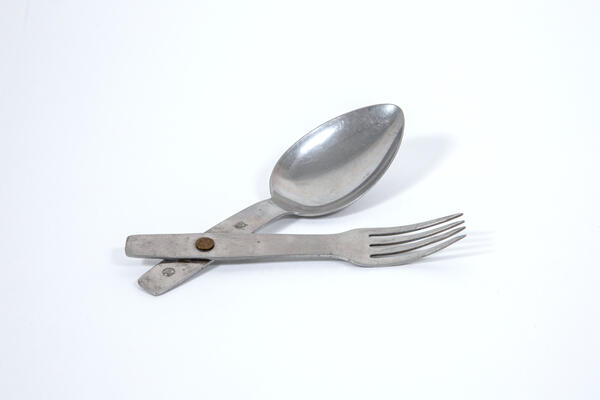
The German soldier’s equipment included a compact form of cutlery — a combined spoon and fork. It was used by soldiers of the Reichswehr, the armed forces of the Weimar Republic, and by soldiers of the Wehrmacht during World War II.
This cutlery included a spoon and fork, which were fastened with a metal rivet, therefore they could be rotated and fixed in one line. The manufacturer and the year of manufacture were embossed on the handle. Sometimes the imperial eagle was depicted, as well.
The spork displayed in the museum is made of stainless metal, presumably steel. The preserved factory branding indicates “W.S.M. 41 ROSTFREI”. It means that the cutlery was produced in 1941 and made of “stainless” material. Since about 1943, the sporks began to be made of cheaper iron, rarely — of lightweight aluminum.
Almost every German soldier had a spork. In field conditions, it was kept in the inner pocket of the dry bag. Some folding cutlery sets, called Essbesteck, also included a table knife and a can opener.
Dozens of German factories produced similar items during World War II. Many firms and companies, which manufactured such items for the armed forces of Nazi Germany, continued to work after the war. Company W.S.M. — W. Seibel Metalle, Mettmann — which produced the spork, displayed in the Museum Resource Center, produces cutlery to this day.
The founder of the company, Wilhelm Seibel, was born in 1843 in Gebersdorf (modern Frielendorf). In 1895 he founded the W. Seibel, Mettmanner Britanniawarenfabrik, and in 1911 opened the “Hessische Metallwerke Gebr. Seibel, Ziegenhain” factory, which later passed into the hands of his two younger sons Heinrich and Alfred.
Seibel’s company became famous by producing cutlery for the Berlin Summer Olympics in 1936. Seibel’s products were used by the German infantry, air and naval forces. By the end of the war, it was shut down, but from May 1945, it began to recover.
This cutlery included a spoon and fork, which were fastened with a metal rivet, therefore they could be rotated and fixed in one line. The manufacturer and the year of manufacture were embossed on the handle. Sometimes the imperial eagle was depicted, as well.
The spork displayed in the museum is made of stainless metal, presumably steel. The preserved factory branding indicates “W.S.M. 41 ROSTFREI”. It means that the cutlery was produced in 1941 and made of “stainless” material. Since about 1943, the sporks began to be made of cheaper iron, rarely — of lightweight aluminum.
Almost every German soldier had a spork. In field conditions, it was kept in the inner pocket of the dry bag. Some folding cutlery sets, called Essbesteck, also included a table knife and a can opener.
Dozens of German factories produced similar items during World War II. Many firms and companies, which manufactured such items for the armed forces of Nazi Germany, continued to work after the war. Company W.S.M. — W. Seibel Metalle, Mettmann — which produced the spork, displayed in the Museum Resource Center, produces cutlery to this day.
The founder of the company, Wilhelm Seibel, was born in 1843 in Gebersdorf (modern Frielendorf). In 1895 he founded the W. Seibel, Mettmanner Britanniawarenfabrik, and in 1911 opened the “Hessische Metallwerke Gebr. Seibel, Ziegenhain” factory, which later passed into the hands of his two younger sons Heinrich and Alfred.
Seibel’s company became famous by producing cutlery for the Berlin Summer Olympics in 1936. Seibel’s products were used by the German infantry, air and naval forces. By the end of the war, it was shut down, but from May 1945, it began to recover.
#21
Full name: Spork. Item of personal equipment of a Wehrmacht soldier
Date: 1941
Technique: factory-made
Place: Germany
Copyright: Museum Resource Center of Noyabrsk
Dimensions: 4,6×23,2×2,7 cm
Goskatalog Number: 16663650
Date: 1941
Technique: factory-made
Place: Germany
Copyright: Museum Resource Center of Noyabrsk
Dimensions: 4,6×23,2×2,7 cm
Goskatalog Number: 16663650
#22
Bakelite Case
#23
#4
During World War II, the German personal protective equipment, in addition to a gas mask and an anti-yperite cape made of thick cloth, included means for decontaminating skin, uniforms, and weapons. Every Wehrmacht soldier carried a small brown box with ten losantin tablets in the lid of the gas mask canister. It was used to decontaminate the skin in case of contact with poisonous blister agents, such as mustard gas or lewisite.
The mustard gas droplets in contact with the skin caused serious damage — extensive redness, blisters, ulcers, and necroses. Since the mustard gas had a slower and stealthier effect, it took several hours for the damage to become noticeable. Liquid lewisite, on the contrary, penetrated the skin within minutes and instantly caused inflammation, redness, blisters, and non-healing ulcers.
Losantin had to be applied immediately on the battlefield. If the skin was affected, a soldier had to open the case, crush the pills in the palm of his hand, and mix with water or saliva to form a paste. The resulting paste was rubbed evenly, but without much pressure on the affected surface, and in 10-15 minutes the soldier rinsed the area with water or wiped it with a damp cloth.
The active calcium hypochlorite, a component of losantin, reacted with the poisonous chemicals and neutralized them. However, the chemical itself was toxic. The first lines of the instruction stated: ‘For external use only! Avoid contact with eyes, mouth, and genitalia! ’
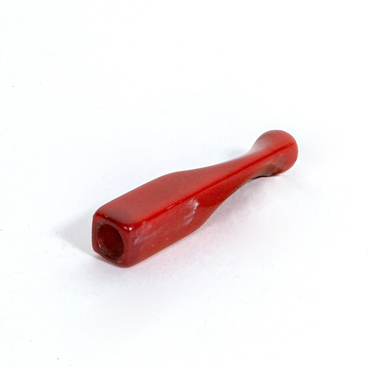
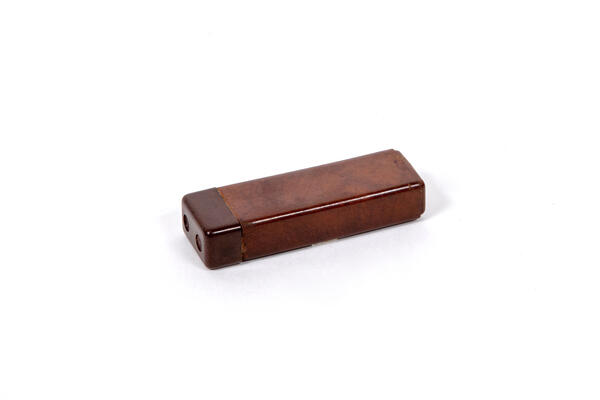
The rectangular case with a lid, in which the losantin tablets were kept, was made of Bakelite. This material was obtained in 1909 by chemist Leo Baekeland. It was the first synthetic plastic that did not soften at high temperature — it could withstand heat up to 300 degrees, and at higher temperatures it would char, but would not burn completely. Water, diluted alkalis, and acids also had no impact on it.
The displayed German Bakelite case was discovered during battlefield excavations, conducted in 2008-2010 by the Noyabrsk joint search party ‘Vitalis’ in the Nelidovsky district, Tver Oblast. The ‘Vitalis’ commander, Natalia Usenko, donated the item to the museum.
The mustard gas droplets in contact with the skin caused serious damage — extensive redness, blisters, ulcers, and necroses. Since the mustard gas had a slower and stealthier effect, it took several hours for the damage to become noticeable. Liquid lewisite, on the contrary, penetrated the skin within minutes and instantly caused inflammation, redness, blisters, and non-healing ulcers.
Losantin had to be applied immediately on the battlefield. If the skin was affected, a soldier had to open the case, crush the pills in the palm of his hand, and mix with water or saliva to form a paste. The resulting paste was rubbed evenly, but without much pressure on the affected surface, and in 10-15 minutes the soldier rinsed the area with water or wiped it with a damp cloth.
The active calcium hypochlorite, a component of losantin, reacted with the poisonous chemicals and neutralized them. However, the chemical itself was toxic. The first lines of the instruction stated: ‘For external use only! Avoid contact with eyes, mouth, and genitalia! ’
The rectangular case with a lid, in which the losantin tablets were kept, was made of Bakelite. This material was obtained in 1909 by chemist Leo Baekeland. It was the first synthetic plastic that did not soften at high temperature — it could withstand heat up to 300 degrees, and at higher temperatures it would char, but would not burn completely. Water, diluted alkalis, and acids also had no impact on it.
The displayed German Bakelite case was discovered during battlefield excavations, conducted in 2008-2010 by the Noyabrsk joint search party ‘Vitalis’ in the Nelidovsky district, Tver Oblast. The ‘Vitalis’ commander, Natalia Usenko, donated the item to the museum.
#24
Full name: Bakelite Case with 10 Losantin Tablets, Part of Wehrmacht Anti-chemical and Protective Equipment
Date: 1940
Technique: factory-made
Place: Germany
Copyright: Museum Resource Center of Noyabrsk
Dimensions: 2,4×7,4×2,5 cm
Goskatalog Number: 16663667
Date: 1940
Technique: factory-made
Place: Germany
Copyright: Museum Resource Center of Noyabrsk
Dimensions: 2,4×7,4×2,5 cm
Goskatalog Number: 16663667
#26
Personal identification tag
#27
#5
Items found during search operations often help identify their owner. Such things can be classified into circumstantial evidence and direct evidence. Mugs, spoons, pots are deemed as circumstantial evidence; whereas documents, Red Army soldiers' ID tags (the so called ‘death medallions’), and Wehrmacht soldiers' dog tags — as direct evidence.
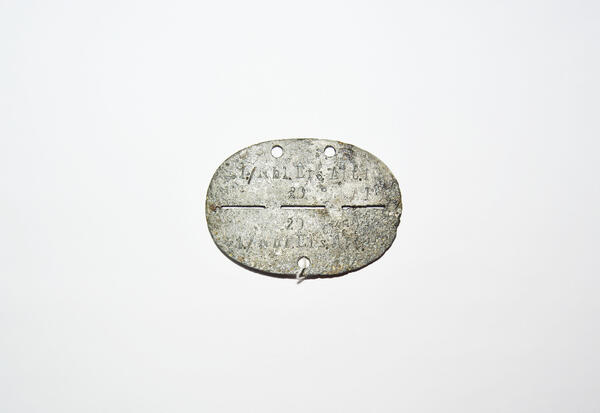
Military dog tags have been used by the German army since the middle of the 19th century. In 1869, the Prussian War Ministry issued an order that required every soldier to wear a tin dog tag on a chain/cord under the uniform, the tag indicated the owner’s battalion, unit, and serial number. In 1878, the shape of the tag was changed from rectangle to oval. In 1915, the size was established — 70 by 50 millimeters; it remained standard until 1945. These tags were used by the infantry, the Air Force, the Waffen-SS, the police, and the Wehrmacht Auxiliary Forces.
Since 1917, the identification information was indicated on both the top and the bottom halves of the dog tag. They were separated by three thin slits along the long side of the oval so that the dog tag could be broken in half — the bottom halves were collected to count the dead. In 1925, a small hole was added to the bottom half of the tag, so that these parts could be hooked on a metal ring and sent to Germany with the reports of the losses.
The tags were issued by the designated military unit. The abbreviated name of the unit, its official number, and the serial number of the soldier, which was given during the initial recruitment, was stamped onto both halves of the tin disk of the tag. All units generally stamped the same type of information on the tags: the abbreviation of the military unit on the top half; the soldier’s blood type and the serial number on the bottom. Names and surnames were not indicated on the tags.
Such complex system helped to identify the fallen soldiers and estimate the number of missing soldiers during the war. All the records and the accumulated halves of the tags were kept in the Wehrmacht Central Information Office for Casualties — Wehrmacht-Auskunft-Stelle (WASt) — in Berlin.
There, the soldiers' identities were established and the losses were accounted for. There are presently more than 100 million records of when and where the tags were issued, as well as about the unit designation, place of death, the time a person went missing, how the tag was found, etc. in the German Federal Archives, the successor agency of Wehrmacht-Auskunft-Stelle (WASt).
Military dog tags have been used by the German army since the middle of the 19th century. In 1869, the Prussian War Ministry issued an order that required every soldier to wear a tin dog tag on a chain/cord under the uniform, the tag indicated the owner’s battalion, unit, and serial number. In 1878, the shape of the tag was changed from rectangle to oval. In 1915, the size was established — 70 by 50 millimeters; it remained standard until 1945. These tags were used by the infantry, the Air Force, the Waffen-SS, the police, and the Wehrmacht Auxiliary Forces.
Since 1917, the identification information was indicated on both the top and the bottom halves of the dog tag. They were separated by three thin slits along the long side of the oval so that the dog tag could be broken in half — the bottom halves were collected to count the dead. In 1925, a small hole was added to the bottom half of the tag, so that these parts could be hooked on a metal ring and sent to Germany with the reports of the losses.
The tags were issued by the designated military unit. The abbreviated name of the unit, its official number, and the serial number of the soldier, which was given during the initial recruitment, was stamped onto both halves of the tin disk of the tag. All units generally stamped the same type of information on the tags: the abbreviation of the military unit on the top half; the soldier’s blood type and the serial number on the bottom. Names and surnames were not indicated on the tags.
Such complex system helped to identify the fallen soldiers and estimate the number of missing soldiers during the war. All the records and the accumulated halves of the tags were kept in the Wehrmacht Central Information Office for Casualties — Wehrmacht-Auskunft-Stelle (WASt) — in Berlin.
There, the soldiers' identities were established and the losses were accounted for. There are presently more than 100 million records of when and where the tags were issued, as well as about the unit designation, place of death, the time a person went missing, how the tag was found, etc. in the German Federal Archives, the successor agency of Wehrmacht-Auskunft-Stelle (WASt).
#28
Full name: 1935 personal identification tag of a Wehrmacht soldier
Date: before 1945
Technique: stamping
Place: Germany
Copyright: Museum Resource Center of Noyabrsk
Dimensions: 7×5×0,1 cm
Goskatalog Number: 16663692
Date: before 1945
Technique: stamping
Place: Germany
Copyright: Museum Resource Center of Noyabrsk
Dimensions: 7×5×0,1 cm
Goskatalog Number: 16663692
#29
Lamp
#30
#6
German soldiers began using pocket lamps for military purposes back in the First World War. They turned on the light mainly at night to see the area. In addition, soldiers could maintain communication between units using light signals in poor visibility.
Before the Second World War, every soldier of the Wehrmacht received a pocket lamp. With the outbreak of war, the economic situation gradually deteriorated. The troops were supplied with pocket lamps selectively, depending on their combat missions and climate conditions.
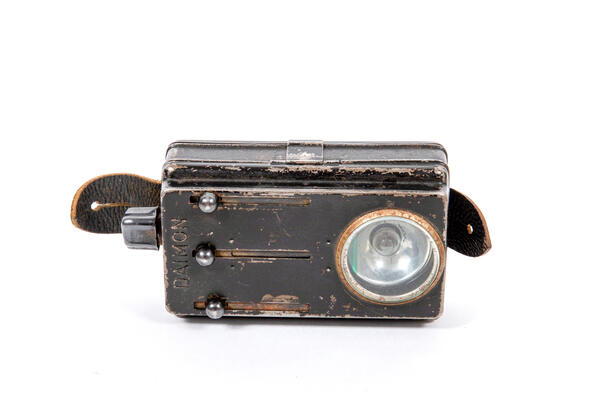
The standard field pocket lamp Feldtaschen Lampe was included in the Wehrmacht special equipment. It had a rectangular flat body. A circular lens on the front side was on the bottom of the pocket lamp. Moreover, there were three cells for plastic color filters above it, which were used to switch to blue, red, or green. Thus, soldiers could send light signals. The color filters were pulled out with sliding pins of the corresponding color. A large button was installed on top to turn the light on and off.
Loops were installed at the top and bottom sides of the pocket lamp to attach it to the uniform. The upper side was attached to an epaulet and the lower one — to a button of the breast pocket.
A retroreflector was included in some pocket lamp kits; it was also called a ‘blackout curtain’. It directed the light at the soldier’s feet without revealing its owner.
Since the main light bulb could burn out at any moment, a spare one was placed in a special holder inside the pocket lamp so that the soldier would not waste time looking for it.
The pocket lamp ran on batteries. The Wehrmacht equipment also had autonomous pocket lamps that ran on a mini-generator. However, they could not emit short signals for communication purposes and they buzzed loudly during operation. Advance guards did not use them, but such pocket lamps came in handy in mountainous areas, where supply shortages could last for a long time.
Officers, non-commissioned officers, and many privates used captured or commercial models in addition to the standard pocket lamps. The most common brands were Pertrix, Wif focus, Hawe, Crone, and Daimon.
Before the Second World War, every soldier of the Wehrmacht received a pocket lamp. With the outbreak of war, the economic situation gradually deteriorated. The troops were supplied with pocket lamps selectively, depending on their combat missions and climate conditions.
The standard field pocket lamp Feldtaschen Lampe was included in the Wehrmacht special equipment. It had a rectangular flat body. A circular lens on the front side was on the bottom of the pocket lamp. Moreover, there were three cells for plastic color filters above it, which were used to switch to blue, red, or green. Thus, soldiers could send light signals. The color filters were pulled out with sliding pins of the corresponding color. A large button was installed on top to turn the light on and off.
Loops were installed at the top and bottom sides of the pocket lamp to attach it to the uniform. The upper side was attached to an epaulet and the lower one — to a button of the breast pocket.
A retroreflector was included in some pocket lamp kits; it was also called a ‘blackout curtain’. It directed the light at the soldier’s feet without revealing its owner.
Since the main light bulb could burn out at any moment, a spare one was placed in a special holder inside the pocket lamp so that the soldier would not waste time looking for it.
The pocket lamp ran on batteries. The Wehrmacht equipment also had autonomous pocket lamps that ran on a mini-generator. However, they could not emit short signals for communication purposes and they buzzed loudly during operation. Advance guards did not use them, but such pocket lamps came in handy in mountainous areas, where supply shortages could last for a long time.
Officers, non-commissioned officers, and many privates used captured or commercial models in addition to the standard pocket lamps. The most common brands were Pertrix, Wif focus, Hawe, Crone, and Daimon.
#31
Full name: Standard field pocket lamp Feldtaschen Lampe. Wehrmacht special equipment
Date: 1933–1945
Technique: factory-made
Place: Germany
Copyright: Museum Resource Center of Noyabrsk
Dimensions: 12,6×6,9×3,5 cm
Goskatalog Number: 16663705
Date: 1933–1945
Technique: factory-made
Place: Germany
Copyright: Museum Resource Center of Noyabrsk
Dimensions: 12,6×6,9×3,5 cm
Goskatalog Number: 16663705
#32
Straight razor
#33
#7
The first straight, or ‘dangerous’ razors with an open blade and handle, began to be produced back in 1680 in Switzerland. They became known as ‘straight’ much later, after 1901, when King Camp Gillette began to massively produce safer T-shaped razors with cheap thin replaceable blades.
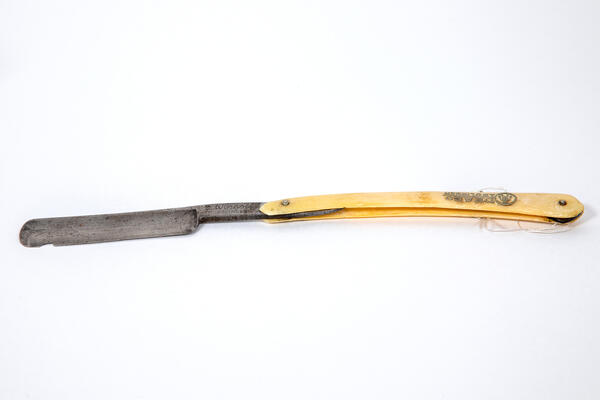
The straight razor presented in the exhibition was found at a site of World War II battles in Tver oblast, Toropets region. The manufacturer’s stamps on it are well preserved: the razor was made in Germany, some time before 1945. It could not be established specifically to which army — the Wehrmacht or the Red Army — the razor belonged.
‘Paul Adrian’ company made this razor. It also produced other popular razors (for example, Mona Lisa, Mona Lisa Luxus, Wasserträger), as well as cutlery and knives. The company was founded in 1901.
The inscription ‘Solingen’, preserved on the blade, is the name of the German city in which the company is located, and a sign of quality. Solingen has been and remained the main manufacturer of striking, edged and hunting weapons in Germany, since the Middle Ages up until now.
Soviet fighters highly appreciated the Solingen SS daggers and Wehrmacht gravity knives, and the Solingen razors were a very popular trophy among the Red Army soldiers, and even were passed to other generations. According to veterans, razors from Solingen were often exchanged for other things or services.
All Red Army soldiers were required to be smoothly shaved. Nevertheless, straight razors were classified as personal belongings and, unlike a boiler and cutlery, were not given out. Fighters bought inexpensive straight razors, used homemade or captured blades. To ensure their performance longevity, they had to be sharpened from time to time and regularly fixed — the edges of the metal had to be aligned. Abrasive stones were usually used for sharpening. And to align the edges, a wide and smooth leather belt (razor strop) was stretched, a blade was put on it flatways and, without applying strong pressure, the blade was polished several times. Sometimes various abrasive compounds were applied to the strop.
The straight razor presented in the exhibition was found at a site of World War II battles in Tver oblast, Toropets region. The manufacturer’s stamps on it are well preserved: the razor was made in Germany, some time before 1945. It could not be established specifically to which army — the Wehrmacht or the Red Army — the razor belonged.
‘Paul Adrian’ company made this razor. It also produced other popular razors (for example, Mona Lisa, Mona Lisa Luxus, Wasserträger), as well as cutlery and knives. The company was founded in 1901.
The inscription ‘Solingen’, preserved on the blade, is the name of the German city in which the company is located, and a sign of quality. Solingen has been and remained the main manufacturer of striking, edged and hunting weapons in Germany, since the Middle Ages up until now.
Soviet fighters highly appreciated the Solingen SS daggers and Wehrmacht gravity knives, and the Solingen razors were a very popular trophy among the Red Army soldiers, and even were passed to other generations. According to veterans, razors from Solingen were often exchanged for other things or services.
All Red Army soldiers were required to be smoothly shaved. Nevertheless, straight razors were classified as personal belongings and, unlike a boiler and cutlery, were not given out. Fighters bought inexpensive straight razors, used homemade or captured blades. To ensure their performance longevity, they had to be sharpened from time to time and regularly fixed — the edges of the metal had to be aligned. Abrasive stones were usually used for sharpening. And to align the edges, a wide and smooth leather belt (razor strop) was stretched, a blade was put on it flatways and, without applying strong pressure, the blade was polished several times. Sometimes various abrasive compounds were applied to the strop.
#34
Full name: Straight razor PEASO SOLINGEN
Date: before 1945
Technique: factory-made
Place: Solingen
Copyright: Museum Resource Center of Noyabrsk
Dimensions: Full length — 23.7 cm, blade length — 7.7 cm, blade width — 1.7 cm
Goskatalog Number: 16663654
Date: before 1945
Technique: factory-made
Place: Solingen
Copyright: Museum Resource Center of Noyabrsk
Dimensions: Full length — 23.7 cm, blade length — 7.7 cm, blade width — 1.7 cm
Goskatalog Number: 16663654
#35
Gas Mask Canister
#36
#8
During the Second World War, there were three models of gas masks used by Wehrmacht soldiers: Gasmaske 24, 30, and 38. They consisted of a filter and a gas mask. In wartime, only the personnel of the army reserve, who trained new recruits and guarded the rear, used in limited quantities the old 1924 gas masks and their cases. The 1930 models were made of rubberized fabric and leather, and the 1938 gas masks were entirely made of rubber. Both models were equipped with a round filter that was screwed onto the mask’s muzzle.
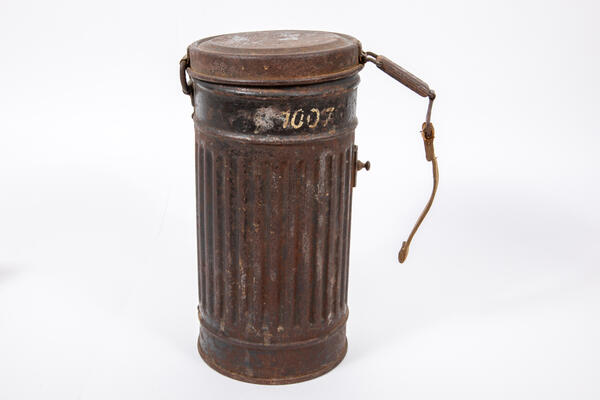
Three types of canisters were produced for gas masks (Tragbuchse fur Gasmaske). The 1930 and 1938 models were compatible with each other. A container for a 1930 gas mask is displayed in the museum. The cylindrical case is made of metal. The lid on the pin hinge is closed with a spring latch on a braided strap.
Soldiers wore the gas mask canister over the bread bag, directly under the waist belt with the lid forward, so that the gas mask could be quickly taken out. The over the shoulder strap was adjusted so that the case was almost in a horizontal position. A short supporting loop with a hook was hung on the waist belt between the left loop of the bread bag and its central supporting hook.
There were other permitted ways for wearing gas mask canisters. These methods depended on the military occupational specialty of a soldier. Machine gunners carried the canisters with the lid to the left; drivers and motorcyclists — on a shortened strap on the chest with the lid to the right; cavalrymen — on the right hip below the waist belt. However, soldiers often wore the gas mask canisters in the way they considered the most convenient.
In winter, gas mask canisters were sometimes painted with washable white paint or covered with white lime for camouflage purposes.
Each service member carried a small brown box in the lid of the gas mask canister with ten losantine tablets for skin disinfection. They were used in case of poisoning with blister agents based on mustard gas and lewisite.
Three types of canisters were produced for gas masks (Tragbuchse fur Gasmaske). The 1930 and 1938 models were compatible with each other. A container for a 1930 gas mask is displayed in the museum. The cylindrical case is made of metal. The lid on the pin hinge is closed with a spring latch on a braided strap.
Soldiers wore the gas mask canister over the bread bag, directly under the waist belt with the lid forward, so that the gas mask could be quickly taken out. The over the shoulder strap was adjusted so that the case was almost in a horizontal position. A short supporting loop with a hook was hung on the waist belt between the left loop of the bread bag and its central supporting hook.
There were other permitted ways for wearing gas mask canisters. These methods depended on the military occupational specialty of a soldier. Machine gunners carried the canisters with the lid to the left; drivers and motorcyclists — on a shortened strap on the chest with the lid to the right; cavalrymen — on the right hip below the waist belt. However, soldiers often wore the gas mask canisters in the way they considered the most convenient.
In winter, gas mask canisters were sometimes painted with washable white paint or covered with white lime for camouflage purposes.
Each service member carried a small brown box in the lid of the gas mask canister with ten losantine tablets for skin disinfection. They were used in case of poisoning with blister agents based on mustard gas and lewisite.
#37
Full name: Gas Mask Canister from a kit “Gas Mask Model 1930”. Wehrmacht
Date: 1937
Technique: factory-made
Place: Solingen
Copyright: Museum Resource Center of Noyabrsk
Dimensions: 25,4×11,8×11,8 cm
Goskatalog Number: 16663699
Date: 1937
Technique: factory-made
Place: Solingen
Copyright: Museum Resource Center of Noyabrsk
Dimensions: 25,4×11,8×11,8 cm
Goskatalog Number: 16663699
#38
Gas Mask Filter Box
#39
#9
Germany became the first country to mass use chemical warfare during military operations. During the First World War, on April 22, 1915, the German army released 168 tons of chlorine gas on the positions of French troops near Belgian Ypres. The Germans also were affected by the deadly gas and were unable to take an advantage of the attack.
Many countries sought to find an effective means of protection from this new type of weapons of mass destruction, including Russia. Multilayer gauze bandages soaked in different solutions did not help in cases of prolonged contact with chlorine, phosgene, or mustard gas.
In 1915, chemist Nikolay Zelinsky synthesized activated charcoal and proved its ability to absorb toxic gases. In November of the same year, engineer Edmond Kummant, a technologist at the ‘Triangle’ factory, presented a special rubber helmet with glasses that protected not only the eyes and respiratory organs but also the head. In Russia, the first batch of coal gas masks was released in 1916 after field tests.
England and Germany launched the new invention of the Russian scientists into production earlier and then they modified the filter by adding chemical absorbers to it — for example, soda lime. In 1915, Germany was the first to provide its soldiers with personal chemical protection equipment.
During the Second World War, Wehrmacht used three models of gas masks: Gasmaske 24, 30, and 38. The gas masks of the 1930 and 1938 models had a similar design: a round filter that was screwed onto the muzzle of the protective mask.
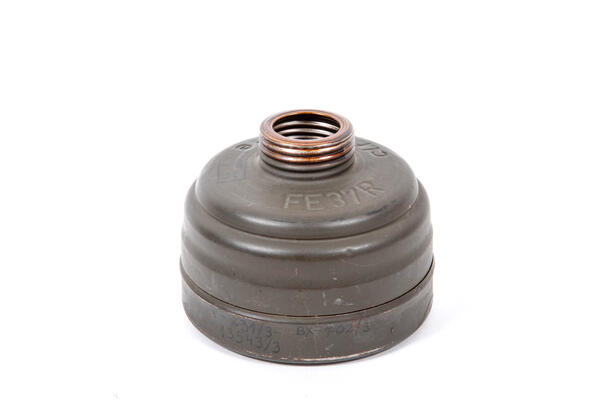
A cylindrical filter box from a gas mask of the 1930 model is housed in the Noyabrsk Museum Resource Center. It is made of metal and painted in a khaki color. The upper part of the box has a thread which is attached to the mask. Inside, there is a filter consisting of alternating layers of filtering, the thickness and the structure of which varied depending on the model. For example, the FE 37 filter had three layers: a fabric soaked in solutions that protects against gases, activated charcoal, and a woven lining that trapped leaked dangerous particles.
The Nazi symbols visible on the exhibit do not seek to promote any ideologies, but reflect the military history of the first half of the 20th century.
Many countries sought to find an effective means of protection from this new type of weapons of mass destruction, including Russia. Multilayer gauze bandages soaked in different solutions did not help in cases of prolonged contact with chlorine, phosgene, or mustard gas.
In 1915, chemist Nikolay Zelinsky synthesized activated charcoal and proved its ability to absorb toxic gases. In November of the same year, engineer Edmond Kummant, a technologist at the ‘Triangle’ factory, presented a special rubber helmet with glasses that protected not only the eyes and respiratory organs but also the head. In Russia, the first batch of coal gas masks was released in 1916 after field tests.
England and Germany launched the new invention of the Russian scientists into production earlier and then they modified the filter by adding chemical absorbers to it — for example, soda lime. In 1915, Germany was the first to provide its soldiers with personal chemical protection equipment.
During the Second World War, Wehrmacht used three models of gas masks: Gasmaske 24, 30, and 38. The gas masks of the 1930 and 1938 models had a similar design: a round filter that was screwed onto the muzzle of the protective mask.
A cylindrical filter box from a gas mask of the 1930 model is housed in the Noyabrsk Museum Resource Center. It is made of metal and painted in a khaki color. The upper part of the box has a thread which is attached to the mask. Inside, there is a filter consisting of alternating layers of filtering, the thickness and the structure of which varied depending on the model. For example, the FE 37 filter had three layers: a fabric soaked in solutions that protects against gases, activated charcoal, and a woven lining that trapped leaked dangerous particles.
The Nazi symbols visible on the exhibit do not seek to promote any ideologies, but reflect the military history of the first half of the 20th century.
#40
Full name: Gas Mask Filter Box from a kit “Gas mask model 1930”. Wehrmacht
Date: 1941
Technique: factory-made
Place: Solingen
Copyright: Museum Resource Center of Noyabrsk
Dimensions: 8,4×10,8×10,8 cm
Goskatalog Number: 16663653
Date: 1941
Technique: factory-made
Place: Solingen
Copyright: Museum Resource Center of Noyabrsk
Dimensions: 8,4×10,8×10,8 cm
Goskatalog Number: 16663653
#41
Gas Mask
#42

#10
During World War II, the opposing forces almost never used chemical weapons, like they did during World War I. However, the German command supplied all Wehrmacht soldiers with gas masks — individual means of protecting respiratory organs, eyes, and facial skin against toxic chemicals and their effects.
The German Army used three models of gas masks (Gasmaske) — 1924, 1930, and 1938 models. The main parts of each model were a tightly sealed mask and a round filter box, which was screwed onto the muzzle of the mask.
During the war, only the personnel of the reserve army, who trained new recruits, military schools and some other institutions used in limited quantities the outdated 1924 gas masks and their cases. Active-duty soldiers received the Gasmaske 30 and Gasmaske 38 models. Their designs were similar, the only difference was that the 1930 masks were made of rubberized cloth and leather, while the 1938 masks were made entirely of rubber.
The mask displayed in the museum is a 1930 model gas mask. It is made of rubberized camouflage fabric, and lined with soft leather on the inside.
The lenses, or visors, consist of two parts: an outer glass layer and an inner layer of transparent plastic. An air pocket in between them prevents the glasses from fogging up in cold weather. Soldiers who had bad eyesight were given special glasses with diopters that could be fastened inside the gas mask.
Elastic straps, joined together with special metal buckles, were attached to the mask. Belts were used to adjust the gas mask, but it did not help if it was not the right size. Looser-fitting masks offered no protection.
At the bottom of the mask was a muzzle with two valves: one for the filtered air and the other for the exhaled carbon dioxide. The filter box was screwed onto the muzzle.
The German Army used three models of gas masks (Gasmaske) — 1924, 1930, and 1938 models. The main parts of each model were a tightly sealed mask and a round filter box, which was screwed onto the muzzle of the mask.
During the war, only the personnel of the reserve army, who trained new recruits, military schools and some other institutions used in limited quantities the outdated 1924 gas masks and their cases. Active-duty soldiers received the Gasmaske 30 and Gasmaske 38 models. Their designs were similar, the only difference was that the 1930 masks were made of rubberized cloth and leather, while the 1938 masks were made entirely of rubber.
The mask displayed in the museum is a 1930 model gas mask. It is made of rubberized camouflage fabric, and lined with soft leather on the inside.
The lenses, or visors, consist of two parts: an outer glass layer and an inner layer of transparent plastic. An air pocket in between them prevents the glasses from fogging up in cold weather. Soldiers who had bad eyesight were given special glasses with diopters that could be fastened inside the gas mask.
Elastic straps, joined together with special metal buckles, were attached to the mask. Belts were used to adjust the gas mask, but it did not help if it was not the right size. Looser-fitting masks offered no protection.
At the bottom of the mask was a muzzle with two valves: one for the filtered air and the other for the exhaled carbon dioxide. The filter box was screwed onto the muzzle.
#43
Full name: Gas Mask from a kit “Gas Mask Model 1930”. Wehrmacht
Date: 1937
Technique: factory-made
Place: Solingen
Copyright: Museum Resource Center of Noyabrsk
Dimensions: 14,5×11×11 cm
Goskatalog Number: 16663650
Date: 1937
Technique: factory-made
Place: Solingen
Copyright: Museum Resource Center of Noyabrsk
Dimensions: 14,5×11×11 cm
Goskatalog Number: 16663650
#44
Infantry Backpack
#45
#11
The German equipment of the Second World War looked a lot like the one used in the First World War. The Tornister 34 backpack, displayed in the museum, became part of the German army equipment in November 1934.
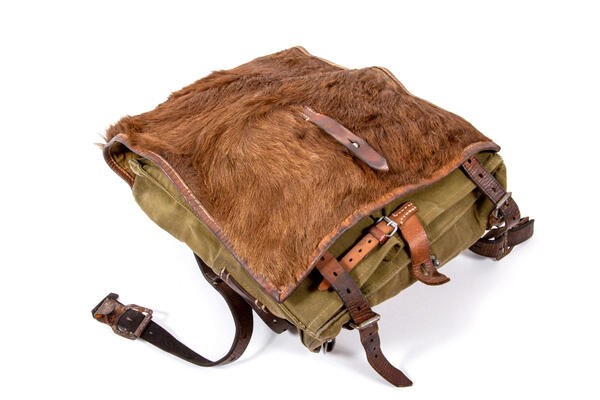
The backpack was made of a dense water-repellent olive-green tarpaulin. It had a calfskin covered frame. It also had leather corners and straps and the outer flap was covered with calfskin. Later, as the economic situation deteriorated during the war, some of the backpacks were made only with a canvas cover.
The manufacturer’s mark was placed on a wide leather strip at the top of the backpack where it connects to the back. The manufacture of backpacks, as well as the production of most items of the German equipment, was carried out by private firms. The name of the company, the city in which it was located, and the year of manufacture were usually indicated on the products. After the invasion of Poland, Germany obliged all its military contractors to put three-letter designations instead — in order to hide the sources of military production.
The backpack displayed in the collection was made in 1940 at the Gebruder Kruger Lederwarenfabrik & Lederfarberei factory in Breslau (Wroclaw, Poland). In addition to backpacks, this company produced leather holsters for personal weapons.
In the field, military personnel signed their backpacks with chemical pencils and indicated the initials or their full name, and sometimes their unit number.
Five years after the release of the 1934 design backpacks, the Tornister 39 was developed. Their contents were the same and strictly regulated. In the main compartment, there were shoes with laces, which were placed with the soles to the side. In the left shoe, they kept a cream and a cloth, and shoe brushes in the right one. A mess tin with biscuits was stored in a special pocket. In the same compartment, they put a bag with camping gear such as a black two-meter rope and wooden pegs. They kept weapon cleaning kits nearby wrapped in a case, a pair of wool socks, a warm sweater, and emergency food — canned meat.
The backpack was made of a dense water-repellent olive-green tarpaulin. It had a calfskin covered frame. It also had leather corners and straps and the outer flap was covered with calfskin. Later, as the economic situation deteriorated during the war, some of the backpacks were made only with a canvas cover.
The manufacturer’s mark was placed on a wide leather strip at the top of the backpack where it connects to the back. The manufacture of backpacks, as well as the production of most items of the German equipment, was carried out by private firms. The name of the company, the city in which it was located, and the year of manufacture were usually indicated on the products. After the invasion of Poland, Germany obliged all its military contractors to put three-letter designations instead — in order to hide the sources of military production.
The backpack displayed in the collection was made in 1940 at the Gebruder Kruger Lederwarenfabrik & Lederfarberei factory in Breslau (Wroclaw, Poland). In addition to backpacks, this company produced leather holsters for personal weapons.
In the field, military personnel signed their backpacks with chemical pencils and indicated the initials or their full name, and sometimes their unit number.
Five years after the release of the 1934 design backpacks, the Tornister 39 was developed. Their contents were the same and strictly regulated. In the main compartment, there were shoes with laces, which were placed with the soles to the side. In the left shoe, they kept a cream and a cloth, and shoe brushes in the right one. A mess tin with biscuits was stored in a special pocket. In the same compartment, they put a bag with camping gear such as a black two-meter rope and wooden pegs. They kept weapon cleaning kits nearby wrapped in a case, a pair of wool socks, a warm sweater, and emergency food — canned meat.
#46
Full name: 1934 model “Tornister 34” Backpack. Wehrmacht
Date: 1940
Technique: factory-made
Place: Solingen
Copyright: Museum Resource Center of Noyabrsk
Dimensions: 76×29,8×11 cm
Goskatalog Number: 16663718
Date: 1940
Technique: factory-made
Place: Solingen
Copyright: Museum Resource Center of Noyabrsk
Dimensions: 76×29,8×11 cm
Goskatalog Number: 16663718
#47
Ministry of Culture of the Russian Federation
read morehide
00:00
00:00
1x
0
 Point your smartphone camera to open in the app
Open in app
Share