#13

Mill, Tin box, Pastry box, Tea storage box, Portfolio, Sander
#20
Hand-cranked mill
#14

#2
Originally, coffee beans were brewed whole without being ground first. The pestle and mortar in which the Bedouins ground coffee beans are considered to be the ancestor of the coffee grinder. This method was not very productive and required significant physical effort, so only Arabian men who had received special training were involved in it.
The first manual coffee grinder was invented in the 15th century. It was a hollow cylinder, usually wooden, into which whole grains were poured. Inside it were two millstones, between which coffee beans were ground. The millstones were set in motion by rotating a handle attached to the top of the cylinder.
In the middle of the 17th century, the first Turkish coffee grinders appeared. They also had a cylindrical shape that made it easy to hold the mill in your hand. The folding handle could be removed into the body. It also served as a wrench, with which you could change the distance between the millstones and disassemble the grinder for cleaning.
Building on Turkish coffee grinders, European variants appeared. They were usually in the shape of a cube with a small pull-out drawer into which the ground coffee was poured after it left the millstones. To load coffee beans, a special funnel was used, which could be of two types - closed and open. In a closed funnel, coffee oxidized less and retained its aroma longer.
Two millstones were placed inside the coffee grinder, which can be brought closer to each other using a special screw. The closer the grindstones, the finer the grind of coffee. The smaller the distance between the millstones, the finer the grinding of the grains is. Millstones were made from different materials, based on their properties - metal ones differed in strength and durability, ceramic ones heated less during grinding, and did not enter into chemical reactions and retained the taste of coffee better. The cube shape that European coffee grinders had was not very convenient, since you had to hold the fixed part with one hand. Sometimes these grinders were secured with a clamp, or clip, to a fixed surface.
On an industrial scale, coffee grinders began to be produced only in the 19th century. The first factory for the production of coffee grinders was owned by the Peugeot brothers in France.
The first manual coffee grinder was invented in the 15th century. It was a hollow cylinder, usually wooden, into which whole grains were poured. Inside it were two millstones, between which coffee beans were ground. The millstones were set in motion by rotating a handle attached to the top of the cylinder.
In the middle of the 17th century, the first Turkish coffee grinders appeared. They also had a cylindrical shape that made it easy to hold the mill in your hand. The folding handle could be removed into the body. It also served as a wrench, with which you could change the distance between the millstones and disassemble the grinder for cleaning.
Building on Turkish coffee grinders, European variants appeared. They were usually in the shape of a cube with a small pull-out drawer into which the ground coffee was poured after it left the millstones. To load coffee beans, a special funnel was used, which could be of two types - closed and open. In a closed funnel, coffee oxidized less and retained its aroma longer.
Two millstones were placed inside the coffee grinder, which can be brought closer to each other using a special screw. The closer the grindstones, the finer the grind of coffee. The smaller the distance between the millstones, the finer the grinding of the grains is. Millstones were made from different materials, based on their properties - metal ones differed in strength and durability, ceramic ones heated less during grinding, and did not enter into chemical reactions and retained the taste of coffee better. The cube shape that European coffee grinders had was not very convenient, since you had to hold the fixed part with one hand. Sometimes these grinders were secured with a clamp, or clip, to a fixed surface.
On an industrial scale, coffee grinders began to be produced only in the 19th century. The first factory for the production of coffee grinders was owned by the Peugeot brothers in France.
#26
Full name Hand-cranked mill
Author unknown
Date early XX century
Technique forged, handmade
Dimensions 24×14 cm
Collection Kótlas Museum of Local Lore
Copyright MUK ‘Kótlas Museum of Local Lore’
Author unknown
Date early XX century
Technique forged, handmade
Dimensions 24×14 cm
Collection Kótlas Museum of Local Lore
Copyright MUK ‘Kótlas Museum of Local Lore’
#21
Tin box
#15

#4
The fascinating history of the Abrikósov family began with the serf Stepán, who at the beginning of the 19th century belonged to the Pénza landowner Levashóv. Stepán produced a very tasty apricot marshmallow candy, and the lady of the house, Anna Petróvna, allowed him to go to Moscow to work. Being an excellent pastry chef, the serf managed to get rich quickly and with the money he earned, he could buy freedom for his family. In 1814, in memory of his first success, Stepán took the surname Abrikósov, or ‘apricot’.
Abrikósov developed the confectionery business together with his son Ivan, but despite the hard work, the company ran into debt. Ivan had to pull his 14-year-old son Alexey out of school in order to send him to work for the famous pastry chef Ivan Hoffman. This step became fateful: Alexey turned out to be an extremely talented pastry chef and merchant himself. Having inherited the dying business of his father and grandfather, he managed to turn it into a vast production.
Alexei Abrikósov had 22 children, and four of them were involved in the family business. Thus, in 1880 the factory, which had a huge annual turnover of two million rubles, was renamed as ‘Partnership of A. I. Abrikósov and Sons’. In 1899, the confectionary was awarded the title of Supplier to the Court of His Imperial Majesty, and before the 1917 revolution they expanded their raw material base, engaged in charity work, and conducted experimentation to create new products.
Alexey Abrikósov understood the importance of advertising, so a fifth of his factory’s expenses were dedicated to promotion. He created his own packaging workshop and hired the famous artist Fyódor Shemyátkin to design boxes and jars of sweets. The packaging, made by order of the “Partnership of A. I. Abrikósov and Sons”, very clearly was in line with the modernist direction, which at the time was actively spreading through Russian industrial design. Many artists from the association “World of Art” were then engaged in the development of labels for famous trading houses.
In Abrikósov’s stores, customers were presented with pocket calendars for certain purchases. Gifts for children were hidden inside chocolate eggs — paper toys, postcards, mosaics. The packages were made in a recognisable series so that buyers could collect them. One day an ad appeared in the newspaper that only blondes were working in one shop of the factory, and only brunettes in another. Many townspeople went to check if this was true, simultaneously buying candies and other sweets.
Abrikósov developed the confectionery business together with his son Ivan, but despite the hard work, the company ran into debt. Ivan had to pull his 14-year-old son Alexey out of school in order to send him to work for the famous pastry chef Ivan Hoffman. This step became fateful: Alexey turned out to be an extremely talented pastry chef and merchant himself. Having inherited the dying business of his father and grandfather, he managed to turn it into a vast production.
Alexei Abrikósov had 22 children, and four of them were involved in the family business. Thus, in 1880 the factory, which had a huge annual turnover of two million rubles, was renamed as ‘Partnership of A. I. Abrikósov and Sons’. In 1899, the confectionary was awarded the title of Supplier to the Court of His Imperial Majesty, and before the 1917 revolution they expanded their raw material base, engaged in charity work, and conducted experimentation to create new products.
Alexey Abrikósov understood the importance of advertising, so a fifth of his factory’s expenses were dedicated to promotion. He created his own packaging workshop and hired the famous artist Fyódor Shemyátkin to design boxes and jars of sweets. The packaging, made by order of the “Partnership of A. I. Abrikósov and Sons”, very clearly was in line with the modernist direction, which at the time was actively spreading through Russian industrial design. Many artists from the association “World of Art” were then engaged in the development of labels for famous trading houses.
In Abrikósov’s stores, customers were presented with pocket calendars for certain purchases. Gifts for children were hidden inside chocolate eggs — paper toys, postcards, mosaics. The packages were made in a recognisable series so that buyers could collect them. One day an ad appeared in the newspaper that only blondes were working in one shop of the factory, and only brunettes in another. Many townspeople went to check if this was true, simultaneously buying candies and other sweets.
#27
Full name Tin box
Author unknown
Date end of XIX century
Place Moscow, Russia
Technique rolling, chromolithography, embossing, soldering
Dimensions 17,2×24,5 cm
Copyright MUK ‘Kótlas Museum of Local Lore’
Collection Kótlas Museum of Local Lore
Author unknown
Date end of XIX century
Place Moscow, Russia
Technique rolling, chromolithography, embossing, soldering
Dimensions 17,2×24,5 cm
Copyright MUK ‘Kótlas Museum of Local Lore’
Collection Kótlas Museum of Local Lore
#22
Pastry box
#16
#6
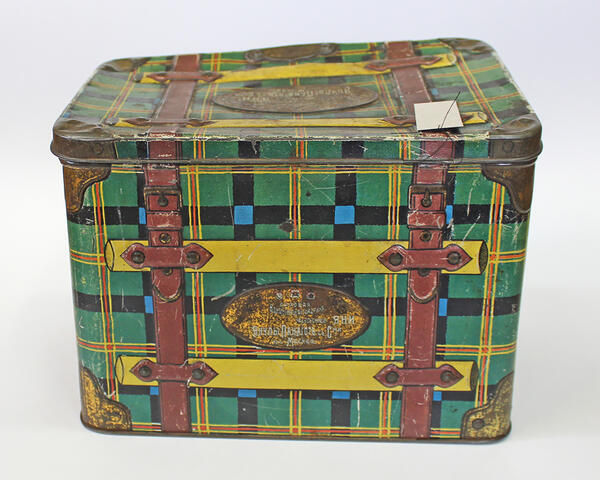
The collection of the Kótlas Museum of Local Lore contains a confectionery box in the form of a chest. On the box is the trademark ‘Steam Confectionery Factory of the Trading House of the Heiress Yanúla Panaiot Yani and Family in Moscow’. The box was given to the collection by a local resident. In such metal boxes, decorated with chromolithography, sweets were packaged for sale.
Chromolithography is a color lithography in which a separate printing plate was used to apply each color. This technique was widely used in the second half of the 19th and early 20th centuries.
Ivan Yani’s factory operated from 1880 to 1917. It was founded by Yani Panayot, a native of the city of Rodósto, now Tekirdág in Turkey. A Greek by nationality, he quickly became Russified, calling himself Ivan Pávlovich and successfully launching the production of oriental sweets in Moscow. Yani’s confectioneries sold Turkish delights, marshmallow and marmalade. But it was his coffee shop in Sokólniki that was especially popular, where visitors were offered coffee with cinnamon and cardamom, baked pears with a slice of cheese and walnut pulp, honey and apple milkshakes, berry marshmallows and sherbet. On holidays, an orchestra played, and children rode on a horse-drawn cart.
After the death of Ivan Pávlovich in 1895, the business passed first to his wife Yanúla, and then to his eldest son Euripides. Soon, sweets began to be produced under the brand name ‘Steam Factory of the Trading House of the Heiress Yanúla Panaiot Yani and Sons in Moscow.’ New coffee shops and pastry shops were opened. A contemporary wrote: ‘For the fifth year now, in Moscow, the cafe “Yani” (Tverskáya, 68) serves as the only meeting place for artists of variety shows and circuses. Here you can find out all the news, and meet a friend, agent, or director. There is a special mail service “on demand”. There is also a large number of magazines, Russian and foreign.’
The selection of confectionery products also increased — glazed chestnuts and various types of caramel started to be sold. At this time, the factory became a leader in the production of marmalade. Numerous medals were affixed on the candy wrappers and candy boxes, including those confirming that the family was the official supplier of the courts of His Majesty the King of Greece and the King of Serbia.
At the beginning of the twentieth century, business developed by leaps and bounds, the wealth of the Yani family grew. But after the revolution, the production of confectionery products stopped, and the factory was closed. Some family members fled the country, while others stayed and were persecuted. Today, only the candy boxes remain as the remnants of former splendor.
Chromolithography is a color lithography in which a separate printing plate was used to apply each color. This technique was widely used in the second half of the 19th and early 20th centuries.
Ivan Yani’s factory operated from 1880 to 1917. It was founded by Yani Panayot, a native of the city of Rodósto, now Tekirdág in Turkey. A Greek by nationality, he quickly became Russified, calling himself Ivan Pávlovich and successfully launching the production of oriental sweets in Moscow. Yani’s confectioneries sold Turkish delights, marshmallow and marmalade. But it was his coffee shop in Sokólniki that was especially popular, where visitors were offered coffee with cinnamon and cardamom, baked pears with a slice of cheese and walnut pulp, honey and apple milkshakes, berry marshmallows and sherbet. On holidays, an orchestra played, and children rode on a horse-drawn cart.
After the death of Ivan Pávlovich in 1895, the business passed first to his wife Yanúla, and then to his eldest son Euripides. Soon, sweets began to be produced under the brand name ‘Steam Factory of the Trading House of the Heiress Yanúla Panaiot Yani and Sons in Moscow.’ New coffee shops and pastry shops were opened. A contemporary wrote: ‘For the fifth year now, in Moscow, the cafe “Yani” (Tverskáya, 68) serves as the only meeting place for artists of variety shows and circuses. Here you can find out all the news, and meet a friend, agent, or director. There is a special mail service “on demand”. There is also a large number of magazines, Russian and foreign.’
The selection of confectionery products also increased — glazed chestnuts and various types of caramel started to be sold. At this time, the factory became a leader in the production of marmalade. Numerous medals were affixed on the candy wrappers and candy boxes, including those confirming that the family was the official supplier of the courts of His Majesty the King of Greece and the King of Serbia.
At the beginning of the twentieth century, business developed by leaps and bounds, the wealth of the Yani family grew. But after the revolution, the production of confectionery products stopped, and the factory was closed. Some family members fled the country, while others stayed and were persecuted. Today, only the candy boxes remain as the remnants of former splendor.
#28
Full name Pastry box
Author unknown
Date late XIX - early XX centuries
Place Moscow, Russia
Technique embossing, soldering, rolling, chromolithography, factory production
Dimensions 24×16,5 cm
Collection Kótlas Museum of Local Lore
Copyright MUK ‘Kótlas Museum of Local Lore’
Author unknown
Date late XIX - early XX centuries
Place Moscow, Russia
Technique embossing, soldering, rolling, chromolithography, factory production
Dimensions 24×16,5 cm
Collection Kótlas Museum of Local Lore
Copyright MUK ‘Kótlas Museum of Local Lore’
#23
Tea storage box
#17

#8
The collection of the Kótlas Museum includes this rectangular tin box with rounded corners and a hinged lid. The box shows views of Moscow. It is decorated with images of the Bolshói Theater in Moscow, the Cathedral of Christ the Savior, the Arc de Triomphe, and the shopping center. On the lid is a view of the Kremlin. Under the top cover is a printed table of the current cost (‘“Preis-Courant “) of tea in bulk versus by the box. The manufacturers are David Vysótsky and Raphael Gotz in Moscow and Odessa, respectively.
Drinking tea in large quantities in Russia began in the 19th century. Two-thirds of the import of tea came from long-leaf loose tea, and a third from pressed bricks of powder. Long-leaf loose tea was in demand in Central Russia, and the compressed bricks became more widespread in Central Asia and Siberia. By the end of the 19th century, tea had become a popular commodity.
One of the most famous tea merchants in Russia was the Vysótsky dynasty. The company opened branches in Russia and abroad, and its own tea-packing factories in Moscow, St. Petersburg, Chelyábinsk, Odessa, Kókand and Sreténsk. The Vysótsky factories were considered some of the most advanced and technically equipped. The number of workers in factories reached 22 thousand people. The level of social security at the enterprises was unusually high by the standards of that time - the company maintained hostels, baths, hospitals, medical centers, and savings and loan banks were created for employees.
In 1904, a representative office of the Vysótskys was opened in New York, and in 1907 a branch opened in London. In 1913, the leadership established a charitable society in Berlin, which financed the training of poor Russian and foreign Jewish technical students in Palestine. In 1913, Vysótsky & Co., with its main warehouses in Moscow, Odessa, Chelyabinsk and Nízhny Novgorod, expanded its network of retail establishments throughout Russia.
However, the life of the empire was interrupted by the First World War. The owners of Vysótsky and Co. transferred large sums of money for military needs, at the disposal of the Moscow Exchange Committee and the Moscow Jewish Society for Aid to the Wounded and Sick Soldiers. An infirmary was organized at the Moscow tea-packing factory. The October Revolution ended the history of the Vysótsky tea company in Russia. In 1918, all branches and tea-packing factories were nationalized.
However, Vysótsky & Co. was the only Russian tea company that managed to continue its business, transferring management to London, preserving capital and its foreign branches. The firm later moved to Palestine and eventually settled in Israel.
Drinking tea in large quantities in Russia began in the 19th century. Two-thirds of the import of tea came from long-leaf loose tea, and a third from pressed bricks of powder. Long-leaf loose tea was in demand in Central Russia, and the compressed bricks became more widespread in Central Asia and Siberia. By the end of the 19th century, tea had become a popular commodity.
One of the most famous tea merchants in Russia was the Vysótsky dynasty. The company opened branches in Russia and abroad, and its own tea-packing factories in Moscow, St. Petersburg, Chelyábinsk, Odessa, Kókand and Sreténsk. The Vysótsky factories were considered some of the most advanced and technically equipped. The number of workers in factories reached 22 thousand people. The level of social security at the enterprises was unusually high by the standards of that time - the company maintained hostels, baths, hospitals, medical centers, and savings and loan banks were created for employees.
In 1904, a representative office of the Vysótskys was opened in New York, and in 1907 a branch opened in London. In 1913, the leadership established a charitable society in Berlin, which financed the training of poor Russian and foreign Jewish technical students in Palestine. In 1913, Vysótsky & Co., with its main warehouses in Moscow, Odessa, Chelyabinsk and Nízhny Novgorod, expanded its network of retail establishments throughout Russia.
However, the life of the empire was interrupted by the First World War. The owners of Vysótsky and Co. transferred large sums of money for military needs, at the disposal of the Moscow Exchange Committee and the Moscow Jewish Society for Aid to the Wounded and Sick Soldiers. An infirmary was organized at the Moscow tea-packing factory. The October Revolution ended the history of the Vysótsky tea company in Russia. In 1918, all branches and tea-packing factories were nationalized.
However, Vysótsky & Co. was the only Russian tea company that managed to continue its business, transferring management to London, preserving capital and its foreign branches. The firm later moved to Palestine and eventually settled in Israel.
#29
Full name Tea storage box
Author unknown
Date first half of the 20th century
Technique rolling, chromolithography
Place Moscow, Russia
Dimensions 13×13 cm
Collection Kótlas Museum of Local Lore
Copyright MUK “Kótlas Museum of Local Lore”
Author unknown
Date first half of the 20th century
Technique rolling, chromolithography
Place Moscow, Russia
Dimensions 13×13 cm
Collection Kótlas Museum of Local Lore
Copyright MUK “Kótlas Museum of Local Lore”
#24
Birch bark portfolio
#18

#10
The collection of the Kotlas Museum of Local Lore contains a birch bark briefcase of the early 20th century. It was found in an uninhabited house in the village of Voroshílovo, Lénsky District, Arkhángelsk Region.
Birch bark occupied a huge place in the life of a Russian. The bark accompanied a person throughout his life - from birth to the last days. Birch bark was used to make rattles, cradles, sandals, and hats. Various tools were woven from it — baskets, containers, road salt shakers, cases, floats for fishing, birch bark boats, and boxes for women’s jewelry. Often all this was decorated with carving, painting or embossing. Ceiling thatch and lower rims of the housing frame were laid in layers of birch bark to protect huts from dampness and decay.
Birch bark craftsmanship took place mostly in winter and spring, when not otherwise busy with agricultural worries. The most widespread subject of birch bark trade in the Arkhangelsk region was birch baskets. The Russian is borrowed from the Komi language: “toi” means “birch bark”.
For the manufacture of birch bark products, craftsmen used traditional tools: a spade, jamb knife, scissors, “shemíltsi”, and “kochedík”. A jamb knife is a root or branch of a tree sharpened at two angles. It is used to safely remove the bark from a tree. Handcrafted jamb knives are steel blades with different bevel angles and sometimes double-sided sharpening. You can cut birch bark with such a knife both with the toe of the cutter and with its heel. Currently, craftsmen use ordinary scissors, although earlier used special forged ones for work. “Shemiltsy” are simple clamps for birch bark, and a “kochedyk” is a flat awl with a hook-like bend for weaving. In the Arkhángelsk region, many modern craftsmen work observing the traditions of the craft.
Another way of making items from birch bark is actual weaving. Depending on the product, the master would prepare birch bark ribbons with a width of five millimeters to seven centimeters and weaved various objects with straight or oblique weaving. The size of the wickerwork ranged from chicken egg-sized salt shakers to large chests. Baskets and spacious shoulder bags were woven in large quantities. This birch-bark portfolio from the museum’s collection is made in a similar way.
Birch bark occupied a huge place in the life of a Russian. The bark accompanied a person throughout his life - from birth to the last days. Birch bark was used to make rattles, cradles, sandals, and hats. Various tools were woven from it — baskets, containers, road salt shakers, cases, floats for fishing, birch bark boats, and boxes for women’s jewelry. Often all this was decorated with carving, painting or embossing. Ceiling thatch and lower rims of the housing frame were laid in layers of birch bark to protect huts from dampness and decay.
Birch bark craftsmanship took place mostly in winter and spring, when not otherwise busy with agricultural worries. The most widespread subject of birch bark trade in the Arkhangelsk region was birch baskets. The Russian is borrowed from the Komi language: “toi” means “birch bark”.
For the manufacture of birch bark products, craftsmen used traditional tools: a spade, jamb knife, scissors, “shemíltsi”, and “kochedík”. A jamb knife is a root or branch of a tree sharpened at two angles. It is used to safely remove the bark from a tree. Handcrafted jamb knives are steel blades with different bevel angles and sometimes double-sided sharpening. You can cut birch bark with such a knife both with the toe of the cutter and with its heel. Currently, craftsmen use ordinary scissors, although earlier used special forged ones for work. “Shemiltsy” are simple clamps for birch bark, and a “kochedyk” is a flat awl with a hook-like bend for weaving. In the Arkhángelsk region, many modern craftsmen work observing the traditions of the craft.
Another way of making items from birch bark is actual weaving. Depending on the product, the master would prepare birch bark ribbons with a width of five millimeters to seven centimeters and weaved various objects with straight or oblique weaving. The size of the wickerwork ranged from chicken egg-sized salt shakers to large chests. Baskets and spacious shoulder bags were woven in large quantities. This birch-bark portfolio from the museum’s collection is made in a similar way.
#30
Full name Birch bark portfolio
Author unknown
Date early XX century
Technique weaving, handmade
Place derevnya Voroshilovo, Lenskij rajon, Arhangel’skaya oblast', Russia
Dimensions 25,5×31,5 cm
Copyright MUK “Kótlas Museum of Local Lore”
Collection Kótlas Museum of Local Lore
Author unknown
Date early XX century
Technique weaving, handmade
Place derevnya Voroshilovo, Lenskij rajon, Arhangel’skaya oblast', Russia
Dimensions 25,5×31,5 cm
Copyright MUK “Kótlas Museum of Local Lore”
Collection Kótlas Museum of Local Lore
#25
Sander, inkstand component
#19

#12
The museum’s collection contains this component of an inkstand kit - a golden sander. It came to the collection from the Solvychevódsky district of the Vológda province.
Such a sander was needed to dry the ink. During the 17th-19th centuries, the set of writing materials included ink, quills, a sander, paper, pencils, and — in the era of goose feather quills — a penknife. With the advent of machine-made goose pens, as well as steel quills, fountain tips were included, as well as slate boards and slates. A knife was also usually included for cutting the pages of books and magazines - although it was not part of the actual writing utensils, it was typically used on the inkstand. The sander was usually the same shape as the paired inkwell. The difference was that the inkwell had a hinged lid, while the sander had a lid with numerous small holes. The sander existed as a component of stationary material from the 17th century to the beginning of the 19th century and was mentioned in literature.
“On the table were two inseparable friends: an inkwell and the sander”
Alexey Pisémsky, 1821-1881
In Russia, until 1917, a sander was a part of the inkstand in the form of a small metal box with numerous small holes in the lid, which were filled with special fine boiled sand to dry the ink. Subsequently, in office use, blotting paper became a competitor to the sander, and with the gradual disappearance of ink from bureaucratic and school offices, sanders finally fell out of use.
The museum sander is made in the form of an ancient Greek amphora with a round base. The base was attached to the body with a screw connection. The body itself is a figure, narrow at the bottom, smoothly widening towards the middle, and then smoothly tapering towards the neck, which is the narrowest part of the sander. The top of the sander looks like a flattened ball. At the top of the ball there are four holes, and at the very top of the ball in the center is a small mushroom-shaped tip. The sander is decorated with horizontal curly ledges and grooves.
Such a sander was needed to dry the ink. During the 17th-19th centuries, the set of writing materials included ink, quills, a sander, paper, pencils, and — in the era of goose feather quills — a penknife. With the advent of machine-made goose pens, as well as steel quills, fountain tips were included, as well as slate boards and slates. A knife was also usually included for cutting the pages of books and magazines - although it was not part of the actual writing utensils, it was typically used on the inkstand. The sander was usually the same shape as the paired inkwell. The difference was that the inkwell had a hinged lid, while the sander had a lid with numerous small holes. The sander existed as a component of stationary material from the 17th century to the beginning of the 19th century and was mentioned in literature.
“On the table were two inseparable friends: an inkwell and the sander”
Alexey Pisémsky, 1821-1881
In Russia, until 1917, a sander was a part of the inkstand in the form of a small metal box with numerous small holes in the lid, which were filled with special fine boiled sand to dry the ink. Subsequently, in office use, blotting paper became a competitor to the sander, and with the gradual disappearance of ink from bureaucratic and school offices, sanders finally fell out of use.
The museum sander is made in the form of an ancient Greek amphora with a round base. The base was attached to the body with a screw connection. The body itself is a figure, narrow at the bottom, smoothly widening towards the middle, and then smoothly tapering towards the neck, which is the narrowest part of the sander. The top of the sander looks like a flattened ball. At the top of the ball there are four holes, and at the very top of the ball in the center is a small mushroom-shaped tip. The sander is decorated with horizontal curly ledges and grooves.
#31
Full name Sander, inkstand component
Author unknown
Date XIX century
Place Sol’vychegodsk, Arhangel’skaya oblast', Russia
Technique casting, factory Production
Dimensions 16,5×8,5 cm
Collection Kótlas Museum of Local Lore
Copyright MUK “Kótlas Museum of Local Lore”
Author unknown
Date XIX century
Place Sol’vychegodsk, Arhangel’skaya oblast', Russia
Technique casting, factory Production
Dimensions 16,5×8,5 cm
Collection Kótlas Museum of Local Lore
Copyright MUK “Kótlas Museum of Local Lore”
read morehide
00:00
00:00
1x
Mill, Tin box, Box, Tea box, Portfolio, Sander
Collection
Exhibition
0
 Point your smartphone camera to open in the app
Open in app
Share