Font
Color
Graphics
Изображение точки

To see AR mode in action:

1. Install ARTEFACT app for iOS or Android;

2. Find the exhibition «Stary Oskol: from a Fortress to a Metals Giant»

3. Push the «Augmented reality» button and point your phone's camera at the exhibit;

Скрыть точки интересаПоказать точки интереса
Показать в высоком качестве
#9
Festive rushnik
#3
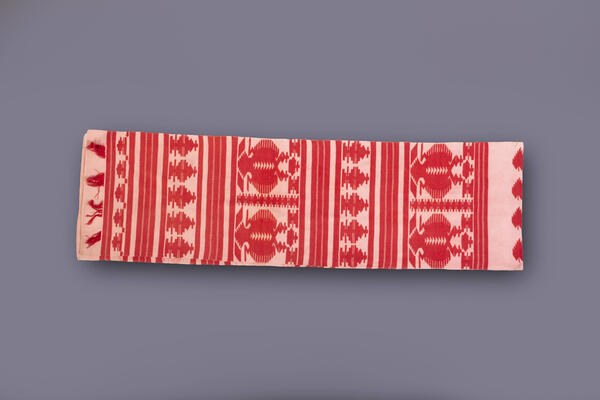
The festive rushnik towel was embroidered at the weaving factory of Krolevets. Krolevets is a small old town, located in the Sumy region of Ukraine. Since ancient times the town has been a center of patterned weaving. The Krolevets towels gained the greatest popularity in the 19th century. Krolevets Craft School founded in 1909, trained potters, blacksmiths and weavers. This school exists today and provides training for future builders, construction technicians, hairdressers, salesmen, and masters of handmade artistic weaving.

The history of the Krolevets factory “Artistic Weaving” dates back to 1922, when weavers working at home united to establish the cooperative craft society of decorative art “Revival”. The artistic image of the Krolevets rushnik absorbed the main features of Slavic peasant decorative patterns: rosettes, circles, rhombuses, squares, triangles, and stars. Old rushniks feature stylized floral motifs, vases with flowers, similar to tulips, “crane” medallions, as well as “candlesticks”, from which, like a flame, red mallows rise up — the flowers that are clearly identified both on the weaved and embroidered patterns. Geometric shapes are accurately reproduced in the pattern. This style featured flowers, leaves, wheat heads, stars, birds, and the sky. A straight horizontal line represented the earth, a wavy line — water, and the cross was a symbol of fire.

The most typical geometric shape for weaving was the rhombus that once symbolized the sun, the ancient deity of the Slavic farmers. One of the significant elements of the design was the state symbol — the two-headed eagle. Such rushniks could be given by young people to elderly relatives as a sign of respect; they were also presented to brothers or a beloved one, who went for a long term military service. They were also used to cover the icon “In Search of the Perishing”. The combination of white and red colors is characteristic of the Krolevets rushniks. On a white background between the dense red parallel stripes a lavish pattern was woven. Some towels are woven with an all-over pattern, while others have such patterns that are dense on the edges and thin down to the middle. The use of the traditional weaving technique perebor is quite common.
#10
Наименование: Festive rushnik
Дата создания: the early 20th century
Место создания: Krolevets, the Russian Empire
Техника: patterned weaving
Размеры: 246×35 cm
#11
Rubel
#5
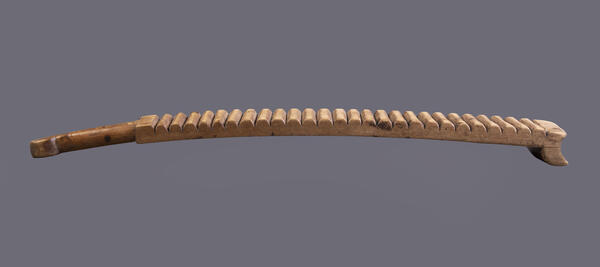
A rubel was an ironing tool made of wood. It is often confused with the valyok, which looks very much like a rubel and was used to beat the laundry while washing it. A valyok has a shorter and wider blade, without the ribs typical of a rubel. A rubel is a wooden board with carved cross grooves for rolling the laundry. The laundry, pressed by hand, was wound onto a roller or rolling pin and rolled using the rubel. The laundry was folded several times in narrow strips. The winding had to be very tight and without folds. A housewife would roll the bundle on the table, pressing it firmly with a rubel. This was physically hard work, but the laundry rolled this way was soft and smooth.

Rubels were made in the form of a hardwood board with a handle at one end. The board had transverse rounded grooves on one side, while the other remained smooth and was sometimes decorated with intricate carvings. In different regions rubels could be different in shape or peculiar ornaments. So, in the Vladimir governorate a rubel, decorated with geometrical carving, was unusually long; on the river Mezen a rubel was wide and slightly widened towards the end, and in the Yaroslavl governorate besides geometrical carving a rubel was sometimes decorated with a volumetric sculpture, which, protruding over a carved surface, served at the same time as a very convenient second handle.

The intricate carving on the displayed rubel combines solar signs and geometric ornamentation. The solar signs symbolize wealth, joy and good fortune.

In Starooskolsky uyezd, woodworking crafts were the most widespread ones. They included wheel making, production of sleighs, carts, cooperage, production of distaffs, harrows, combs and rubels. The woodworking industry was concentrated mainly in the villages of Lapygino, Kurskaya, Bor-Anpilovka, Obukhovka and Orlinka. In total 250 homesteads were engaged in this craft. The goods were exported to Kursk, Voronezh and other cities in small batches and sold at fairs.
#12
Наименование: Rubel
Дата создания: the early 20th century
Место создания: the Russian Empire
Техника: wood, wood carving
Размеры: 64×8 cm
#13
“Horseman” clay toy
#7
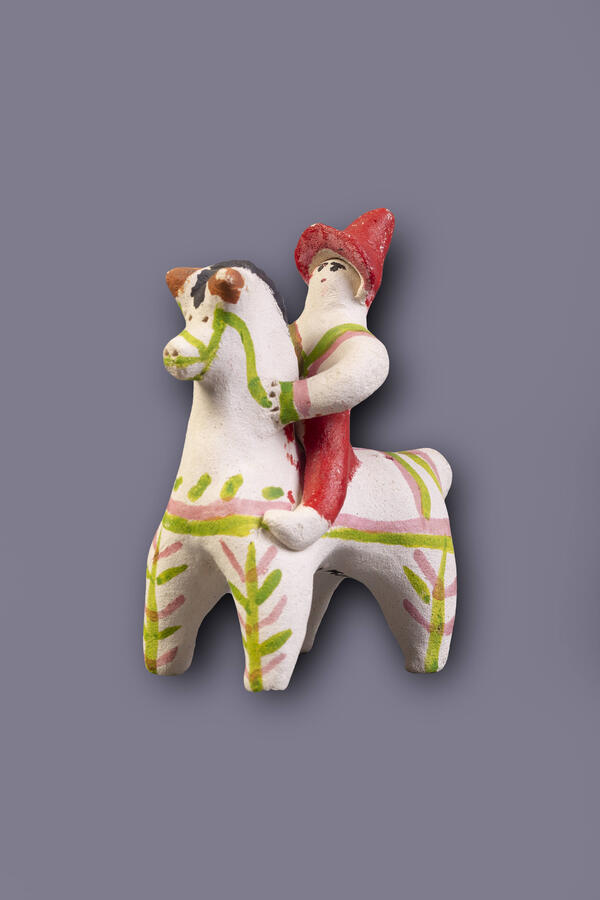
The “Horseman” is made in the traditions of Stary Oskol clay toys. The figurine is decorated with acrylic paints.

Pottery was one of the first crafts to emerge in Stary Oskol. Once the Stary Oskol frontier fortress had been transformed into a regular town, the military service of the Cossacks who had founded the settlement was abolished. Most of the Cossacks joined the category of state peasants and artisans. The Cossack settlement saw a gradual development of pottery, which survived until the mid-20th century. Along with the traditional pottery craftsmen made clay toys. Easy to make, the toy was molded to fill the place in the kiln between the large vessels. It was cheap and very popular. Each craftsman had their own technique of making toy whistles. But all of them were based on certain traditions that have survived to this day.

The Stary Oskol toys are characterized by a lively and naïve image, soft sculptured forms, uneven surface texture, and clear deep sound of whistles. In the early 20th century, the trade began to disappear, as clay handmade toys could not compete with the manufactured ones.

Sisters Olga Mikhailovna (1913–1997) and Natalya Mikhailovna (1918-2010) Goncharovs are the founders of the present industry of clay toys. The sisters acquired their skills of clay toy modeling in the 1920s, having learned them from their parents. As the living keepers of centuries-old traditions they revived the art of clay toy modeling of Stary Oskol, preserved its originality and passed the secrets of their skill to their apprentices.

The technique of modeling is as follows: a figurine is modeled from a lump of clay, the other parts and elements (headdress, clothing, etc.) are superimposed. The figurine is fired at a temperature of 200 to 850 degrees for 3 hours. At full firing, the clay becomes light. To paint figurines watercolors and tempera paints are used, nowadays ceramic paints are common too. The toys traditionally feature the figures of bears, horses, deer, birds, ladies, and riders.
#14
Наименование: “Horseman” clay toy
Автор: Natalya Goncharova
Дата создания: 1989
Место создания: Stary Oskol, the USSR
Техника: molding, painting
Размеры: height — 9.5 cm
#8
read morehide
00:00
00:00
1x

Festive rushnik, rubel, clay toy

0
Point your smartphone camera to open in the app
Share
VkontakteOdnoklassnikiTelegram
Share on my website
Copy linkCopied
Copy
Open in app
To see AR mode in action:
  1. Install ARTEFACT app for 
  2. iOS or Android;
  3. Find and download the «Paintings in Details» exhibition
  4. Push the «Augmented reality» button and point your phone's camera at the painting;
  5. Watch what happens on your phone screen whilst you flip through the pictures.
 
We use Cookies
Cookies on the Artefact Website. We use cookies to ensure that we give you the best experience on our website. If you continue without changing your settings, we'll assume that you are happy to receive all cookies on the Artefact website. However, if you would like to, you can change your cookie settings at any time.
Learn more about cookie useHide
Content is available only in Russian

X

Нашли опечатку?...

%title%%type%