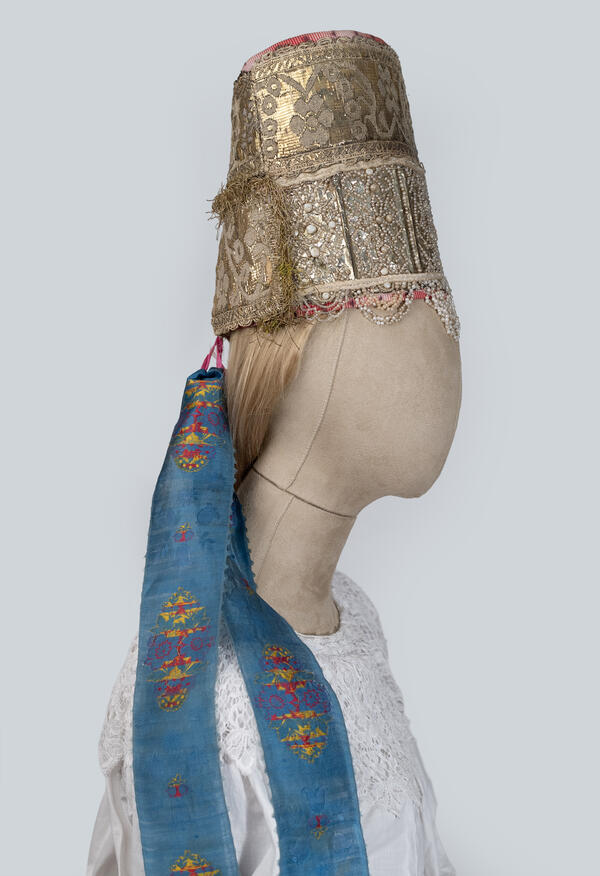
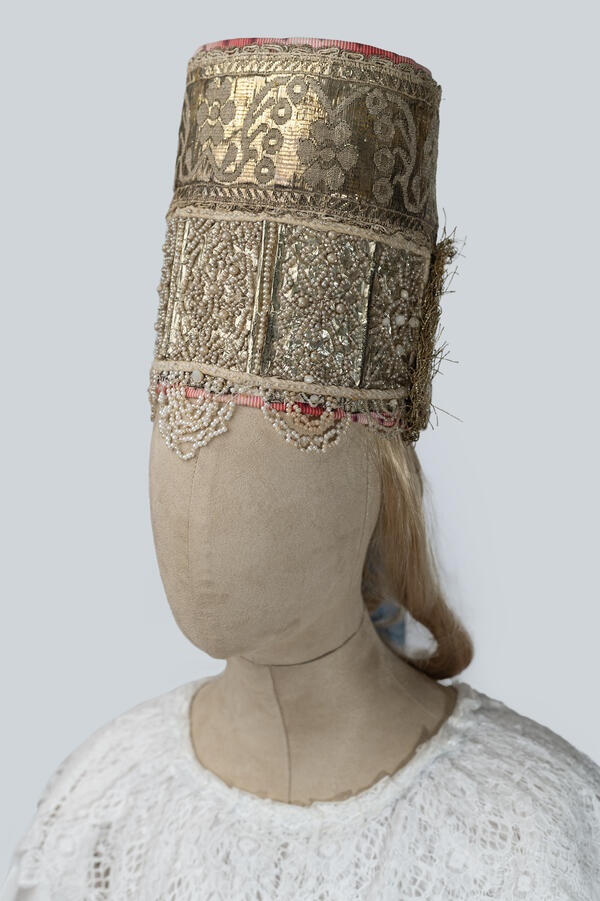
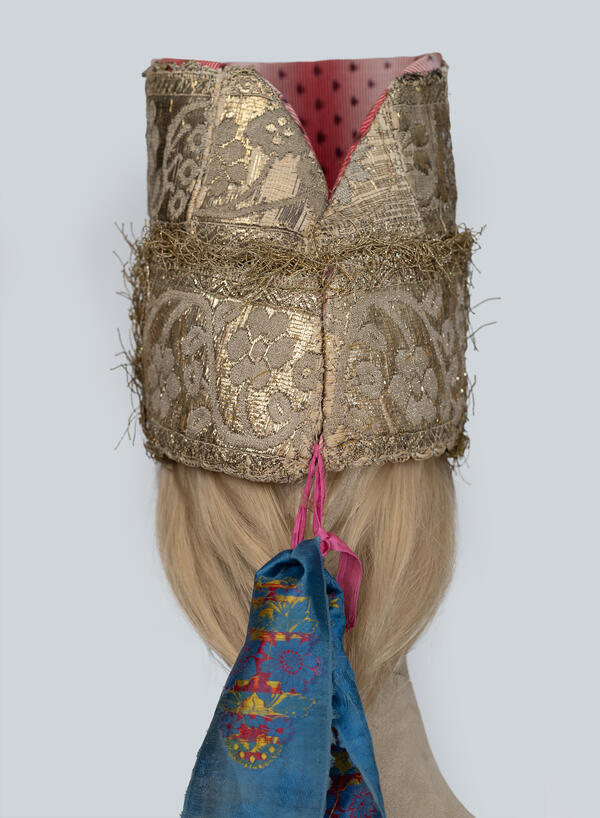
This women’s headband was made either in the late 19th or early 20th century. The craftsman decorated it with beads, button-shaped pearls, and a strip of fabric called khaz (a higher-quality piece of a headdress, always worn on the outside) with two blue ribbons. Headbands like this one were worn on special occasions and had a solid backing with wide ribbons. The height usually ranged from 7 to 19 centimeters.
The upper part of the headband and the ends of the ribbons were made from seaming lace. The lower part made of foil was divided into five squares, and they were decorated with patterns of beads, glass beads, and button-shaped pearls. There is a string of beads along the lower edge, falling in festoons over the forehead. Russian craftsmen often used round and floral rosettes, snowflakes, and blooming branches as sewing motifs.
Russian women could wear different headdresses depending on their status: soroka, povoinik, kokoshnik, and various types of headbands. Some were worn on a daily basis, while others were reserved for special occasions. Each headdress corresponded to the wearer’s age and status.
Even though the headdresses were referred to by the same name almost throughout the country, they had major design differences. There could be variations in names and styles found even in two neighboring villages. That was also the case for the southern coast and the Onega coast of the White Sea.
Older women wore headdresses that completely covered their heads, so that no one could see their hair. The shape often depended on the way the hair was tied up, which was either in a bun or “a bird’s nest”. If the former, the headdress had an elongated, protruding hard edge above the forehead called “ochelye”. In case there were two braids placed on the top of the head in the form of a nest, the shape of the headdress was different — round and cylindrical like the one worn in Pomorye and Pinezhsky regions. Unmarried young women could let their braids fall freely.
The woman’s age could be guessed not only from the details of the headdress she had on: younger women’s festive clothes were more colorful and brighter, and great store was set by decorative elements, which were mostly ornamental.