Font
Color
Graphics
Изображение точки

To see AR mode in action:

1. Install ARTEFACT app for iOS or Android;

2. Find the exhibition «The Ethnography of Transbaikal»

3. Push the «Augmented reality» button and point your phone's camera at the exhibit;

Скрыть точки интересаПоказать точки интереса
Показать в высоком качестве

Belt, Pozatylnik, Kokoshnik

0
Open in app
#1
Belt, Pozatylnik, Kokoshnik
#2
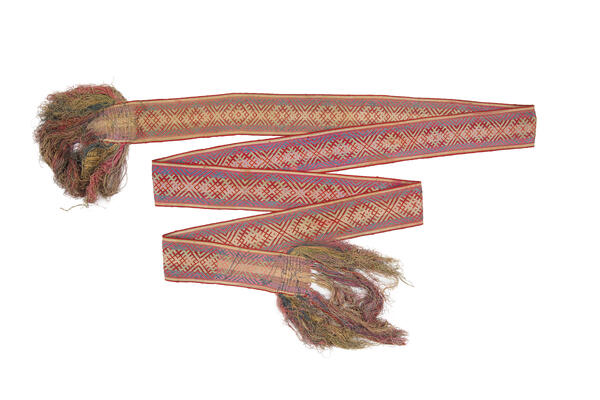
Belt of the Semeiskie of Transbaikal
#10
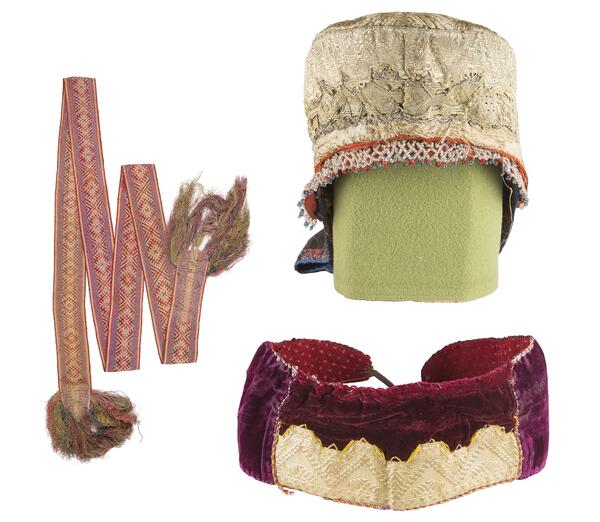
The Transbaikal Regional Museum of Local Lore houses a narrow thin silk homespun belt. It was an obligatory element of men’s and women’s costume of the Semeiskie — a community of Old Believers who were forced to relocate from Poland to Transbaikalia in the 18th century. The Semeiskie used bright expensive fabrics for their clothing items: satin, cashmere, canvas, silk and velvet.

The belt of 6.5 centimeters in width was made in the 1920s–1930s; the item was transferred to the museum after an ethnographic expedition. It was worn over a sundress and under a zapon — a traditional apron. Decorations and the size of the belt were different: some belts could reach 15 centimeters in width and 3.5 meters in length. Ornamented belts were popular among the Semeiskie in the Republic of Buryatia. Such items were decorated with embroidery and patterns. In Transbaikalia, Old Believers wore monochrome accessories made of fabric scraps. They sewed colorful longitudinal stripes on them or did not decorate them at all.

Various districts in Transbaikalia established their own rules and traditions of sewing and wearing the belt. In the 2010s, researchers analyzed the results of several expeditions and concluded that in the Bichursky District both types of the belt were common — with patterns and with colored stripes, whereas in the Krasnochikoysky District it was possible to find only one, without ornaments.

Belts of the Bichursky Semeiskie were simple in design, 2.5 to 3.5 meters in length and 30 to 60 centimeters in width. This clothing item was made of dark fabric and decorated with colorful longitudinal stripes, or ornaments. In the Bichursky district, the Semeiskie wore such belt only over outerwear, and rarely over a shirt. They often wrapped it around the waist several times and tucked the ends inside or fastened on a side with a pin.

The Chikoysky Semeiskie preferred to wear belts embroidered with longitudinal stripes, without a pattern. They tied them differently: the belt was wrapped twice around the waist, tied in a simple knot and then the ends were thrown over the belt, letting them fall down on the left side.

In the Krasnochikoysky District, both men and women wore such belts. They were used to belt sundresses, shirts and outerwear.
#3
Полное наименование: Belt of the Semeiskie of Transbaikal
Дата создания: the 1920s–1930s
Размер: 6.50×260 cm
Техника: silk, thread; embroidery
Место создания: Trans-Baikal Territory (Trans-Baikal Region) 
Коллекция: Ethnography
№ Госкаталога: 9867977

#4
Pozatylnik
#11
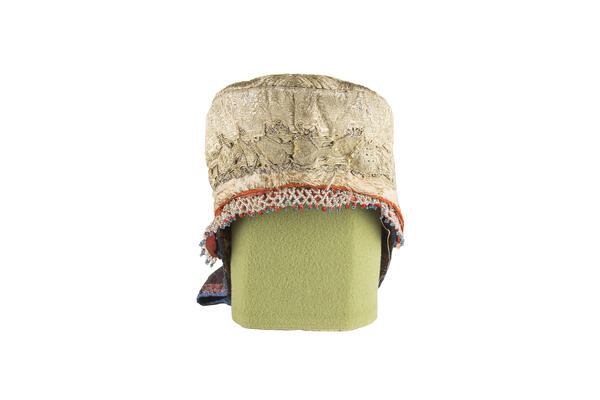
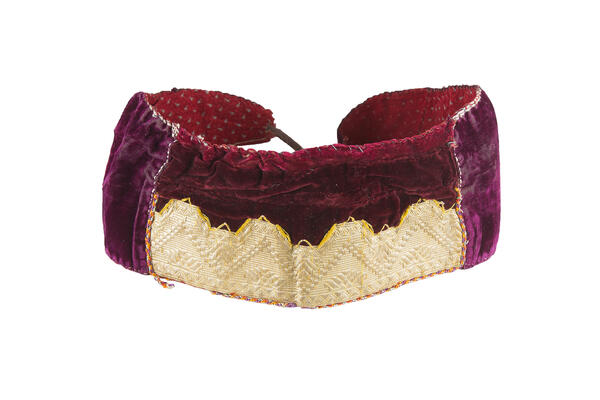
The pozatylnik presented in the museum is an element of women’s headdress.

The item belonged to the Semeiskie — a community of Old Believers from Poland, who were forced to relocate to Transbaikalia in the 18th century.

Traditionally, girls of all ages had to cover their hair at home, on the street, and in church. The women’s headdress of the Semeiskie included several elements: a shawl, a kichka, a pozatylnik, and a kokoshnik. Craftswomen sewed and decorated headdresses at home.

The kichka was a head cap which covered the hair. It was made of cotton cloth with a high firm brim which fit tightly on the forehead.

In the Bichursky, Mukhorshibirsky, and Tarbagataysky districts of the Transbaikal area, the kichka was made in the form of a small hoof. Its front was decorated with a sash — a strip of fabric with a beaded pattern. Sometimes drake feathers, previously dipped into boiling oil in order to give them a curved shape, were added to the decorations.

A Semeiskie woman had several shawls in her wardrobe. Thick items made of wool yarn were worn in winter; fine colored cashmere wool and cotton were used for items worn in warmer weather. The Transbaikal Old Believers had a special kind of shawl called atlas. It was a large two-by-two-meter fabric made of thin silk threads. It was tied on the head like a turban gathered in the front, on the forehead. Researchers believe that the Semeiskie people brought satin from Europe.

Most often, on ordinary days, the Semeiskie women wore only the shawl and kichka, as other pieces were worn only on holidays. The pozatylnik was a solid base made of cardboard or birch bark covered with fabric: velvet, brocade, or silk. It was decorated with webbing, lace, gold threads, or beads on the top. Young women used to tie the pozatylnik in the back to the kichka.

The kokoshnik was the last element of the headdress. It was worn on top of the kichka and pozatylnik. In some Transbaikal districts, for example, in the village of Bichura, Semeiskie young women did not wear kokoshniks, as their festive dress was complimented only by the pozatylnik.

Notwithstanding that the Semeiskie and their descendants still live in Transbaikalia, their traditional headdress have fallen out of use since the beginning of the 20th century, thus, they do not make it anymore. Presently, its elements can be seen only in museums.
#5
Полное наименование: Pozatylnik
Техника: sewing, embroidery
Коллекция: Ethnography
Дата создания: the early 20th century
Место создания: Trans-Baikal Territory (Trans-Baikal Region)
Размер: 11×64 cm
#6
Kokoshnik of the Semeiskie of Transbaikal
#7
The kokoshnik from the museum collection belonged to the Semeiskie of Transbaikal. The Semeiskie were a community of Old Believers and their descendants who were exiled to Transbaikalia in the 18th century by the Russian Imperial government.

The name “Semeiskie” was given to them by the locals because, unlike political exiles and convicts, who were on their own, Old Believers arrived with entire families and numerous possessions. There, they stuck together and settled in groups, forming new villages and settlements, such as Tarbagatay, Kuitun, Bolshoy Kunaley, and others.

In the Transbaikal area, the Semeiskie were mostly engaged in agriculture: they grew rye, wheat, hemp, oats, vegetables, and buckwheat. In the second half of the 19th century, when gold was found in the region, Old Believers began to work in mines.

Craftswomen were engaged in needlework, including sewing traditional Semeiskie costumes. They combined features of Polish, Ukrainian and Byelorussian dresses, and some elements were borrowed from their neighboring craftswomen, the Buryats.

The headdress of the Semeiskie women included a kichka (a type of a headdress), a kokoshnik, a pozatylnik (a piece of cloth sewn to a cardboard and used to cover hair) and a shawl. Their hair had to be covered while they were both at home and at work. On ordinary days, they wore only a headscarf, and married women also wore a kichka, which they could not take off until late in the evening.

The kokoshnik was worn only on holidays. It was made of expensive fabrics: velvet, brocade and silk. The shape echoed the outlines of the kichka. The forehead and the back parts were richly embroidered with beads, silver and gold threads. On top of the kokoshnik women tied a shawl called atlas made of satin silk or a thin cashmere shawl, so that the embroidered bottom of the headdress was visible.

Not all Old Believers wore a kokoshnik. For example, in interviews with researchers, women from Bichura — the largest Semeiskie village in Transbaikalia — mentioned that they wore only a kichka, a pozatylnik and shawl. Most likely, in the Bichursky District, they stopped wearing kokoshniks earlier than in other regions.

Since the 1930s, the traditional female headdress almost fell out of use. Until the 1960s, Semeiskie people continued to wear it to weddings, whereas on other holidays they wore only a kichka. Presently, descendants of displaced Old Believers continue to live in Transbaikalia, but only those who participate in folklore ensembles wear traditionally cut costumes.
#8
Полное наименование: Kokoshnik of the Semeiskie of Transbaikal
Дата создания: the beginning of the XX century
Место создания: Trans-Baikal Territory (Trans-Baikal Region)
Техника: sewing, embroidery
Коллекция: Ethnography
Размер: 10×32×17 cm
#9
read morehide
00:00
00:00
1x

Belt, Pozatylnik, Kokoshnik

0
Point your smartphone camera to open in the app
Share
VkontakteOdnoklassnikiTelegram
Share on my website
Copy linkCopied
Copy
Open in app
To see AR mode in action:
  1. Install ARTEFACT app for 
  2. iOS or Android;
  3. Find and download the «Paintings in Details» exhibition
  4. Push the «Augmented reality» button and point your phone's camera at the painting;
  5. Watch what happens on your phone screen whilst you flip through the pictures.
 
We use Cookies
Cookies on the Artefact Website. We use cookies to ensure that we give you the best experience on our website. If you continue without changing your settings, we'll assume that you are happy to receive all cookies on the Artefact website. However, if you would like to, you can change your cookie settings at any time.
Learn more about useHide
Content is available only in Russian

X

Нашли опечатку?...

%title%%type%