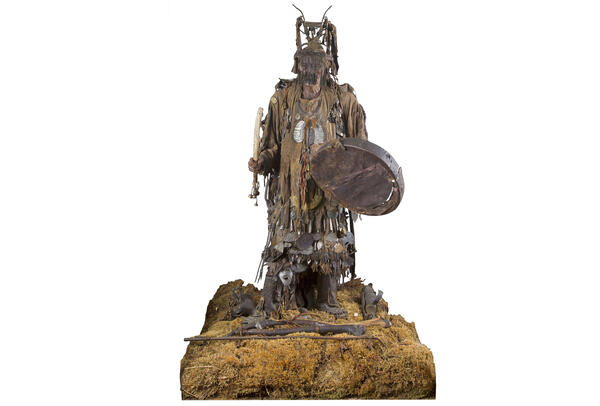
The statue with a tambourine from the exhibition of the Local Lore Museum not only gives an idea of what a shaman looked like, but also represents the beliefs of the indigenous peoples of Transbaikal about the structure of the Universe.
In their opinion, the Universe was divided into three realms arranged in a strict hierarchy: the upper — Heaven, the middle — Earth and the lower — the Underworld. Each of them was inhabited by tengri — spirits. They lived among people, inhabiting lakes, forests, rivers and mountains.
The head of all deities was the master-spirit of the Upper world. The Tungus peoples called him Buga. He played a major role in the life of all people: provided them with food, warmth, was responsible for ensuring that there were many wild animals in the forest and that their domestic herds produced offspring. Buga also was responsible for the weather: arranged rain and droughts, and established moral laws.
The Buryats also worshipped the sky. In their system, the supreme deity was Hukhe munkhe tengri, the “Eternal Blue Sky”, who saw everything that happened on earth.
Shamans served as intermediaries between the deities and people. Only those who had shaman ancestors could become a shaman. It was believed that the gift was inherited through father’s or mother’s line, sometimes bypassing entire generations. Shamanic ancestors were also divided into “white” and “black”. The former served good deities, the latter — the evil ones.
In addition, every shaman had helpers and patron spirits with whom they communicated during the shamanic ritual of feeding the fire. The power of a shaman depended on how many patrons they had, they endowed shamans with special knowledge and abilities.
Most often, people represented the spirits as wild animals, birds and fish. There are metal pendants of different shapes on the shaman’s costume displayed in the museum. Woven cloth and leather inlays that are also symbolic images of spirits.
Usually, the souls of dead ancestors, whose gift the shaman inherited, became patron spirits. They were symbolized on the costume by masks — small images of human faces.
Even if someone had the gift, they had to go through a special rite to become a shaman. Depending on their level of initiation, they could perform different rituals and use a tambourine, a walking stick or a weapon that helped in their battles with evil spirits for people’s souls. Shamans could go through up to nine initiations during their life time.
In their opinion, the Universe was divided into three realms arranged in a strict hierarchy: the upper — Heaven, the middle — Earth and the lower — the Underworld. Each of them was inhabited by tengri — spirits. They lived among people, inhabiting lakes, forests, rivers and mountains.
The head of all deities was the master-spirit of the Upper world. The Tungus peoples called him Buga. He played a major role in the life of all people: provided them with food, warmth, was responsible for ensuring that there were many wild animals in the forest and that their domestic herds produced offspring. Buga also was responsible for the weather: arranged rain and droughts, and established moral laws.
The Buryats also worshipped the sky. In their system, the supreme deity was Hukhe munkhe tengri, the “Eternal Blue Sky”, who saw everything that happened on earth.
Shamans served as intermediaries between the deities and people. Only those who had shaman ancestors could become a shaman. It was believed that the gift was inherited through father’s or mother’s line, sometimes bypassing entire generations. Shamanic ancestors were also divided into “white” and “black”. The former served good deities, the latter — the evil ones.
In addition, every shaman had helpers and patron spirits with whom they communicated during the shamanic ritual of feeding the fire. The power of a shaman depended on how many patrons they had, they endowed shamans with special knowledge and abilities.
Most often, people represented the spirits as wild animals, birds and fish. There are metal pendants of different shapes on the shaman’s costume displayed in the museum. Woven cloth and leather inlays that are also symbolic images of spirits.
Usually, the souls of dead ancestors, whose gift the shaman inherited, became patron spirits. They were symbolized on the costume by masks — small images of human faces.
Even if someone had the gift, they had to go through a special rite to become a shaman. Depending on their level of initiation, they could perform different rituals and use a tambourine, a walking stick or a weapon that helped in their battles with evil spirits for people’s souls. Shamans could go through up to nine initiations during their life time.