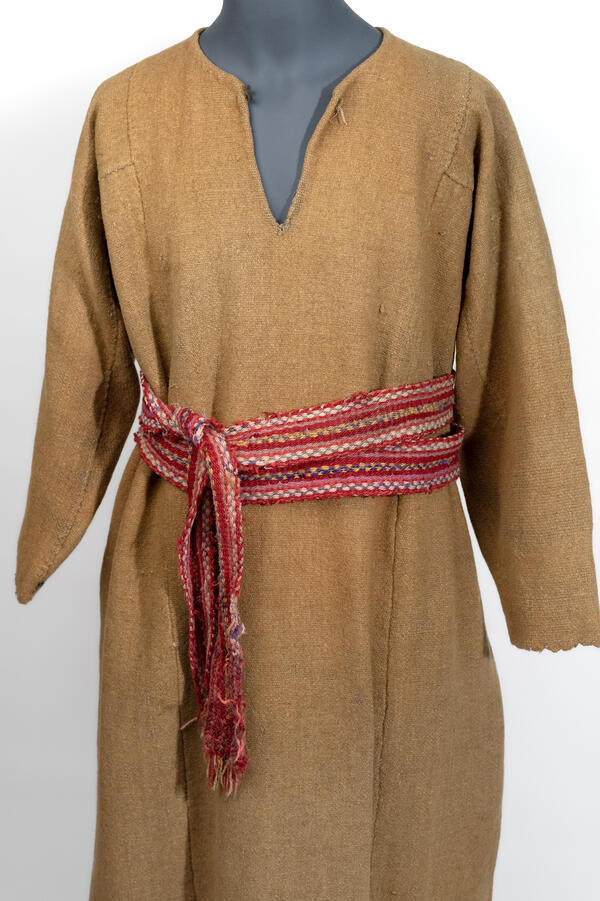
This men’s belt was homespun using wool. It was made in the Onega Uyezd of the Arkhangelsk Governorate, around the turn of the 20th century. Such belts were usually tied over sheepskin coats or jackets. The homespun belt was called a “kushak”. It was made of colored wool, mostly red. Fringes of different lengths were sewn to the ends.
When making the belts, square wooden boards with holes in the corners were used. Threads of different colors were wound around each board. The number of boards depended on the color scheme.
There is an old Russian proverb that goes, “A faithful belt, a true friend.” It indicates that the belt played an important role in the lives of the Slavic people. In Russia, it was an essential part of both men’s and women’s traditional outfits and occupied a prominent place in the spiritual and economic aspects of people’s lives. In ancient Russian clothing, the belt was used not only to fix the top part of the outfit but also to keep the person warm. It was used to tie not only shirts but also dresses, tunics and outerwear. Untying someone’s belt was considered an act of dishonor.
There were two main ways to tie the belt: high under the chest for women and low at the waist for men. The belt was also used for carrying various small items attached to it, such as keys, combs, pouches, and small bags. Belts were made of wool yarn and rough linen threads.
Belts were decorated using simple geometric patterns, such as oblique crosses, corners, columns, and oblique and longitudinal lines. All women knew how to weave belts, this craft was taught from childhood. In Russia, there were numerous rituals associated with the belt. It was believed that by using a belt, one could establish a connection between the old and new homes. Therefore, when moving into a new home, the owner would enter first and pull all family members inside using a belt. A young woman, upon entering her husband’s home after marriage, would throw her belt onto the stove. During the cattle turnout, it was common to place a belt on the ground at the gate, often a red one. This was done to ensure that the animals did not get lost and returned home.