

#1
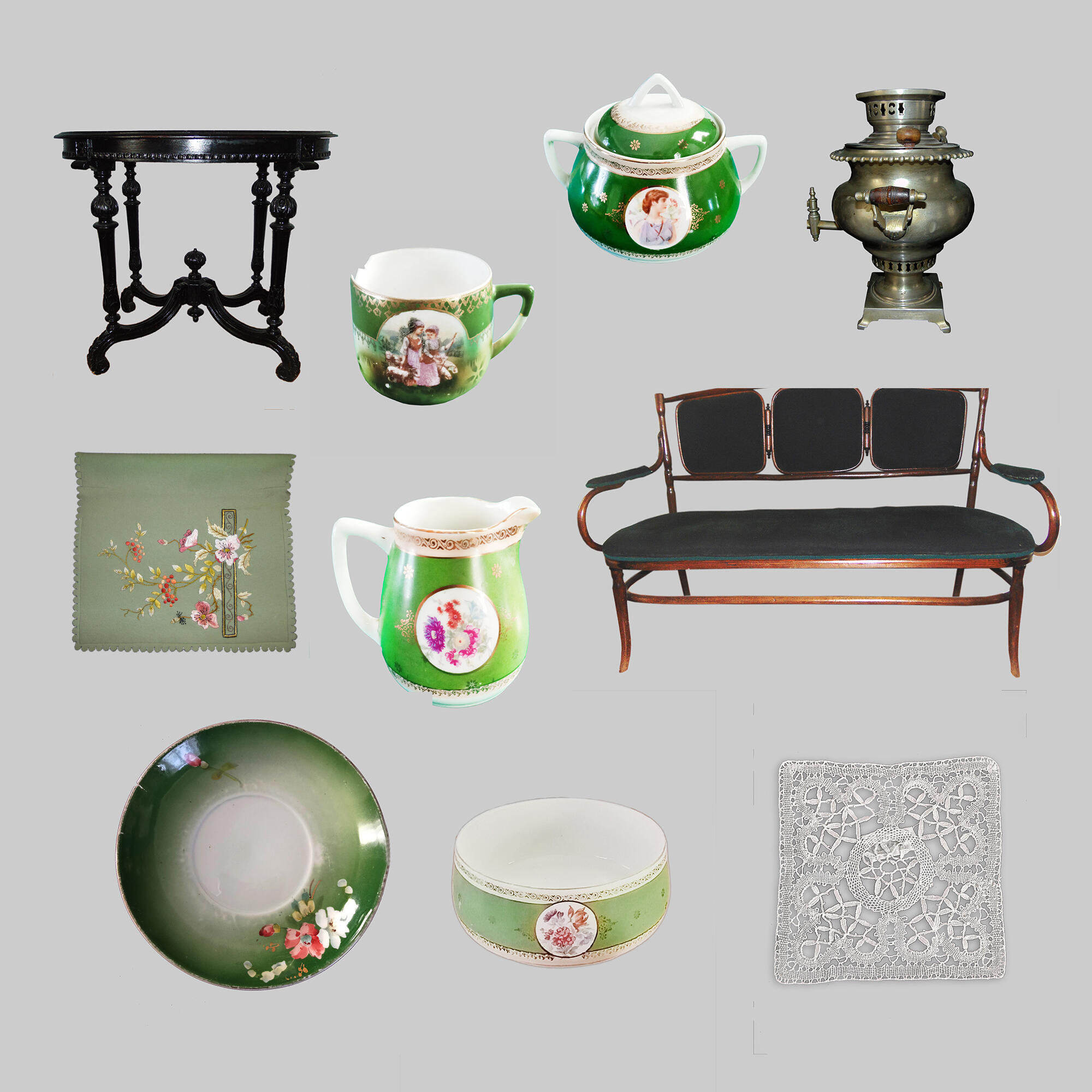
Oval table, Tea cup, Sugar bowl, Samovar, Samovar, Milk pitcher, Couch, Saucer, Candy bowl, Doily
#2
#3
#4
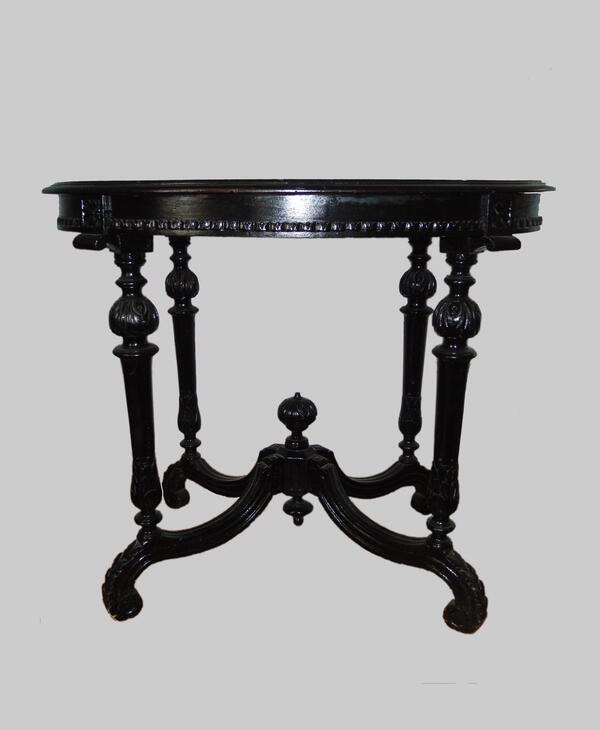
This oval black table is one of the pieces featured in the large sitting room by the ingenious Austro-German woodworker Michael Thonet, who pioneered furniture made of rounded wooden elements. The table has four carved legs curved downwards and stands surrounded by Thonet’s chairs, armchairs and an elegant sofa. It is covered with an elegant burgundy velvet tablecloth, on which sits the famous Kuznetsov porcelain, and at the head of the table is a silver samovar.
Thonet’s wonderful furniture was very popular among Russian nobility at the turn of the 20th century, and creates a confidential and cozy atmosphere in the large sitting room, in which it is very easy to imagine the Aksakovs’ meetings with guests or their family evenings. Given the small size of the table, it could be quickly moved to any space in the room. It is likely that they also did handicrafts behind him, looked through the latest issues of literary magazines, or just talked.
The small size of this table makes it possible to refer it to the type of coffee (also corner or sofa) tables. This is the name given to elongated low tables, which are usually placed in front of a sofa, couch or a group of armchairs in the living room or in the hall to decorate the interior and temporarily place books, magazines, candlesticks and other small items. Coffee tables are usually used to form a seating area, but they can also help receive visitors. According to historians, such tables were first made in Europe in the 18th century.
Sometimes coffee tables are used to organize a small dining area: they can be used for crockery and cutlery, although their low height and small area limit functionality as a piece of dining furniture. These tables are designed for serving coffee, tea and light snacks. Later, when the popularity of periodicals grew, they began to keep the press on them, and this is how the name “coffee table” appeared.
The proliferation of coffee tables subsequently influenced book design and the book market: especially for people waiting for someone or something at the coffee table, the so-called coffee table books were invented: lavishly illustrated landscape-format hardcover books, usually entertaining or secular content.
#5
Author: Michael Thonet
Date: early 20th century
Technique: Woodworking, thermal woodworking, factory production of interior items
Dimensions: 98×77 cm
Copyright: Museum of the Aksakov family
Collection: Furniture
Goskatalog Number: 16752951
Date: early 20th century
Technique: Woodworking, thermal woodworking, factory production of interior items
Dimensions: 98×77 cm
Copyright: Museum of the Aksakov family
Collection: Furniture
Goskatalog Number: 16752951
#6
Tea cup
#7
#8
Along with Gzhel toys, samovars, and Khokhloma decorations, Russian porcelain tableware is one of those things that still shape a generalized and perhaps even stereotypical idea of pre-revolutionary Russia. In many ways, such a reputation for Russian porcelain was created by the Partnership of Porcelain and Faience Manufacture of M.S. Kuznetsov, often rightly called the Porcelain Empire.
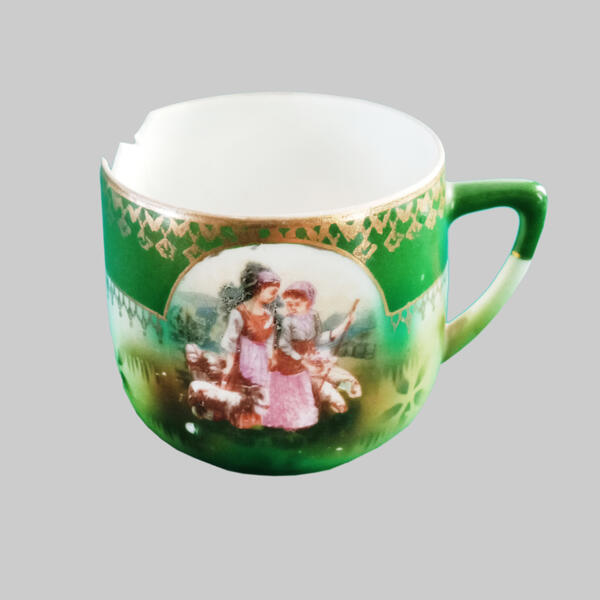
In the large sitting room on Michael Thonet’s coffee table there is a complete set made at one of the Partnership’s factories in the early 20th century. Similar to the rest of the items in the set, the tea cup’s outer surface is decorated in soft green shades; in the center of it there is a picture, typical for romantic pastoral painting of the 19th century, while the inner part of it is left untouched and immediately stands out in its white ceramic color. There was also a saucer in the set, along with the cup. Curiously enough, until the 1820s it was often used to cool some of the hot beverage from the cup, but later, this action was deemed inelegant and was gradually forbidden in secular etiquette. Later, a special indentation for the cup started appearing in the saucers, which helped secure their use as coasters.
Although porcelain and faience products of the Kuznetsov Partnership had played a very important role in the history of Russian decorative and applied art, it was only recently that they received a well-deserved appreciation and were honored the status of antiques. This fact can be explained in several different ways. On the one hand, Soviet art critics were rather reluctant to study Kuznetsov’s products: an overly flattering opinion of an art piece made in Imperial Russia may have led to grave career problems, as it could be regarded as endorsing the capitalist culture. On the other hand, the Partnership itself primarily focused on mass market, which often led to a decrease in both the quality of the porcelain itself and the quality of its decoration.
Nevertheless, Kuznetsov porcelain was a large international brand at the turn of the 20th century. In 1889 and 1890 the Partnership was awarded gold medals at several international exhibitions, and in 1903 in Reims and later in 1905 in Liege it was honored with the Grand Prix.
#9
Author: Partnership for the production of porcelain and faience products M. S. Kuznetsov
Date: early 20th century
Technique: porcelain, painting, factory production
Dimensions: 6.5×6 cm
Collection: Household items
Copyright: Museum of the Aksakov family
Date: early 20th century
Technique: porcelain, painting, factory production
Dimensions: 6.5×6 cm
Collection: Household items
Copyright: Museum of the Aksakov family
#10
Sugar bowl
#11
#12
In the first half of the 19th century, the writer Sergei Timofeevich Aksakov became famous not only for important achievements in literary and social activities, but also for the fact that he collected the brightest minds of the era in his family nest. Combining his brilliant education with the warmest responsiveness, he organized such representative intellectual meetings that they were compared with prominent circles and 19th century salons. The children and grandchildren of Sergei Timofeevich managed to preserve the traditions of the exceptional hospitality of the Aksakov family.
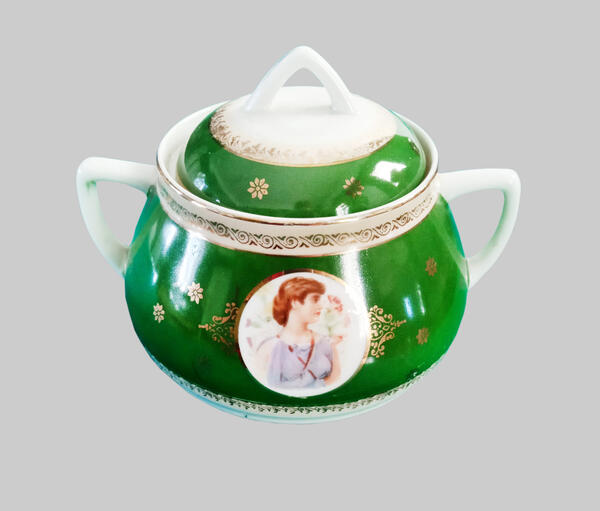
You can’t imagine receiving guests without having tea and a special ceremonial china, the appearance of which could become the subject of social conversation. In the large sitting room, there is a china set made at the beginning of the 20th century at one of the enterprises of the M.S. Kuznetsova porcelain and faience production Comradeship. The sugar bowl is an indispensable tea time attribute. This sugar bowl, made in delicate white-green-gold tones, has a floral arrangement on one side, and a pastoral woman’s portrait on the other. It also has a lid and curving handles.
This china could have looked completely different or even foreign, if not for the figure of Terenty Kuznetsov. Although the founder of the future porcelain empire was still his father, Yakov Kuznetsov, it was Kuznetsov Jr. who organized the Dulevo porcelain factory in the Vladimir province (now it is located in the Moscow region). Subsequently, the products of this factory became famous throughout the Russian Empire and were named Dulevo porcelain. Moreover, the company survived the Soviet regime, the war, the collapse of the USSR and continues to operate even to this day.
Later, Dulevo porcelain factory became one of the main enterprises of the Kuznetsov Partnership. By the end of the 19th century, Kuznetsov porcelain had become as common and popular as, for example, Vologda butter. In the early 20th century, the Partnership was honored one of the most honorary titles of Russian trademarks: the Supplier of the Court of His Imperial Majesty. At that time, this title was held by no more than 30 to 40 companies, which also included several European manufacturers.
#13
Author: M.S. Kuznetsova porcelain and faience production comradeship
Date: early 20th century
Technique: porcelain, painting, factory production
Dimensions: 12×13 cm
Collection: Household items
Copyright: Museum of the Aksakov family
Goskatalog Number: 13446005
Date: early 20th century
Technique: porcelain, painting, factory production
Dimensions: 12×13 cm
Collection: Household items
Copyright: Museum of the Aksakov family
Goskatalog Number: 13446005
#14
Samovar
#15
#16
The large sitting room presents a variety of exhibits associated with secular noble tea drinking: some exquisite china made by the renowned M.S. Kuznetsov porcelain and faience production Comradeship, an elegant oval table, produced at one of the factories of the great master furniture maker Michael Thonet, his Viennese chairs and armchairs, famous all over the world. Of course, the samovar is at the head of the tea collection.
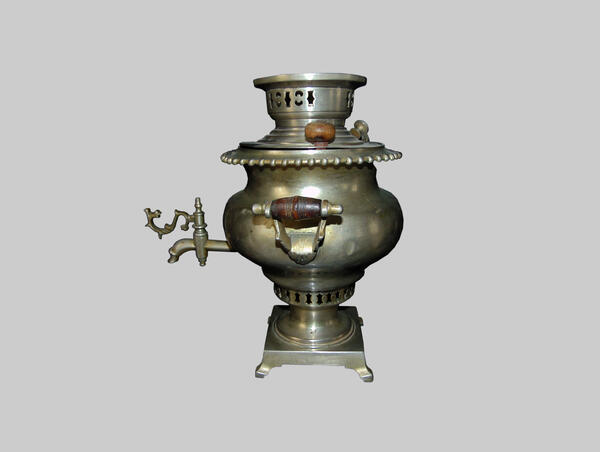
According to popular legend, the samovar was brought to the Russian Empire by Peter I, but this is not so: in fact, they spread to the Russia Empire after his death. No less popular is the erroneous opinion that the birthplace of the Russian samovar is Tula: in fact, they first began to be produced in 1740 in the Western Urals on the territory of the modern Sverdlovsk region. The place of production of the silvery samovar displayed in the large sitting room is unknown. Moreover, its quite modern device suggests that it was released at the beginning of the twentieth century. This samovar consists of a container for water, a circle located at the top of the vessel and a pallet and a tap. It also has handles that are traditional for samovars, which are significantly spaced from the body: they were positioned in such a way so as not to accidentally touch a very heated vessel.
The samovar gradually became one of the key symbols of a Russian household: its popularity grew throughout the 18th-19th centuries. For two incomplete centuries, the samovar has managed to steal the hearts of people of various cultural backgrounds and classes. Of course, this also caused his technical samovar: the quality of workmanship, materials, styles changed. Initially, copper was used to make samovars, later brass came in its place.
Back in the 18th century, samovars were very expensive, so many of them at the turn of the 19th century were made at a high artistic level. Samovars of the second half of the XIX - early XX centuries became the subject of mass culture of that time. Most of them were already assembled industrially from stamped and cast parts. More massive, mass-produced samovars combined a lower cost with a simpler appearance, while it would be wrong to claim that they have completely lost their aesthetic properties.
#17
Date: early 20th century
Technique: metal, tinning production
Dimensions: 28×24 cm
Collection: Household items
Copyright: Museum of the Aksakov family
Goskatalog Number: 16515522
Technique: metal, tinning production
Dimensions: 28×24 cm
Collection: Household items
Copyright: Museum of the Aksakov family
Goskatalog Number: 16515522
#18
Newspaper organizer
#19
#20
The autobiographical works of Sergey Timofeevich Aksakov capture with almost documentary precision the life of the Ufa nobles and family life of the Volga landlords in the late 18th - early 19th centuries. This was facilitated by the fact that the Aksakovs’ family house was the meeting place for several generations of the Russian Empire’s greatest minds. Contrasting with the clubs and salons in St. Petersburg and Moscow, meetings in the Aksakov house stood out for a wider range of topics discussed, as well as a much warmer atmosphere, as Sergey Timofeevich always combined his brilliant erudition with politeness, kindness and responsiveness.
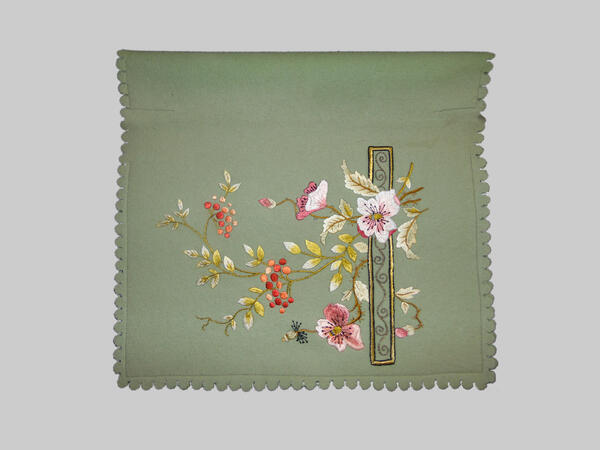
In the 19th century, periodicals were one of the main sources of both news and general knowledge about the world, so in the intelligent reading family of the Aksakovs, newspaper organizers were probably among the most frequently used interior items. A newspaper organizer is a handy accessory for temporary storage of newspapers, magazines, booklets and other printed publications. The exposition in the ‘Large sitting room’ features a fabric newspaper organizer, dating back to the early 20th century. Such organizers were most often hanged on a wall or furniture edges. It is sewn from light-green variety of felt, made of rabbit fur. It is embroidered with a floral composition, and embossed on the edges.
The peak of popularity of newspapers and periodicals was reached at the turn of the 20th century. By this time there was a huge variety of different kinds of magazine and newspaper organizers, though there were much fewer textile versions compared to wooden ones. A variety of types of wood were used for making such magazine racks: oak, beech, walnut, apple, alder. Often wooden racks were designed for use on tabletops. They were made in the shape of open holders, vases, boxes, etc. Placed on a table, they were usually filled with fresh issues of magazines or newspapers. The only essential drawback of such organizers was their rather limited capacity.
However, the varieties installed on the floor were significantly more spacious. Some of them were so large that they were closer to modern bookcases in size. Some varieties with small wheels though were much more mobile, allowing to transport the newspapers and magazines around a hall, ship board or a train car. There were also wall mounted organizers, which looked quite nicely when filled, covering the usually empty vertical surfaces.
#21
Date: early 20th century
Technique: fabric, embroidery
Dimensions: 37.5×54 cm
Collection: Textiles
Copyright: Museum of the Aksakov family
Goskatalog Number: 16515508
Technique: fabric, embroidery
Dimensions: 37.5×54 cm
Collection: Textiles
Copyright: Museum of the Aksakov family
Goskatalog Number: 16515508
#22
Milk pitcher
#23
#24
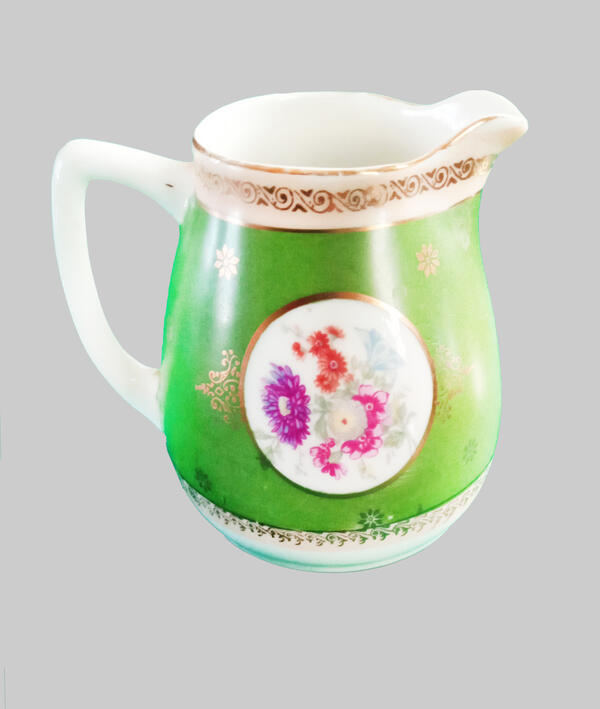
Out of many things that bring to mind Russia, several kinds of kitchenware take a special place. These include porcelain products and, in particular, products of the M.S. Kuznetsov porcelain and faience comradeship products. The milk pitcher displayed in the large sitting room was made at the beginning of the 20th century at this very enterprise.
Russian porcelain and faience, as practical as they are, have always been distinguished by their distinctively elegant and lively style, as most household utensils of Russian masters of all times did. Kuznetsov’s elegant and sophisticated porcelain perfectly matches this description. The milk pitcher on display can serve as an excellent example: a pastoral portrait of a woman is painted in its central volume, and an exquisite golden border surrounds the lower edges. Its shape is outward directed, precise and graceful.
Although porcelain and faience products of the Kuznetsov Comradeship had played a very important role in the history of Russian decorative and applied art, it was only recently that they received a well-deserved appreciation and were honored the status of antiques. The fact is that comradeship dishes in the 19th century were primarily a commodity of mass consumption. Accordingly, decorations and paintings were made by stamping, often eclectic and overly variegated. This can be seen especially clearly in Gardner factory paintings near Moscow, where new painting concepts were often applied to already outdated forms. Such blunders gave rise to a disapproving attitude towards the products of the entire Partnership, and even gave it the offensive nickname “Kuznetsovshchina”: as tasteless things were often referred to.
Any Kuznetsov Comradeship product would invariably have their special brand on it.
The early stamps of the Kuznetsov partnership usually had a vignetted shape enclosed in a circle with the inscription “Factory of the Kuznetsov brothers”. The brand itself was usually slightly indented and drawn in blue or green. Some copies may contain spelling errors. During the period of mass production, they began to put overglaze markings in green or blue on the products; gold and even red colors with Arabic script are less common. Each plant and factory of the Kuznetsov Comradeship had its own stamp indicating the plant or place of manufacture.
#25
Author: M.S. Kuznetsov porcelain and faience comradeship products
Date: early 20th century
Technique: porcelain, painting, factory production
Dimensions: 10×10 cm
Copyright: Museum of the Aksakov family
Collection: Household item
Goskatalog Number: 13446007
Date: early 20th century
Technique: porcelain, painting, factory production
Dimensions: 10×10 cm
Copyright: Museum of the Aksakov family
Collection: Household item
Goskatalog Number: 13446007
#26
Couch
#27
#28
In the middle of the 19th century, Austrian-German cabinetmaker Michael Thonet established a factory in Vienna, manufacturing furniture from bent wood. That furniture was strong, practical and at the same time, remarkably beautiful. While the furniture made of solid pieces of wood was massive and solid, Thonet’s elegant designs were practically floating in the air. It is no coincidence that his furniture quickly gained incredible popularity around the world and, in particular, among the Russian nobility. Since then, Thonet’s furniture has been referred to either by its country of production — Vienna furniture — or by the name of the manufacturer — in the style of Thonet.
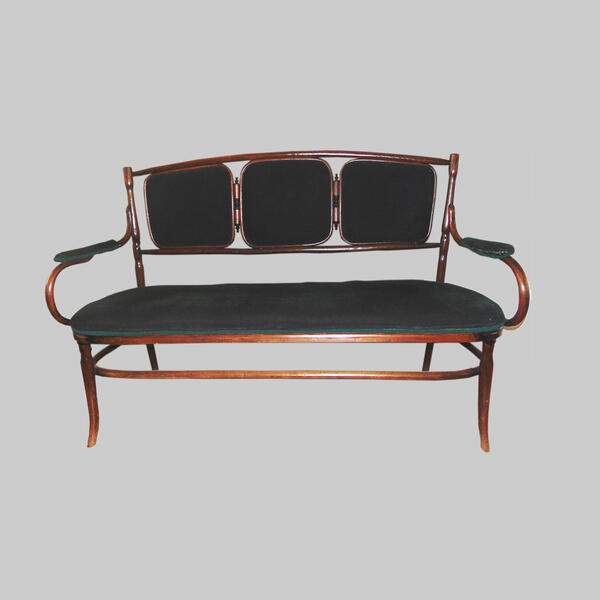
This couch is the largest item from Thonet’s furniture set, presented in the sitting room. Moreover, its size is gracefully concealed by its elegant design: its grips are bent in a semicircle and have neat rectangular armrests, and the backrest has separate soft sections, thus dividing its vast area into three smaller spaces. The choice of color is also masterfully made: the dark green silk velvet upholstery harmoniously blends in with the dark color of the wood.
It’s worth noting that the wooden parts of this furniture have a unique color partially due to the fact that they were treated with steam or boiling water. The wood was exposed to this effect in order to become more flexible, and eventually form the exquisite design of Thonet’s furniture. Soaked in boiling water or steamed with water vapor, the wood was bent and fixed with the help of molds, after which it retained its new shape. At different times, sledges, skis, boats, barrels and other things were already being made of bent wood, but it was Thonet who adapted this technique for furniture manufacturing and in 1942 even obtained a patent for it.
Thonet started out with the ordinary for early 19th century solid wood products, which were produced by his first furniture factory in the German city of Boppard, opened in 1819. He undertook the first experiments on production of strong and light structures using bending and bonding layers of plywood only after eleven years. At one of the industrial exhibitions, an unusual wooden chair by Thonet drew the attention of Austrian Chancellor Prince Klemens von Metternich, who offered the master to move to Vienna. After a little while, Thonet agreed to his proposal.
#29
Author: Michael Thonet
Date: early 20th century
Technique: wood, fabric, factory production
Dimensions: 141×94×51 cm
Copyright: Museum of the Aksakov family
Collection: Furniture
Goskatalog Number: 16515517
Date: early 20th century
Technique: wood, fabric, factory production
Dimensions: 141×94×51 cm
Copyright: Museum of the Aksakov family
Collection: Furniture
Goskatalog Number: 16515517
#30
Saucer
#31
#32
The decorative and applied art in Russia is largely defined by The Partnership of Porcelain and Faience Manufacture of M.S. Kuznetsov. By the end of the 19th century it had united the oldest and largest domestic enterprises engaged in the production of porcelain and faience: Dulevo porcelain factory, Gardner porcelain factory, Budy faience factory and many others. Kuznetsov’s Partnership not only made porcelain tableware more accessible to the public, but also brought Russian porcelain to the international market.
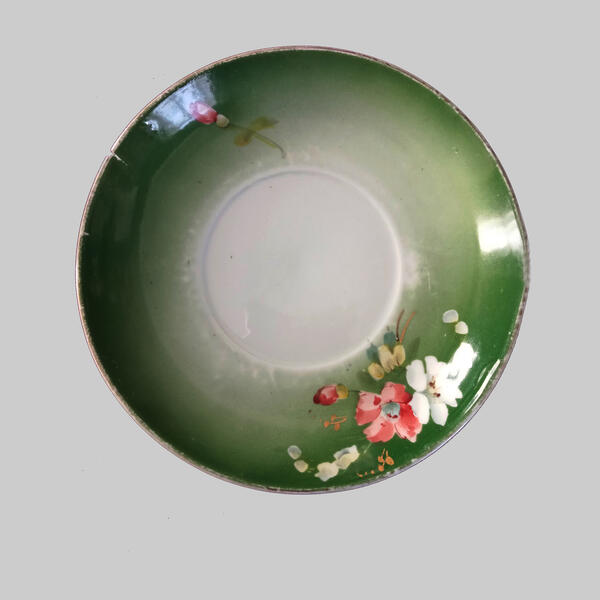
Products manufactured by the Partnership, often referred to as Kuznetsov porcelain, were also widely popular among Russian nobles. In the large sitting room there is a delicate light green porcelain set, made in the early 20th century. That set can justly be defined by the tea cup and saucer alone, as the milk jug or the candy bowl were used less often and served as complementary items for formal tea parties with guests. The image of a flower painted on the saucer rhymes beautifully with the patterns on the tea cup, which has a floral composition depicted on one of its sides. Another unique feature of the set’s design is the darkened edges on the saucer and a lighter shade in its center, visually giving the tea cup placed on it much more room.
Even though entrepreneur Matvey Sidorovich Kuznetsov has managed to build a porcelain empire, and his grandfather Yakov Kuznetsov founded the family business, no less remarkable was the figure of Terenty Kuznetsov. It was he who established the Dulevo porcelain factory in Vladimir province (now located in the Moscow Region). Subsequently, the products of this factory became famous throughout the Russian Empire and were named Dulevo porcelain. Moreover, the company survived the Soviet regime, the war, the collapse of the USSR and continues to operate even to this day.
Later, Dulevo porcelain factory became one of the main enterprises of the Kuznetsov Partnership. By the end of the 19th century, Kuznetsov porcelain had become as common and popular as, for example, Vologda butter. In the early 20th century, the Partnership was honored one of the most honorary titles of Russian trademarks: the Supplier of the Court of His Imperial Majesty. At that time, this title was held by no more than 30 to 40 companies, which also included several European manufacturers.
#33
Author: Partnership for the production of porcelain and faience products M. S. Kuznetsov
Date: early 20th century
Technique: porcelain, painting, factory production
Dimensions: 15 cm in diameter
Copyright: Museum of the Aksakov family
Collection: Household items
Date: early 20th century
Technique: porcelain, painting, factory production
Dimensions: 15 cm in diameter
Copyright: Museum of the Aksakov family
Collection: Household items
#34
Candy bowl
#35
#36
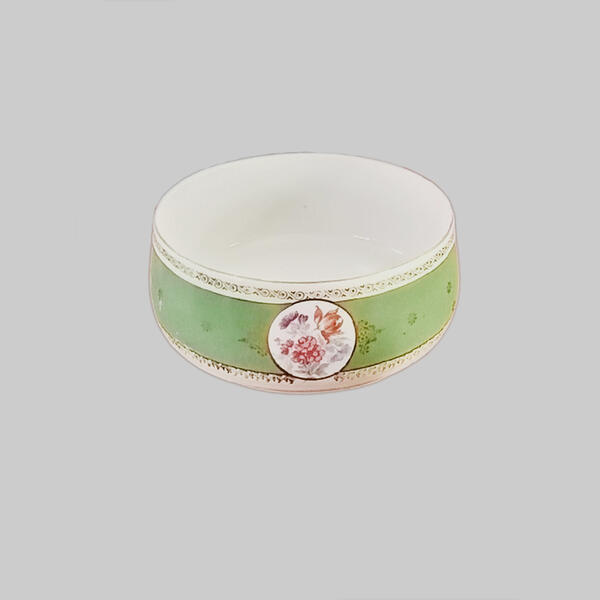
In the large sitting room, on a sophisticated ‘Thonet’ style coffee table, there is a set of tableware without which a Russian noble nest at the turn of the 20th century is hard to imagine. This is a complete porcelain china set that includes cups, saucers, a small milk pitcher, sugar bowl, candy bowl. It is made in gentle light green tones, plant and figured ornaments in its design are used simultaneously with golden borders and pastoral female portraits in the spirit of romantic painting of the 19th century.
The candy bowl in this set is the largest item. At the beginning of the 20th century, it could easily be filled to the top with a variety of confectionery products produced in the Russian Empire. At that time there were over 1000 factories throughout the country alone, producing chocolate products, 200 of them located in Moscow, and 170 in the capital of St. Petersburg. And this is not counting confectionery giants like the A.I. Abrikosov’s sons (in the USSR it will become a factory named after Babaev) and the Einem Comradeship (would later become Red October).
This china was produced by the renowned Comradeship for producing M.S. Kuznetsova porcelain and faience products. In the history of Russian decorative and applied art, porcelain and faience of the Kuznetsov Comradeship only recently that they received a well-deserved appreciation and were honored the status of antiques. The fact is that comradeship dishes in the 19th century were primarily a commodity of mass consumption. Accordingly, decorations and paintings were made by stamping, often eclectic and overly variegated. This can be seen especially clearly in Gardner factory paintings near Moscow, where new painting concepts were often applied to already outdated forms. Such blunders gave rise to a disapproving attitude towards the products of the entire Partnership, and even gave it the offensive nickname “Kuznetsovshchina”: as tasteless things were often referred to.
Nevertheless, Kuznetsov porcelain was a large international brand at the turn of the 20th century. In 1889 and 1890 the Partnership was awarded gold medals at several international exhibitions, and in 1903 in Reims and later in 1905 in Liege it was honored with the Grand Prix.
#37
Author: Partnership for the production of porcelain and faience products M. S. Kuznetsov
Date: early 20th century
Technique: porcelain, painting, factory production
Dimensions: 7×16 cm
Copyright: Museum of the Aksakov family
Collection: Household item
Goskatalog Number: 13446008
Date: early 20th century
Technique: porcelain, painting, factory production
Dimensions: 7×16 cm
Copyright: Museum of the Aksakov family
Collection: Household item
Goskatalog Number: 13446008
#38
Doily
#39
#40
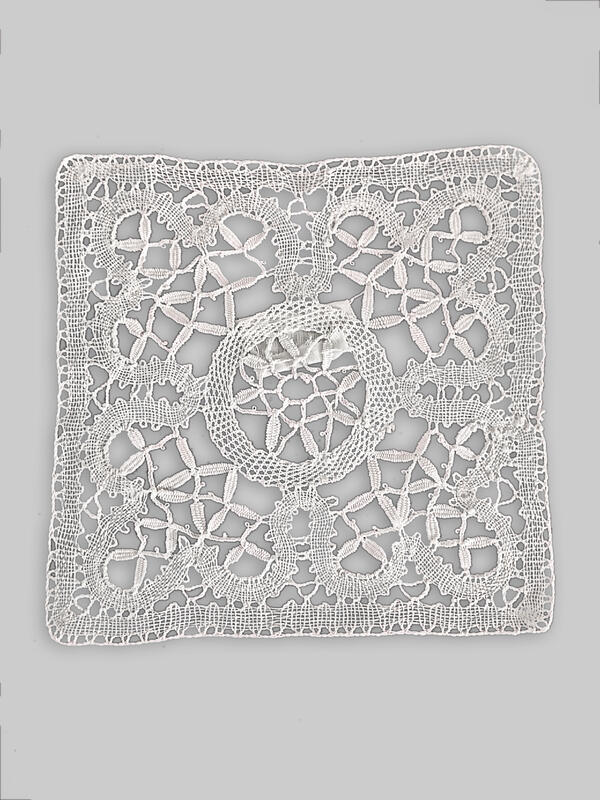
The large sitting room museum Aksakov family exhibition displays several pieces of elegant Thonet style furniture. It also has an oval table located near the sofa and covered with a burgundy velvet tablecloth. It is easy to imagine a china set and a samovar on this table: it was indeed often used for tea drinking. On his burgundy tablecloth, a white square cotton napkin immediately stands out, tied on bobbins, wooden spools on which special threads were wound for weaving lace.
This napkin is exclusively decorative. It is not the only bobbin-lace piece in the large sitting room: the miniature table stand is covered with a lace tablecloth. Lace has attracted attention at all times thanks to its openwork intertwining patterns. Although the process of its creation is associated with many difficulties, there have always been craftswomen who completely devoted themselves to filigree work with lace.
Lace is believed to have originated in Italy and Spain. In the Middle Ages, due to the rapid development of trade, this technology penetrated into Russia, where it absorbed the features of the national culture, becoming unique and distinctive. Legend has it that lace spread in the Russian Empire thanks to Peter I: allegedly it was he who brought several lacemakers from Holland, who taught Russian women their craft.
One of the most common methods for creating lace is bobbin braiding. Most often, bobbins are made of hard wood species with a smooth structure: such products do not leave splinters. Dozens of bobbins can be used to make one lace: they are chosen individually, depending on what the result should be. Therefore, the length of the bobbins varies from 10 to 100 mm.
Most often, you will see plant motifs in Russian lace: trees, flowers, berries characteristic of the native lands of the creator of lace. Often among the ornaments of Russian lace one could find a pattern in the form of oak leaves. In Slavic folklore, oak is the most фrevered tree. The spikelet-shaped pattern was also often repeated: it was believed that such a pattern helps to attract wealth and prosperity. Popular belief was that the pattern in the form of an ear, like that of an oak leaf, also protected from wickedness and evil spirits.
#41
Date: the end of the 20th century
Technique: Lacework
Dimensions: 14×14 cm
Copyright: Museum of the Aksakov family
Collection: Lace
Technique: Lacework
Dimensions: 14×14 cm
Copyright: Museum of the Aksakov family
Collection: Lace
read morehide
00:00
00:00
1x
Dishes, table, couch, doily
0
 Point your smartphone camera to open in the app
Open in app
Share