In the past, being married was a transition to a whole new social status for a mari woman, and therefore, it would be wrong for her to continue wearing the same headdress. And thus, after marriage, the Mari women would don a shymaksh. This accessory was mandatory for women that belonged to the Eastern and Meadow Mari groups, living in Krasnoufimsk, Biysk, Yelabuga, and the surrounding areas. A headdress of this type not only set mature married women apart from young unmarried girls, but went even further, pointing to the wearer’s exact age and even her family’s financial status and social standing.
The Mari shymaksh evolved from a different type of headwear, called shurki. A shurki did not have a rigid base; it was a rectangular piece of fabric sewn into a bashlyk-like cap. Both women and men could wear shurki.
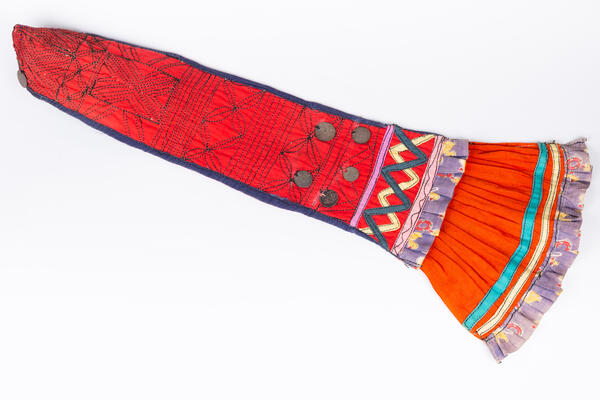
A traditional shymaksh was made of a rectangular cloth, whose upper part formed a sharp cone. The main surface was covered with fine embroidery or dense silk threads, or had pieces of silk attached to it. The lower edge, which covered the woman’s back, was decorated with woolen fringe. The cap and the edge of the nape part were decorated with embroidery, coins, and beads.
Different regions had different rules for wearing a shymaksh. For instance, the Meadow Mari women shifted their headdress to the crown of their head and covered it with a scarf or a special shawl that was called a pylyshmovich. They also had to do their hair up very carefully, to keep the pointed cap secure and comfortable. The hairdo was to be tight in order to hold the fastener in the form of a stick, which was inserted in the shymaksh at the top of the head. So women made several small braids at the top of the head and then wrapped them around the cap. The remaining hair locks were used for a single braid under the nape. Then women lifted the braid to the solid part of the core fastening the cap with a stick, and wrapped the braid around the cap.
Unlike the Meadow Mari, the Eastern Mari women pulled the shymaksh down to their forehead. Their hair style was completely different as well: they gathered their hair into a tight bun at the top of their head, holding it together with a ribbon. The bun kept the cap in place.
The modern Mari women do not wear such headdresses any longer, but you can take a look at one at our museum.
The Mari shymaksh evolved from a different type of headwear, called shurki. A shurki did not have a rigid base; it was a rectangular piece of fabric sewn into a bashlyk-like cap. Both women and men could wear shurki.
A traditional shymaksh was made of a rectangular cloth, whose upper part formed a sharp cone. The main surface was covered with fine embroidery or dense silk threads, or had pieces of silk attached to it. The lower edge, which covered the woman’s back, was decorated with woolen fringe. The cap and the edge of the nape part were decorated with embroidery, coins, and beads.
Different regions had different rules for wearing a shymaksh. For instance, the Meadow Mari women shifted their headdress to the crown of their head and covered it with a scarf or a special shawl that was called a pylyshmovich. They also had to do their hair up very carefully, to keep the pointed cap secure and comfortable. The hairdo was to be tight in order to hold the fastener in the form of a stick, which was inserted in the shymaksh at the top of the head. So women made several small braids at the top of the head and then wrapped them around the cap. The remaining hair locks were used for a single braid under the nape. Then women lifted the braid to the solid part of the core fastening the cap with a stick, and wrapped the braid around the cap.
Unlike the Meadow Mari, the Eastern Mari women pulled the shymaksh down to their forehead. Their hair style was completely different as well: they gathered their hair into a tight bun at the top of their head, holding it together with a ribbon. The bun kept the cap in place.
The modern Mari women do not wear such headdresses any longer, but you can take a look at one at our museum.