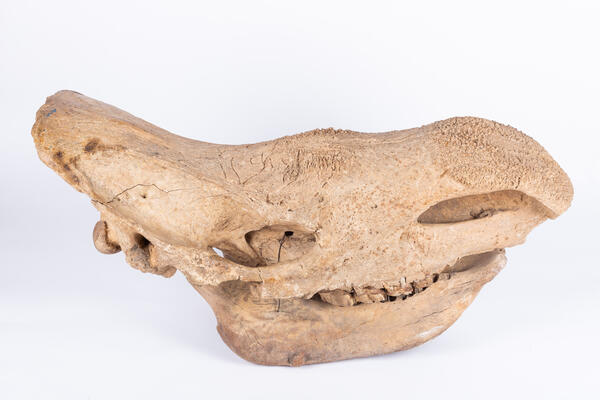
В экспозиции музея представлен череп вымершего еще в доисторическую эпоху шерстистого носорога. Свое название животное получило из-за характерной грубой шерсти с густым подшерстком. Окраска кроющего волоса могла быть желтоватой или светло-бурой.


Woolly rhinoceros skull
Creation period
неизвестно
Place of сreation
неизвестно
Dimensions
47 cm tall
Collection
Exhibition
1
Open in app#1
Woolly rhinoceros skull
#2
#6
This exhibit is the skull of a woolly rhinoceros, an animal that went extinct during the prehistoric period. It earned the name ‘woolly’ because its body was covered in very distinct wool with a thick undercoat. The topcoat was either yellowish or light-brown.
In terms of size, a woolly rhinoceros was comparable to a mammoth, as it could weigh as much as three tons. This animal had a powerful, stocky frame, short and thick legs, an elongated head, and an enormous crest at the back of its neck. Its skeleton was over 300 centimeters long, and it was about one and a half meters tall, counting the crest. The rhinoceros had thick, callus-like lumps on its forehead and nose. They served as base for two massive horns. The front horn was larger, growing to reach as much as 103 in length, and could weigh 12 kilos. It was 25 centimeters in diameter.
These impressive horns adorned the heads of male and female animals alike. They were capable of reaching such an astounding size because they were formed out of very viscous substance. The animals used their horns to plough their way through the dense undergrowth along the river banks, as well as to successfully defend themselves from numerous predators.
When hungry, they caught at the tree branches and grass with their hardened lips and ripped them out, as they had no canine or incisor teeth. Unlike their modern cousins, the woolly rhinoceroses did not move in herds, limiting their company to their mate or babies.
Wary of their aggressive nature and sharp horns, humans almost never hunted them. Therefore, it is nearly impossible to find woolly rhinoceros carcasses when exploring the campsites of our prehistoric ancestors.
Scientists believe that these ancient giants were originally from Northern China. But there is another theory, suggesting that they might have some from the Baikal. Rhinoceros skulls are not a rare find in Siberia—unlike North America, where no such remains have ever been found.
The only depiction of a woolly rhinoceros that has been preserved in Russia is a painting in the Kapova Cave, located in south of the Ural region. According to expert estimates, the woolly rhinoceros became extinct at the end of the Pleistocene, approximately 14 thousand years ago. They were likely incapable of adapting to the warm and humid Holocene climate, just like many of the mammoth, bison, horse, and muskox herds.
In terms of size, a woolly rhinoceros was comparable to a mammoth, as it could weigh as much as three tons. This animal had a powerful, stocky frame, short and thick legs, an elongated head, and an enormous crest at the back of its neck. Its skeleton was over 300 centimeters long, and it was about one and a half meters tall, counting the crest. The rhinoceros had thick, callus-like lumps on its forehead and nose. They served as base for two massive horns. The front horn was larger, growing to reach as much as 103 in length, and could weigh 12 kilos. It was 25 centimeters in diameter.
These impressive horns adorned the heads of male and female animals alike. They were capable of reaching such an astounding size because they were formed out of very viscous substance. The animals used their horns to plough their way through the dense undergrowth along the river banks, as well as to successfully defend themselves from numerous predators.
When hungry, they caught at the tree branches and grass with their hardened lips and ripped them out, as they had no canine or incisor teeth. Unlike their modern cousins, the woolly rhinoceroses did not move in herds, limiting their company to their mate or babies.
Wary of their aggressive nature and sharp horns, humans almost never hunted them. Therefore, it is nearly impossible to find woolly rhinoceros carcasses when exploring the campsites of our prehistoric ancestors.
Scientists believe that these ancient giants were originally from Northern China. But there is another theory, suggesting that they might have some from the Baikal. Rhinoceros skulls are not a rare find in Siberia—unlike North America, where no such remains have ever been found.
The only depiction of a woolly rhinoceros that has been preserved in Russia is a painting in the Kapova Cave, located in south of the Ural region. According to expert estimates, the woolly rhinoceros became extinct at the end of the Pleistocene, approximately 14 thousand years ago. They were likely incapable of adapting to the warm and humid Holocene climate, just like many of the mammoth, bison, horse, and muskox herds.
#7
Ministry of Culture of the Russian Federation
read morehide
00:00
00:00
1x
Woolly rhinoceros skull
Creation period
неизвестно
Place of сreation
неизвестно
Dimensions
47 cm tall
Collection
Exhibition
1
 Point your smartphone camera to open in the app
Open in app
Share