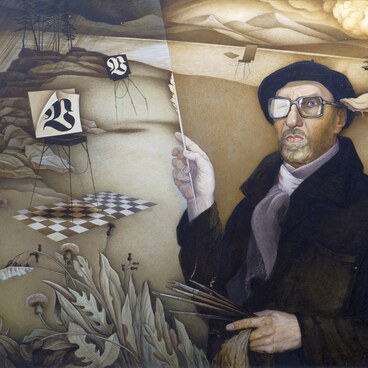
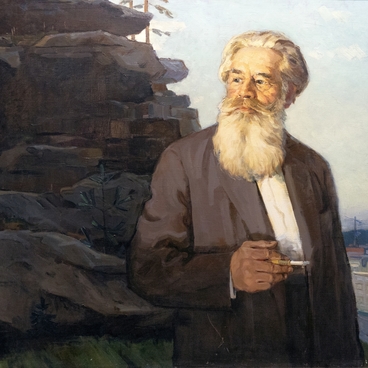
The Ural artist Boris Vasilyevich Volkov (1918–1979) was known for his thematic paintings, landscapes, and portraits. Among his notable works is “Portrait of Pavel Petrovich Bazhov” (1955), which depicts the renowned writer in his later years, set against the majestic, snow-capped peaks of the Ural Mountains. Though Pavel Bazhov had already passed away, his enduring legacy made him a powerful symbol of Ural identity, and this work stands as a tribute to the cultural memory the Ural people cherished.
Pavel Petrovich Bazhov (1879–1950) was a Russian and Soviet writer best known for his lyrical retellings of Ural folk tales. Born in 1879, in the village of Sysertsky Zavod (now the city of Sysert, Sverdlovsk Oblast), Bazhov grew up in a working-class family. His father, Pyotr Bazhov, labored in the local mining factories, while his mother devoted herself to domestic tasks, including sewing and hand-weaving lace for commission.
As the only child in the family, Pavel received an education rooted in both secular and religious traditions. He studied at the Sysertsky Zemstvo Men’s College, then graduated from the theological college in Yekaterinburg and later the Perm Theological Seminary. From 1907 to 1913, he taught at the Yekaterinburg Diocesan Women’s College — a period that proved pivotal in his personal life: in July 1911, he married Valentina Alexandrovna Ivanitskaya, one of his former students.
In 1914, the couple moved to Kamyshlov, where Bazhov took up a teaching position at the local theological college. With the outbreak of the February Revolution in 1917, he left education behind and became deeply involved in civic and political affairs. Within two years, he held multiple public offices, including Commissioner for Public Order and, briefly, Mayor of Kamyshlov.
By the end of 1921, ill health compelled him to return to Kamyshlov, where he resumed his work as a journalist and editor. In 1923, he and his wife relocated to Yekaterinburg, where Bazhov joined the editorial staff of Krestyanskaya Gazeta (The Peasant Newspaper). The 1920s marked a period of intense literary productivity. In November 1924, he published his first book, “Ural Tales”, a collection of historical essays chronicling the lives of workers in the Sysert ironworks. His breakthrough came in 1936 with the publication of his first tale, “Azov Girl”. This was followed in 1939 by his seminal work, “The Malachite Casket”, a luminous anthology of Ural folk legends reimagined through poetic prose.
The collection became an instant classic, widely translated and celebrated across the Soviet Union and internationally. In 1943, Bazhov was awarded the Stalin Prize for “The Malachite Casket”; in 1944, he received the Order of Lenin. Bazhov played a vital role in Soviet cultural life. He chaired the Sverdlovsk Branch of the Union of Soviet Writers and edited the influential literary almanac “Uralsky Sovremennik” (Ural Contemporary). Simultaneously, he engaged in public service: from 1946, he served as a deputy to the Supreme Soviet of the USSR.
His final literary work was the autobiographical novel “Far — Near” (1949). Pavel Petrovich Bazhov died on December 3, 1950, in Moscow. He was laid to rest in the Ivanovskoye Cemetery in Sverdlovsk (now Yekaterinburg).