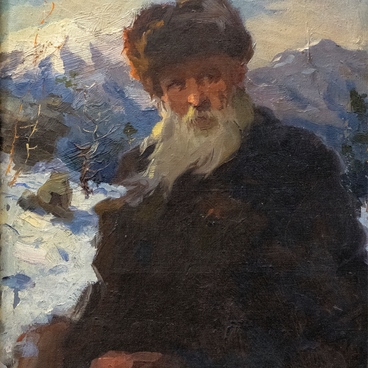
The portrait genre occupies a significant place in the work of the Ural artist Sergey Konstantinovich Zyumbilov. His subjects included young contemporaries, industrial leaders, and Soviet officials. The collection of the Irbit State Museum of Fine Arts includes an expressive portrait by Sergey Zyumbilov, depicting Anatoly Ivanovich Paramonov — revolutionary, statesman, party leader, and a man of extraordinary yet tragic fate.
Paramonov was born on January 30, 1891, in the Beryozovsky Zavod settlement of Perm Province. He received his education at the four-grade Yekaterinburg City College. The turbulent dawn of the 20th century drew the young man into political life — during the events of 1905, Paramonov did not remain on the sidelines. He attended both legal and illegal political gatherings, studied revolutionary literature, and familiarized himself with the programs of various political parties.
The tsarist authorities arrested the young rebel more than once, but each time he returned to political struggle — changing professions over a dozen times during his years living “in the underground”, from lathe operator to chairman of a consumer cooperative. The October Revolution of 1917 found him in Yekaterinburg, where he personally commanded the seizure of the telegraph and telephone exchange. During the Civil War, the former accountant became a division commissar, edited a frontline newspaper, and suffered a concussion in the battles for the Urals.
The 1920s marked the peak of Paramonov’s career: he served as chairman of the Chelyabinsk and Sverdlovsk Executive Committees, becoming one of the key architects of the new Soviet administration in the Urals. But in 1936, the “faithful Leninist” was suddenly branded an “enemy of the people”. In June 1936, he was expelled from the Communist Party “as a double-dealing Trotskyist who did not disarm”, and on August 21, 1936, he was arrested. He was sentenced to five years in forced labor camps.
Paramonov was able to return to the Middle Urals only a decade after his arrest. But in August 1949, he was arrested again and exiled to the Krasnoyarsk Krai. He was finally released on August 5, 1954. Throughout his imprisonment and exile, Paramonov repeatedly protested his innocence. In August 1955, he wrote a letter to Nikita Khrushchev. On October 15, 1955, the Presidium of the Sverdlovsk Regional Court dismissed the case against him for lack of evidence of a crime. In March 1956, the Sverdlovsk Regional Committee of the Communist Party of the Soviet Union (CPSU) reinstated him in the Party.
Until his final days, Anatoly Paramonov actively participated in the social and civic life of Sverdlovsk. He died on November 16, 1970, just two months shy of his eightieth birthday. Today, his portrait in the Irbit Museum stands as a silent witness to his remarkable, turbulent, and ultimately resilient life.