Vasily Vasilyevich Mate was an outstanding Russian engraver, woodcutter, and etcher of German origin, and a prominent figure in St. Petersburg’s artistic life during the Russian Silver Age.
Born in 1856 in Verzhbolovo (in the Augustów Governorate, then part of the Russian Empire) into the family of a railway engineer, Mate received his early education at the St. Petersburg Reformed College. He began his artistic training in 1870 at the Drawing School of the Society for the Encouragement of the Arts, where he studied drawing under Rudolf Zhukovsky. From 1872 onward, he specialized in engraving under the guidance of Lavrenty Seryakov.
In 1875, Mate enrolled at the Imperial Academy of Arts, where he studied in the engraving class of Fyodor Iordan (Friedrich Ludwig Jordan) until 1880. His talent was recognized early: he was awarded a silver medal for an engraving based on a study of the head of John the Baptist — derived from Alexander Ivanov’s preparatory sketch for “The Appearance of Christ before the People”. In 1880, he traveled to Paris to further his studies, perfecting his technique under François Pannemaker and learning etching under Claude Ferdinand Gaillard.
Upon his return to Russia, Mate quickly earned recognition in artistic circles. In 1899, he was conferred the title of Academician of Engraving. As head of the engraving workshop at the Higher Art School (affiliated with the Imperial Academy of Arts), he nurtured a generation of gifted students who became known as artists of the “Mate school”. His exceptional pedagogical skill and organizational abilities played a significant role in advancing Russian printmaking at the turn of the 20th century.
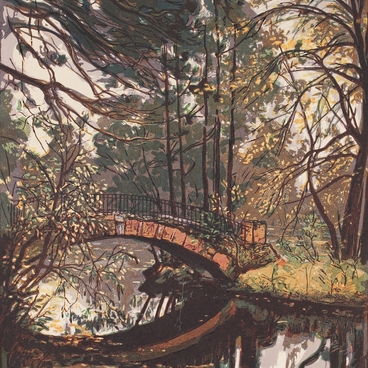
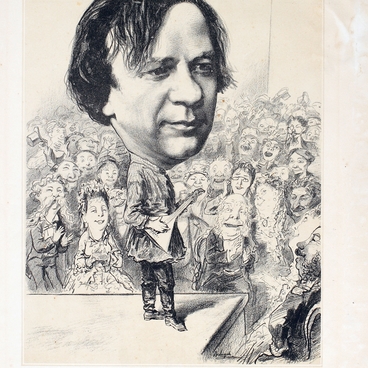
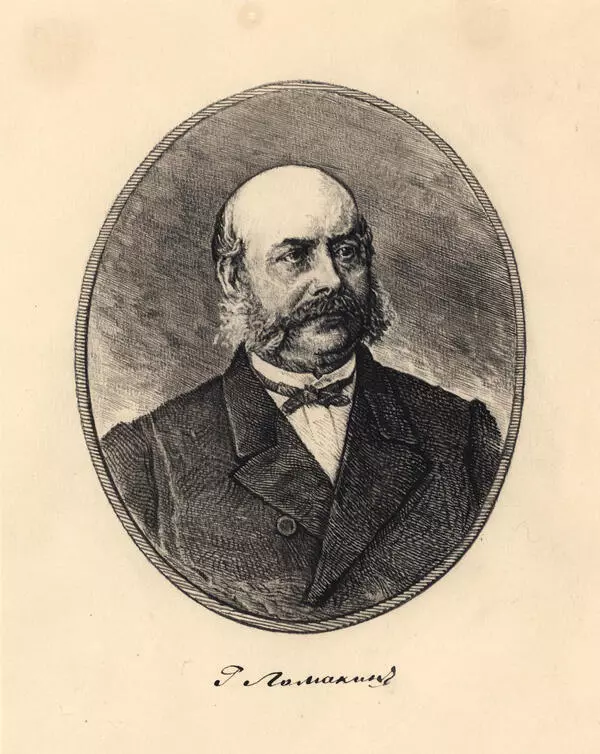
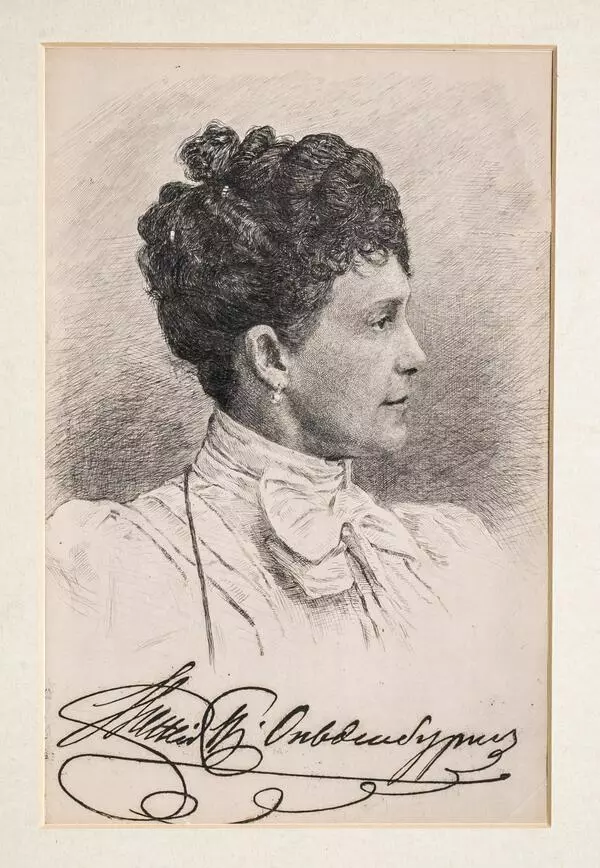
Although Mate did not produce large-scale original compositions, he secured a lasting place in art history as one of the foremost masters of reproductive engraving. He meticulously reproduced iconic portraits of key figures in Russian history and culture. His prints are celebrated for their refined linework, expressive clarity, and technical precision, and were regularly featured in leading periodicals such as “Bee” (“Pchela”), “Russian Antiquity” (“Russkaya Starina”), and “World Illustration” (Vsemirnaya Illyustratsiya).
A particularly significant work in his oeuvre is his print after Orest Kiprensky’s celebrated 1827 portrait of Alexander Pushkin, created to commemorate the poet’s centenary in 1899. The composition presents a half-length portrait of Pushkin in a frock coat and high cravat, his head turned to the right. Mate did not merely replicate the original; he captured the psychological depth and noble dignity of the poet, conveying Pushkin’s inspired gaze and charismatic presence with remarkable sensitivity.