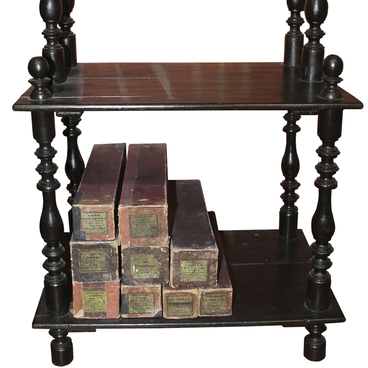
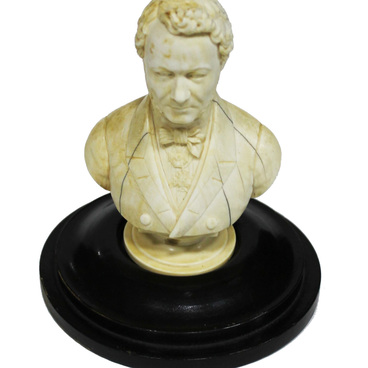
Usually, merchant houses had several staterooms: a hall, a drawing room, and a dining room. While halls served for hosting grand celebrations, the more modest festivities, as well as tea, lunch, and dinner parties, took place in drawing and dining rooms. Staterooms were painstakingly decorated with works of art, expensive furniture, stylish trinkets, and beautiful tableware. In dining rooms, tableware was displayed on wall shelves, while in a living room, tea sets, silverware, and sometimes glassware could be stored inside a cupboard or a cabinet. Found by the fireplace in the merchant’s drawing room of our museum is a small display cabinet holding late 19th/early 20th century porcelain.


Tray
Creation period
Late 19th–early 20th century
Place of сreation
Germany
Dimensions
2x37,7 cm
Technique
Casting, molding, decal
Collection
Exhibition
1
Open in app#1
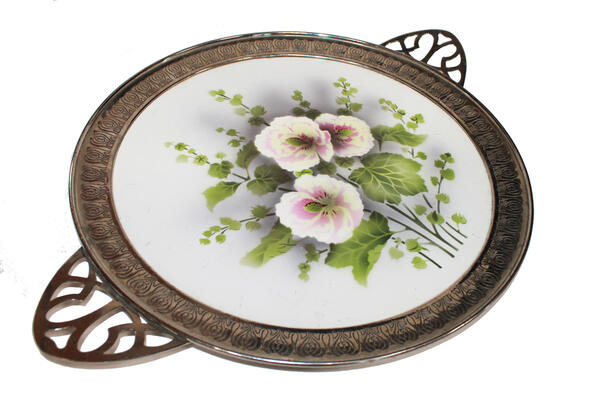
Tray
#3
#4
Among these exhibits is a large round tray made of faience. Traditionally, tableware was decorated with floral ornaments – in our case, the tray features a decal image of flowers. Decal is short for the French “décalcomanie, ” a method of creating special prints for transferring images onto glass or ceramic surfaces. This meant that images could be applied to plates, cups, or milk jugs from a masking sheet, rather than painted by hand with a brush. In the past, paper pre-masks used to be made throug the application of the offset printing technique, however nowadays it is done by special laser printers. Porcelain, glass, and ceramic surface require the aid of high heat for a decal to take hold.
#5
The reverse side of the tray has a light-yellow print. The logo consisting of barely visible letters “M” and “D” may belong to a European producer, Max Dannhorn’s factory. This enterprise was launched in Nuremberg in 1872. M& D’s products are known to often be made of more than one material. Typically, its artisans combined a glazed ceramic base with a metal frame plated with a thin layer of silver. The fact that a similar combination of metal and ceramics is found in our tray, as well as the presence of the print, suggest that it was this company that produced this item.
#6
Tomsk History Museum
read morehide
00:00
00:00
1x
Tray
Creation period
Late 19th–early 20th century
Place of сreation
Germany
Dimensions
2x37,7 cm
Technique
Casting, molding, decal
Collection
Exhibition
1
 Point your smartphone camera to open in the app
Open in app
Share