A tray is a household item of various sizes and shapes that is designed primarily for carrying dishes or cooked food.
In Russian, this word is formed from the verb “to bring”. In medieval Europe, the name of the tray sounded like “savior”, that is, it was derived from the Latin word salvare — “to save”. The name came from the custom of testing drinks and food for poison. The tasting was carried out directly from the tray, after which it was taken to the lord. As early as the late Middle Ages, other terms came into use. For example, in English, “tray” comes from the Old English “trig” (wooden board).
It is not known when the first trays appeared, as they were originally made of wood, an extremely short-lived material. It is certain that trays were used in Egypt and in all ancient civilizations of the East several millennia ago. This is evidenced by frescoes showing servants with trays serving aristocrats. In those times, the tray had slightly curved edges to prevent dishes from sliding on its surface.
The first trays in the Russian Empire began to be made in the first half of the 18th century at the Ural Nizhny Tagil mining plant belonging to the Demidovs, famous industrialists. This factory also produced anchors, chains, nails and other metal products. Artists covered the trays with various patterns of flowers and fruit. Tagil painted trays became a signature of the factory and were in great demand among wealthy citizens. They were offered as gifts even to members of the Imperial family.
Along with metal trays, lighter ones made of papier-mâché were produced in Russia. They cost less than the Ural ones, but they too were painted with a variety of themes.
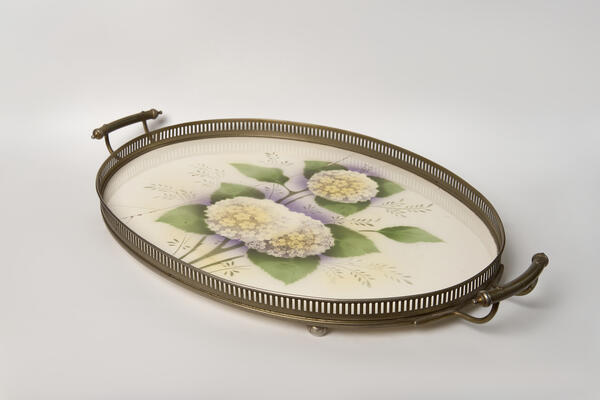
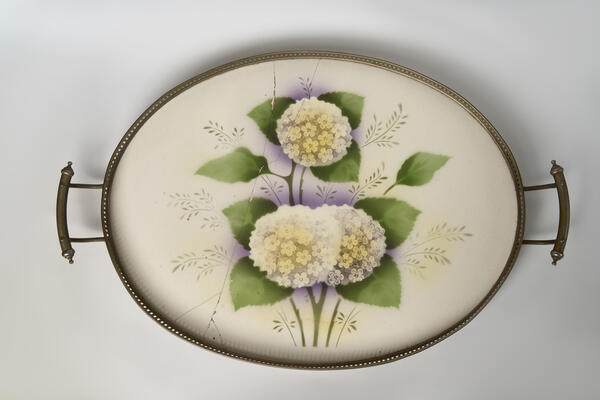
The tray from the museum’s collection has two
handles and an oval earthenware base, which is framed by a low metal fretted
edge. The tray rests on four ball-shaped feet. In the center of the earthenware
base is an underglaze polychrome painting in the form of white spherical
inflorescences of the common snowball flowers on the background of green
leaves.