Font
Color
Graphics
Изображение точки

To see AR mode in action:

1. Install ARTEFACT app for iOS or Android;

2. Find the exhibition «Gelendzhik: Past and Present»

3. Push the «Augmented reality» button and point your phone's camera at the exhibit;

Скрыть точки интересаПоказать точки интереса
Показать в высоком качестве

Watch pouch, Towel rack, Circassian handheld fan

0
Open in app
#1
Watch pouch
#2
According to the experts, pocket watches appeared in the 17th century with the invention of a small clock mechanism that could be put inside a pocket. Men usually wore watches in a special pocket (called fob) on a watch chain with a small decoration. Women wore watches on their wrists as elegant bracelets adorned with precious stones, or around their necks as small necklaces.

In the Caucasus, pocket watches appeared in the 19th century and were a luxury item, a sign of the high social status. Therefore, they were kept very carefully, in a special pouch in the most prominent place in the house. Watch pouches came in different shapes and sizes.

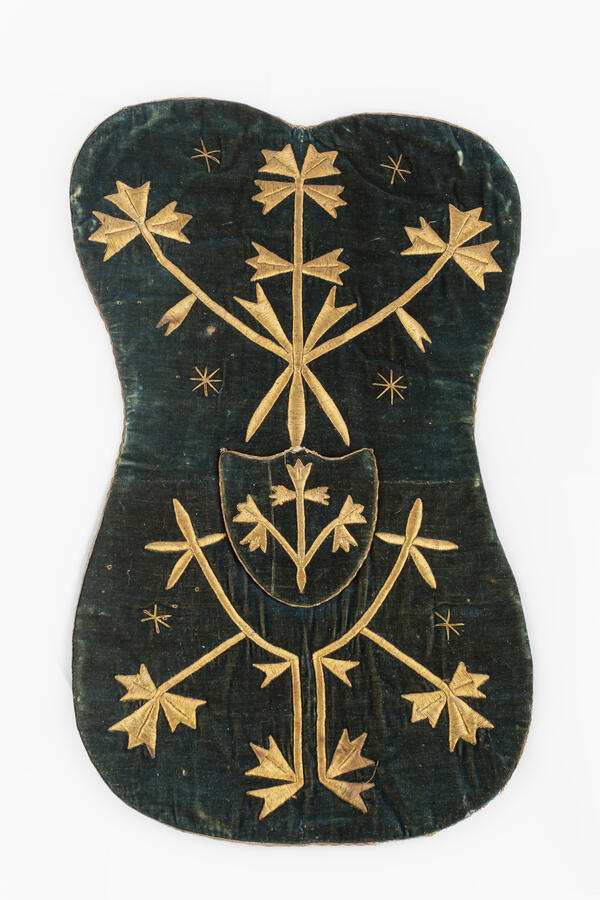
The watch pouch from the museum exhibition was mounted on the wall. It has a guitar shape. This piece was made by a craftswoman from the village of Pchegatlukai in Adygea. To create it, the artisan lined a thick cardboard base with dark green velvet. In the center she sewed a semi-oval pocket, which served as a place to store a pocket watch. The watch pouch is decorated with gold thread embroidery using the “urban sewing” technique. This was the Caucasian term used for satin stitch embroidery, which became popular in the 19th and early 20th centuries, but was considered less lavish than the traditional sewing technique called “v prikrep” (in attachment).

The pattern was embroidered directly on the fabric. Previously, a stencil had been cut out of paper or thin cardboard, sewn onto fabric, embroidered with gold or silver threads, and fixed with silk along the outline of the pattern. Sometimes craftswomen used thin braid to enhance the contours. The satin stitch became more pronounced due to the cardboard stencil or extra padding. Satin stitch embroidery most often decorated small items, and in clothing —women’s hats and false shirtfronts. In the late 19th — early 20th century, a simultaneous combination of the first and second types of sewing could be found on clothes, pouches and fans.

The craftswoman used a floral Circassian pattern as the basis for decorating the watch pouch. Symmetrical stems, which end in two or more petal, form a heart-shaped figure. The pattern was often used to decorate household items, weapons and clothing. All elements of the ornament had a certain meaning and were associated with religious rites.
#3
Наименование: Watch pouch
Дата создания: the 19th century
Техника: velvet, cardboard, sewing
Место создания: Adygea, Russia
Размеры: 57×33 cm
#4
Circassian towel rack
#5
The museum houses a traditional Circassian household item — a wall-mounted towel rack, richly embroidered with gold threads.

Circassian gold embroidery is one of the oldest crafts in the West Caucasus. It is distinguished by a harmonious combination of embroidery with galloons and trimmings made of gold and silver threads. Only the rich could afford such artworks. The ability to embroider with gold and silver threads, as well as weaving were considered obligatory for Circassian girls from noble families, so they began to learn these skills from early childhood. Sometimes, in order to comprehend all the subtleties and secrets of gold embroidery, girls were sent to families where there was a skilled craftswoman. They were exempted from chores, as the technique of gold embroidery required perseverance and patience. Before starting work, the girls treated their fingers with special oils so that their rough skin would not damage the finest gold or silver thread and spoil the embroidery. Girls embroidered clothes, quivers for arrows, saddles, pouches, bullet bags, handicraft bags, and handheld fans with gold and silver. Their rooms were always richly decorated. The main decoration of the rooms were hand-made watch cases, towel racks, scissor cases and other items of urban everyday life.

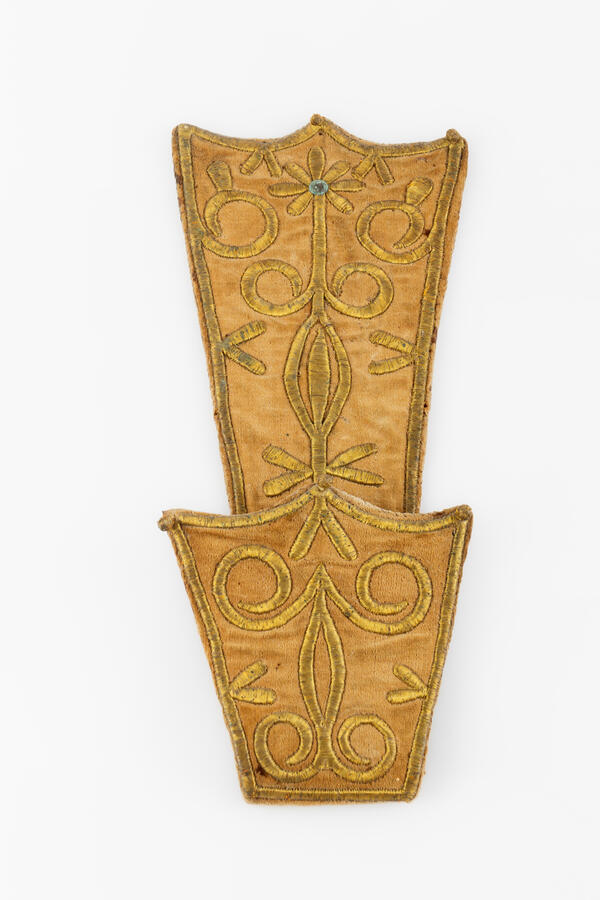
The towel rack on the display was made in the village of Khatazhukay in the 19th century. It was hand-sewn and decorated with traditional Circassian gold embroidery. To make it, the cardboard base was richly decorated and covered with light brown velvet.

The ornament of the towel hanger features patterns in the form of flowers, spirals, the ram’s horns and shoots with petals. All elements had a certain meaning and were associated with religious rites. For example, the ancient decorative element called “the ram’s horns” comes from the cult of the ram that existed in ancient times. The animal was sacrificed, and then the ram’s horns were placed on the hearth, as they were considered a symbol of abundance and a talisman. By using floral patterns, craftswomen showed love and respect for the generous nature of their land. The rack has a trapezoidal shape with bent crown-shaped upper edges. Each edge is decorated with a ball trimmed with gold braid — a fringe.
#6
Наименование: Circassian towel rack
Дата создания: the 19th century
Техника: velvet, metallic thread, cardboard, sewing, embroidery
Место создания: Adygea, Russia
Размеры: 30×12×8 cm
#7
Circassian handheld fan “zhyyf”
#8
Traditional Circassian handheld fans look quite different from European folding fans. Instead, they rather resemble a rectangular flag, which is called “zhyyf” in the Adyghe language. Circassians began to use hand fans at the turn of the 19th century, but these objects were always more than an exclusively women’s accessory. Initially, the fan was used to blow on a fire to keep it burning in the fireplace. Since ancient times, the cult of fire occupied an important place in the Adyghe beliefs. Fire was perceived as a living entity, and it was revered as a deity. The phrase “May the fire die out in your hearth” was considered the most terrible curse, since the hearth was directly related to the well-being of the inhabitants of the house. And the handheld fan, which was used to blow on the fire, was considered a sacred attribute.

Initially, fans were made of straw or dried marsh grass and lined with velvet. Later they were made on a rigid cardboard base measuring 25 by 30 centimeters. The fan was decorated with embroidery made with silver or gold threads and fringe sewn along the edges. The entire surface of the fan was filled with an exquisite ornamental motif.

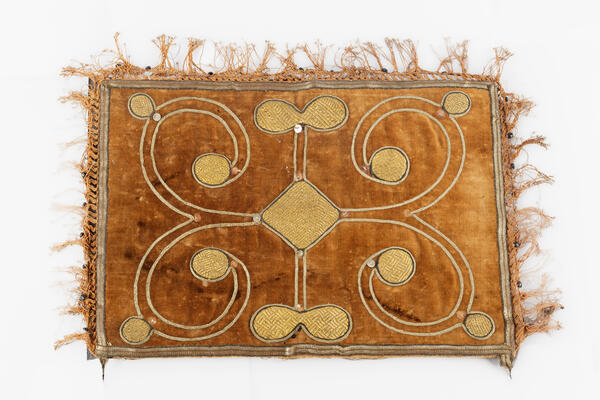
The velvet fan from the permanent exhibition is decorated with the oldest and most valuable kind of gold embroidery — couching. Working in this technique, the craftswoman pricked the contour of the pattern on the fabric using a stencil, and then embroidered it without any auxiliary devices. Such work required pinpoint precision, high concentration and a lot of time. For example, a girl could spend several weeks embroidering a small circle with a diameter of only a few centimeters. Apart from being embroidered, the fan is also decorated with gold braid, which looks like a complex chain. Such a gold or silver cord was first used as a separate element — a necklace, a cord for a watch or a revolver. It was also used to make a ball — a button for the top of a women’s Circassian cap.

When it was completed, the handheld fan was fastened with loops to a carved wooden handle, around which it rotated. Only older members of the family could fan themselves with such a fan in the heat. Sometimes the fan was used to care for the sick, or it was placed on the crossbar of a cradle, and when the crib was rocked, the fan produced a pleasant feeling of coldness. The fan is trimmed with a fringe of threads decorated with transparent and black beads.
#9
Наименование: Circassian handheld fan “zhyyf”
Дата создания: the 19th century
Техника: velvet, cardboard, sewing, embroidery
Место создания: Adygea, Russia
Размеры: 30×21,5 cm
#10
read morehide
00:00
00:00
1x

Watch pouch, Towel rack, Circassian handheld fan

0
Point your smartphone camera to open in the app
Share
VkontakteOdnoklassnikiTelegram
Share on my website
Copy linkCopied
Copy
Open in app
To see AR mode in action:
  1. Install ARTEFACT app for 
  2. iOS or Android;
  3. Find and download the «Paintings in Details» exhibition
  4. Push the «Augmented reality» button and point your phone's camera at the painting;
  5. Watch what happens on your phone screen whilst you flip through the pictures.
 
We use Cookies
Cookies on the Artefact Website. We use cookies to ensure that we give you the best experience on our website. If you continue without changing your settings, we'll assume that you are happy to receive all cookies on the Artefact website. However, if you would like to, you can change your cookie settings at any time.
Learn more about useHide
Content is available only in Russian

X

Нашли опечатку?...

%title%%type%