Font
Color
Graphics
Изображение точки

To see AR mode in action:

1. Install ARTEFACT app for iOS or Android;

2. Find the exhibition «A Composer Ahead of His Time»

3. Push the «Augmented reality» button and point your phone's camera at the exhibit;

Скрыть точки интересаПоказать точки интереса
Показать в высоком качестве

Badges, Cufflinks, Watch

0
Open in app
#1
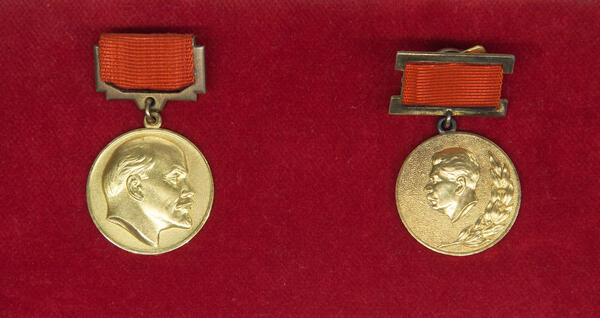
Badges of honor
#8
During Prokofiev’s lifetime, his music was distinguished with prestigious international and Soviet awards. In 1943, the composer received a second-class Stalin Prize for his Seventh Sonata. Later, in 1946, Prokofiev was awarded three Stalin Prizes: one for the Fifth Symphony and the Eighth Piano Sonata, another for the score to Part I of the movie “Ivan the Terrible”, and the third one for the ballet “Cinderella”. These were all first-class prizes. Prokofiev received another first-class Stalin Prize for his Violin Sonata No. 1 in 1947.

It can be assumed that Prokofiev was awarded such high accolades so often because, for some time, he was the favorite composer of Joseph Stalin. He was the one to be commissioned with the cantata “Zdravitsa” that commemorated Stalin’s 60th birthday in 1939. Stalin Prize was usually awarded once a year, on December 21, the national leader’s birthday. The prize also carried a cash award. Its sum increased between 1940 and 1953, and on average it was 100,000 rubles for first-class, 50,000 rubles for second-class, and 25,000 rubles for third-class awards.

Prokofiev received his last lifetime award after 1948. During his later years, the composer was branded a “formalist” which came to mean an “enemy of the people” who created anti-Soviet music. The term “formalism” was used to describe any artworks which did not fit the arbitrary requirements of Socialist realism or contradicted its principles. Most performers started ignoring Prokofiev’s music, people feared to be friends with him, and his first wife became a political prisoner.

After several years of silence and oblivion, the music of the great genius of the 20th century once again sounded in Soviet concert halls thanks to the incredible efforts of Prokofiev’s true friends, most importantly, the cellist Mstislav Rostropovich.

Prokofiev received his last Stalin Prize for his choral compositions: the suite “Winter Bonfire” and the oratorio “On Guard for Peace” (a Stalin prize second class). After Stalin’s death, the award was renamed after Lenin, and in 1957, the composer was posthumously awarded a Lenin Prize for one of his last major works, the Seventh Symphony.
#4
Name: Badges of honor
Date of creation: the mid-20th century (1947, 1956)
Technique: Stalin Prize badge: .950 gold (medal); .925 silver (suspension device, screw, ring nut, connecting ring); gold, silver, moire. Lenin Prize badge: .950 gold (medal), .583 gold (connecting ring); .925 silver; silver, gold, moire
Dimensions: Stalin Prize badge — 25 cm. Lenin Prize badge — 27 cm
#2
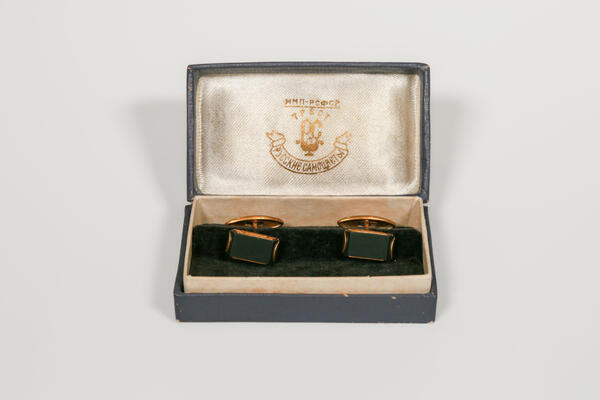
Sergei Prokofiev’s cufflinks
#14
Sergei Prokofiev was a very stylish man.
#15
He had smooth fair hair, was tall and elegantly turned out.
the pianist Heinrich Neuhaus
#9
Prokofiev’s suits were made perfectly with close attention to every little detail, including the cufflinks.

In his diary, Prokofiev mentioned cufflinks that caught his fancy, “In the afternoon, Mama and I went to buy some cufflinks for my name-day. They are very nice indeed, semi-precious ruby, or rose quartz as it is called.” The composer treasured his cufflinks.

In 1941, Prokofiev went on a one-day trip to Leningrad where the Kirov Theater was working on the production of his opera “Betrothal in a Monastery”. The composer shared the train compartment with Dmitri Shostakovich. During that journey, Prokofiev lost one of his favorite cufflinks and was very upset about it. In the evening, he was returning to Moscow on the same train. Prokofiev informed the train attendant of his loss, and the responsible employee took care to find the cufflink and return it to the owner.

Prokofiev liked to dress extravagantly.
#10
One sunny day I was walking along the Arbat and saw quite an exotic man. He had a very strong appeal, walking by like a breath of fresh air. His clothes were checkered all over, with bright yellow shoes and a reddish-orange tie. I couldn’t resist turning my head at him — it was Prokofiev.
Sviatoslav Richter
#11
The conductor Gennady Rozhdestvensky also shared his memories about Prokofiev’s fashion, “All of a sudden, I noticed people on the street turning to stare at someone. I also turned my head. They happened to be looking at an eccentric man: he was tall, handsome, wearing a broad-brimmed hat resembling a sombrero, and a stylish short car coat. He was carrying canary-yellow leather gloves and swinging them rhythmically, without paying any attention whatsoever to the onlookers. I believe he was composing something.”

During his student days, Prokofiev enjoyed dressing up. He wrote, “By tradition, the annual party arranged by the Academic classes of the Conservatory takes place on January 4. I put on my dinner jacket, white waistcoat, brilliantly shiny shoes, found myself to be the epitome of style, and went to the party.” Going on his Italy trip in 1915, he also dressed fashionably, “I was immaculate in my short-trousered Swiss suit, a grey scarf, green overcoat, and English check cap.”
#6
Name: Sergei Prokofiev’s cufflinks
Date of creation: the mid-20th century
№: 5962439
Technique: factory production
Dimensions: 2×0,9×2 cm
#3
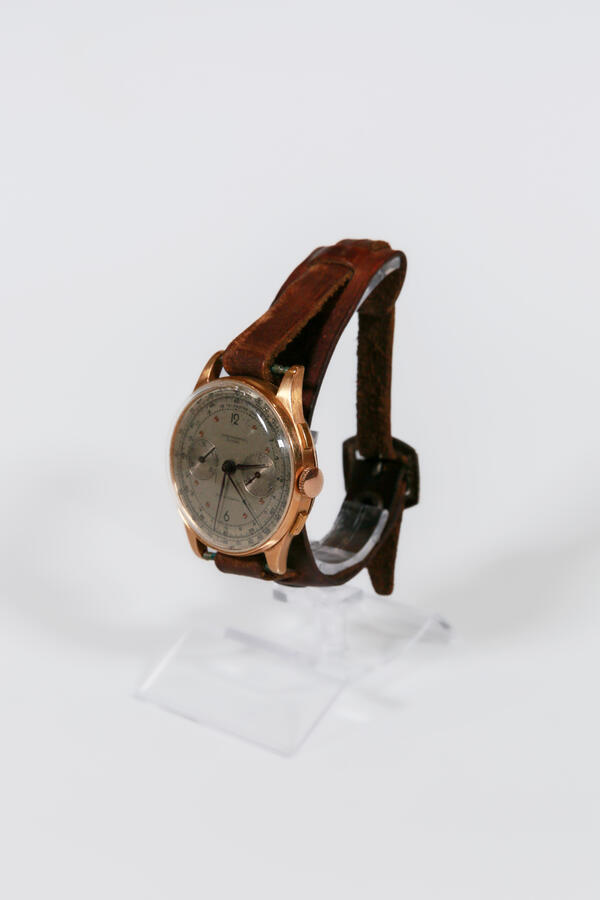
Watch of Sergei Prokofiev
#13
Sergei Prokofiev bought this Chronographe Suisse watch in the 1940s. During that time, the watches of this Swiss company were very popular among tourists because of their relatively low price.

Prokofiev was incredibly punctual and valued his time. His secretary Georgy Gorchakov reminisced, “Sergei Sergeyevich was an amazing person: he was always absorbed in his work and had a very tight schedule. Sometimes, he would set up a meeting, and the other person would arrive five minutes earlier. Sergei Sergeyevich would come out of his office, point to his watch, and go back again. If a visitor was late, he would definitely cancel the appointment.”

The composer’s custom to work in a timely manner was highlighted by the Soviet director Sergei Eisenstein whose films were scored by Prokofiev. He reminisced, “Prokofiev told me, ‘You will have the music by noon.’ We leave the small projection room. Although it is now midnight my mind is at rest. For I know that at exactly 11.55 a.m. a small, dark blue automobile will come through the gates of the film studio. Sergei Prokofiev will emerge from the car. The next piece of music for ‘Alexander Nevsky’ will be in his hands.”

Eisenstein admired the composer’s punctuality, writing, “Prokofiev works like a clock. This clock neither gains nor loses time. Like a sniper, it hits the very heart of punctuality. Prokofiev’s punctuality is not a matter of business pedantry. His exactness in time is a by-product of creative exactness. Of absolute exactness in transposing the imagery into a mathematically exact means of expression, which Prokofiev has harnessed with a bridle of hard steel.”

“Prokofiev felt the heartbeat of time, ” said the Soviet writer Ilya Ehrenburg. Prokofiev usually worked in the morning: he got up early, composed, played the piano, or conducted an orchestra. He was an industrious person and worked even on holidays, including his birthday and New Year’s Eve. The composer was strict with himself and even wanted to cut down on sleep to be able to work more. In his diary entry of May 21, 1932, he wrote, “I am seized with the idea of cutting down on my hours of sleep. The moment one realizes that sleep is not necessary for true repose, it becomes necessary to reduce it.”
#7
Name: Watch of Sergei Prokofiev
№: 5961422
Date of creation: the 1940s
Place of creation: Switzerland
Technique: factory production
Dimensions: 3,7×3,7 cm
#12
read morehide
00:00
00:00
1x

Badges, Cufflinks, Watch

0
Point your smartphone camera to open in the app
Share
VkontakteOdnoklassnikiTelegram
Share on my website
Copy linkCopied
Copy
Open in app
To see AR mode in action:
  1. Install ARTEFACT app for 
  2. iOS or Android;
  3. Find and download the «Paintings in Details» exhibition
  4. Push the «Augmented reality» button and point your phone's camera at the painting;
  5. Watch what happens on your phone screen whilst you flip through the pictures.
 
We use Cookies
Cookies on the Artefact Website. We use cookies to ensure that we give you the best experience on our website. If you continue without changing your settings, we'll assume that you are happy to receive all cookies on the Artefact website. However, if you would like to, you can change your cookie settings at any time.
Learn more about useHide
Content is available only in Russian

X

Нашли опечатку?...

%title%%type%