#1
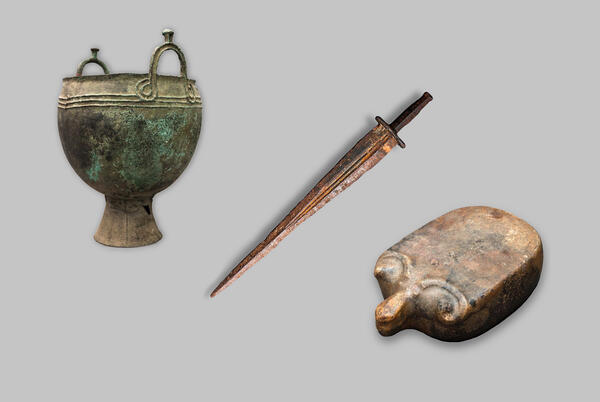
Sacrificial slab, Acinaces, Bronze cauldron
#11
#2
#3
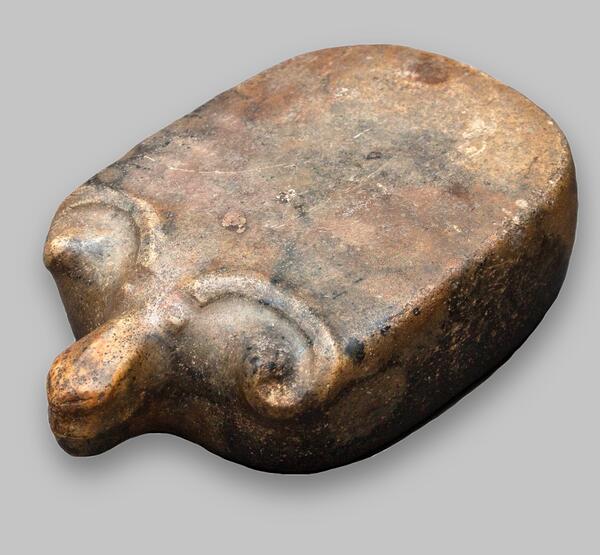
The stone sacrificial slab was found accidentally in a plowed field near the city of Kurgan of the Tobolsk province. It was found by Reshetnikov, a student of the district school. There were no other objects of worship nearby. The slab was given to the Tobolsk Provincial Museum on May 27, 1891 by the priest Grivtsov. This is one of the first museum’s exhibits.
The found sacrificial slab is a solid stone of flat, slightly elongated shape with rounded edges. On the sides and planes of the stone, both upper and lower, there are traces of grinding, and the edges are smoothed. From the point of view of artistic execution, the sculpture is very schematic and resembles a ram’s head. The eyes are made in the form of bumps. The mouth is outlined by a simple facet that separates the upper and lower jaws.
Researchers believed that this sacrificial stone was used in the funeral rite, since such slabs were often left on mounds after performing ritual actions. It was assumed that they could represent a totem creature.
An important place in the structure of almost any ancient traditional ritual was occupied by the act of sacrificing something or someone. Accordingly, in most shrines, one of the main elements was the altar. It was a kind of sacred object, on which the sacrifice was performed. In the Indo-European culture, in which the stone had a special meaning, this material was very often used as an altar.
The time of existence of the archaeological monument found in Kurgan belongs to the Early Iron Age, i.e. from the 5th century BC to the 5th century AD. Most likely, this sacrificial slab can be attributed to the Scythian-Sarmatian era. The shape of the sacrificial slab is characteristic exclusively for the Trans-Urals and is not repeated anywhere in other regions. Images of rams were widespread in many cultures. Very often, they are found in Siberia starting from the Karasuk time.
The Karasuk culture is an archaeological culture of the Bronze Age of the late 2nd - early 1st Millennium BC, which was spread in southern Siberia and Kazakhstan. It is named after the excavations of reference monuments on the Karasuk River, a tributary of the Yenisei, near the village of Bateni in the Bogradskiy District of Khakassia.
The found sacrificial slab is a solid stone of flat, slightly elongated shape with rounded edges. On the sides and planes of the stone, both upper and lower, there are traces of grinding, and the edges are smoothed. From the point of view of artistic execution, the sculpture is very schematic and resembles a ram’s head. The eyes are made in the form of bumps. The mouth is outlined by a simple facet that separates the upper and lower jaws.
Researchers believed that this sacrificial stone was used in the funeral rite, since such slabs were often left on mounds after performing ritual actions. It was assumed that they could represent a totem creature.
An important place in the structure of almost any ancient traditional ritual was occupied by the act of sacrificing something or someone. Accordingly, in most shrines, one of the main elements was the altar. It was a kind of sacred object, on which the sacrifice was performed. In the Indo-European culture, in which the stone had a special meaning, this material was very often used as an altar.
The time of existence of the archaeological monument found in Kurgan belongs to the Early Iron Age, i.e. from the 5th century BC to the 5th century AD. Most likely, this sacrificial slab can be attributed to the Scythian-Sarmatian era. The shape of the sacrificial slab is characteristic exclusively for the Trans-Urals and is not repeated anywhere in other regions. Images of rams were widespread in many cultures. Very often, they are found in Siberia starting from the Karasuk time.
The Karasuk culture is an archaeological culture of the Bronze Age of the late 2nd - early 1st Millennium BC, which was spread in southern Siberia and Kazakhstan. It is named after the excavations of reference monuments on the Karasuk River, a tributary of the Yenisei, near the village of Bateni in the Bogradskiy District of Khakassia.
#4
Date: 5th century BC - 5th century AD
Technique: stone, grinding
Place: Middle Trans-Urals, Russia
Dimensions: 7.4×15.5×26 cm
Collection: Archeology
Copyright: Tyumen Province State Autonomous Cultural Institution ‘Tyumen Museum and Educational Association’, Structural Division ‘Tobolsk Historical and Architectural Museum Reserve’
Goskatalog Number: 7946889
Technique: stone, grinding
Place: Middle Trans-Urals, Russia
Dimensions: 7.4×15.5×26 cm
Collection: Archeology
Copyright: Tyumen Province State Autonomous Cultural Institution ‘Tyumen Museum and Educational Association’, Structural Division ‘Tobolsk Historical and Architectural Museum Reserve’
Goskatalog Number: 7946889
#13
Acinaces
#5
#6
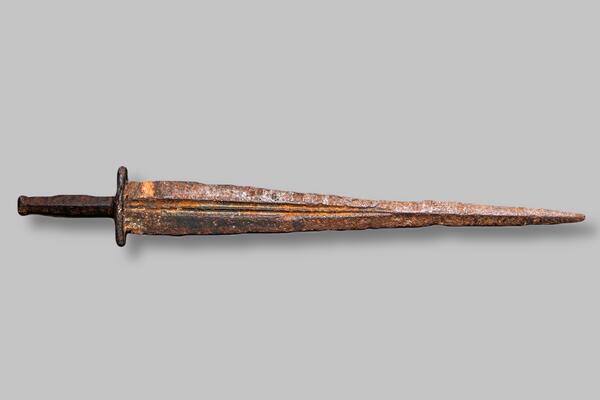
The acinaces is a double-edged Sarmatian type iron sword. It is one of the first exhibits of the Tobolsk Provincial Museum. It was found accidentally near the town of Zavodoukovsk, Tobolsk province, in 1903. The acinaces is part of the so-called Scythian triad, i.e. a complex of items typical of the Scythian culture. It is not known exactly how it ended up in the Tobolsk province.
The acinaces is a stabbing weapon for hand-to-hand combat common among nomadic peoples during the Iron Age. It was distinguished from other types of swords by a short triangular blade up to 60 centimeters with a wide base and a thin tip. Despite the fact that the acinaces was described as a stabbing weapon, the weight of the blade was about two kilograms and allowed for strong slashing blows. The acinaces’ blade and hilt were usually forged from a single strip of metal, and sometimes from several strips. After that, they were connected by forging welding, with the crosshair and pommel attached in the same way.
The Tobolsk acinaces is unusual in that it has dales, i.e. thin longitudinal strips on the blade that reduce its weight. Initially, acinaci had no dales. The first swords with dales and stiffeners were found in the graves of the North Caucasian culture. They were dated to the 7th century BC.
Most often, acinaci were auxiliary weapons, since nomads preferred to shoot bows and throw javelins and spears. Short swords were wielded by members of the military aristocracy. Ordinary soldiers did not have them. The acinaces was worn on the belt on the right in a wooden scabbard with a special extension at the top for attaching to the belt. The scabbard was decorated with a bone tip and bronze or gold plates with images in the animal style. It was an ornamental style typical of the Scythian culture.
Most of the Scythians led a nomadic life. At the same time, they could travel long distances in a relatively short period of time. It is very difficult to distinguish their ancestors among the many tribes with a similar culture. The Scythian civilization flourished in the 7th century when the Scythians dominated not only the steppes of the Black Sea Region, but also the whole of Asia Minor where they created the Scythian state of Ishkuza. By the beginning of the 6th century, they were driven out of Asia Minor. Traces of the Scythians found in the Caucasus date back to the same time.
The acinaces is a stabbing weapon for hand-to-hand combat common among nomadic peoples during the Iron Age. It was distinguished from other types of swords by a short triangular blade up to 60 centimeters with a wide base and a thin tip. Despite the fact that the acinaces was described as a stabbing weapon, the weight of the blade was about two kilograms and allowed for strong slashing blows. The acinaces’ blade and hilt were usually forged from a single strip of metal, and sometimes from several strips. After that, they were connected by forging welding, with the crosshair and pommel attached in the same way.
The Tobolsk acinaces is unusual in that it has dales, i.e. thin longitudinal strips on the blade that reduce its weight. Initially, acinaci had no dales. The first swords with dales and stiffeners were found in the graves of the North Caucasian culture. They were dated to the 7th century BC.
Most often, acinaci were auxiliary weapons, since nomads preferred to shoot bows and throw javelins and spears. Short swords were wielded by members of the military aristocracy. Ordinary soldiers did not have them. The acinaces was worn on the belt on the right in a wooden scabbard with a special extension at the top for attaching to the belt. The scabbard was decorated with a bone tip and bronze or gold plates with images in the animal style. It was an ornamental style typical of the Scythian culture.
Most of the Scythians led a nomadic life. At the same time, they could travel long distances in a relatively short period of time. It is very difficult to distinguish their ancestors among the many tribes with a similar culture. The Scythian civilization flourished in the 7th century when the Scythians dominated not only the steppes of the Black Sea Region, but also the whole of Asia Minor where they created the Scythian state of Ishkuza. By the beginning of the 6th century, they were driven out of Asia Minor. Traces of the Scythians found in the Caucasus date back to the same time.
#7
Date: 9th - 3rd centuries BC
Technique: iron, hand forging
Dimensions: 47×5 cm
Collection: Archeology
Copyright: Tyumen Province State Autonomous Cultural Institution “Tyumen Museum and Educational Association”, Structural Division “Tobolsk Historical and Architectural Museum Reserve”
Goskatalog Number: 4110143
Technique: iron, hand forging
Dimensions: 47×5 cm
Collection: Archeology
Copyright: Tyumen Province State Autonomous Cultural Institution “Tyumen Museum and Educational Association”, Structural Division “Tobolsk Historical and Architectural Museum Reserve”
Goskatalog Number: 4110143
#14
Bronze cauldron
#8
#9
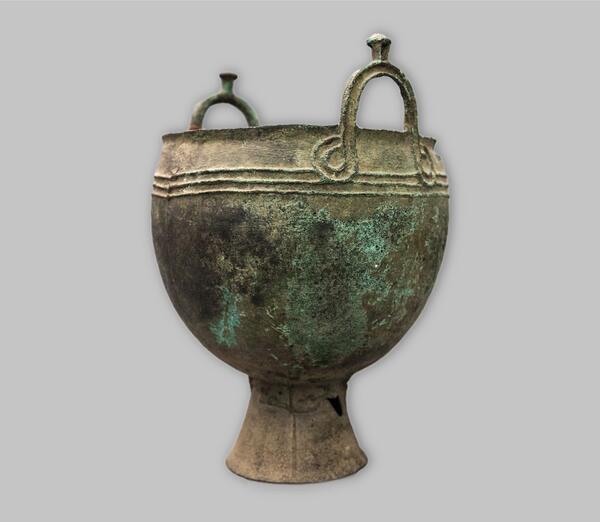
The bronze cauldron became one of the first exhibits of the Tobolsk Provincial Museum. The researchers suggested that it was used by representatives of the Sargat culture, i.e. the tribes who lived from the 7th-6th centuries BC to the 3rd–5th century BC on the territory of Western Siberia from the Ural foothills along the major rivers Irtysh, Ishim, and Tobol, and along the middle course of the Om and in the lower reaches of the Iset. They led a nomadic lifestyle and engaged in cattle breeding. Large Sargat settlements with an area of about 10,000 sq. m are known, but most of the settlements were medium in size. People lived in rectangular semi-dugouts built of wood, and reeds, brush branches, and turf were also used in construction.
Currently, cauldrons and other artifacts of the Sargat culture are found on the sites of ancient settlements, altars, and burial mounds. But most often they are found not in archaeological complexes, but by chance in ordinary localities. This bronze cauldron with handles on a pallet in the shape of a cone was found in the village of Klyuchevsky in the Kurgan District of Tobolsk Province. A vertical casting seam is visible on it. This means that the cauldron was cast in a special two-part form. The master poured molten metal into the mold, and poured metal then occupied the space at the junction of the halves. Thus, there was a ridge or seam. Usually it was sanded, but sometimes the seam marks on the surface could not be hidden.
The purpose of this cauldron is not exactly known. They performed several functions. For example, among the Nganasans and Khants, the cauldron could replace a shaman’s tambourine and was involved in establishing a connection between the worlds. But researchers pay special attention to their connection with the idea of fertility and well-being, a protective function. Such cauldrons symbolized unity. They were used for turning to the gods, or asking for protection and health.
Usually the most common archaeological materials of the Sargat culture are ceramics and numerous various arrowheads. Sargat pottery is found in several types, i.e. round or elongated, conical pots, as well as flat-bottomed and round-bottomed. In addition to them and cast bronze cauldrons, stone dishes were also found. Many items of the Sargat culture have analogues in the steppe world of the late 1st Millennium BC and the first centuries of our era.
Currently, cauldrons and other artifacts of the Sargat culture are found on the sites of ancient settlements, altars, and burial mounds. But most often they are found not in archaeological complexes, but by chance in ordinary localities. This bronze cauldron with handles on a pallet in the shape of a cone was found in the village of Klyuchevsky in the Kurgan District of Tobolsk Province. A vertical casting seam is visible on it. This means that the cauldron was cast in a special two-part form. The master poured molten metal into the mold, and poured metal then occupied the space at the junction of the halves. Thus, there was a ridge or seam. Usually it was sanded, but sometimes the seam marks on the surface could not be hidden.
The purpose of this cauldron is not exactly known. They performed several functions. For example, among the Nganasans and Khants, the cauldron could replace a shaman’s tambourine and was involved in establishing a connection between the worlds. But researchers pay special attention to their connection with the idea of fertility and well-being, a protective function. Such cauldrons symbolized unity. They were used for turning to the gods, or asking for protection and health.
Usually the most common archaeological materials of the Sargat culture are ceramics and numerous various arrowheads. Sargat pottery is found in several types, i.e. round or elongated, conical pots, as well as flat-bottomed and round-bottomed. In addition to them and cast bronze cauldrons, stone dishes were also found. Many items of the Sargat culture have analogues in the steppe world of the late 1st Millennium BC and the first centuries of our era.
#10
Date: 5th century BC - 5th century AD
Technique: bronze, cast
Place: Middle Irtysh Region, Russia
Dimensions: 25×22×22 cm
Collection: Archeology
Copyright: Tyumen Province State Autonomous Cultural Institution “Tyumen Museum and Educational Association”, Structural Division “Tobolsk Historical and Architectural Museum Reserve”
Goskatalog Number: 3455396
Technique: bronze, cast
Place: Middle Irtysh Region, Russia
Dimensions: 25×22×22 cm
Collection: Archeology
Copyright: Tyumen Province State Autonomous Cultural Institution “Tyumen Museum and Educational Association”, Structural Division “Tobolsk Historical and Architectural Museum Reserve”
Goskatalog Number: 3455396
read morehide
00:00
00:00
1x
Sacrificial slab, Acinaces, Bronze cauldron
Collection
Exhibition
0
 Point your smartphone camera to open in the app
Open in app
Share